 Yong Wan Bryan Choi한국어
Preface
Translated from the Korean original. Read the Korean original
**East Asia, Mother of All Civilizations
(civilization begins in Manchuria)
Yong Wan Choi**
Preface:
In our lives we keep striving to find the truth, exchanging words and letters with one another. Our time, together with space, carries our lives along. Looking at the time and space that modern humans have passed through is endlessly fascinating. This book is an attempt by one architect, who spent a lifetime looking around the world's cultures and civilizations in search of their roots and the truth, to share an interesting story with thinking people around the world. Understanding the truth is the power of knowledge. (Finding truth is power of knowledge.) The modern world is the information age, and when we put together the new information, it differs greatly from the knowledge we have learned in school until now.
The history we have learned so far was explained on the basis of written records, and so it was a short-sighted history. Now we have been given the opportunity to see human history on this earth more broadly and more accurately by examining astronomy, geology, archaeology, and human genetic genealogy together. Humans are the youngest child among the animals of our family. We have reached a point where we can look at where we came from and where we are going.
Thanks to the information age, we have come to know that modern human civilization began in the East Asian region, centered on the Korean Peninsula. This book is not a history book; it is an architect's story of what he came to understand through more than forty years of study and field research (drawing on photographs and pictures gathered from Google). To bring truth and fact to light, show them to the world, and correct prejudice and misconception is the duty of an educated person. To take an interest in new information and understand the truth is the ability of the modern thinking person.
A property common to every culture that exists on earth is the phenomenon of evolution. Looking at life through genes, from the very beginning there was a chemical substance with the ability to copy itself, which we call DNA. It is the ability of genetic material to keep copying similar material. That ability produced life, and so the living things of today came to be made. It made bacteria, then frogs, then monkeys, then people, and it has kept on copying until now. The culture and civilization that human life creates also have continuity and limits. Never once broken, they have continued and kept evolving until now.
Just as life branched out into many strands from a single one at the beginning, the culture that people carry on also has a oneness. In July 2008, genetic genealogists announced in an American science magazine that the modern humans now on earth began living in Africa 100,000 years ago, began migrating toward the east where the sun rises, reached Southeast Asia 60,000 years ago, and reached East Asia 50,000 years ago. By finding the continuity of humankind in a single origin, these genetic scientists brought together the many questions and guesses of the past into one. If we trace back all the many peoples that exist in today's global village, they all have a single ancestor. We do not exist alone; if we go back far enough, I, other people, and their cultures all came from one household.
There are countless questions and guesses about the origin of human civilization and culture. But when we trace the historical data of the information age, their evolution and continuity appear as one. If you understand the contents of this book, you will see a way to answer many of the questions about civilization and culture that have gone unanswered until now.
Geologists explain that from 100,000 years ago until 25,000 years ago, Europe, northern Asia, and northern North America were in an ice age, and that the islands of Indonesia in Southeast Asia formed a single landmass. We come to understand that 50,000 years ago Europe and Southwest Asia were not environments where humans could live a settled life. It shows that the descendants of the modern humans who reached East Asia 50,000 years ago passed through East Asia, with its comfortable weather of four seasons, and migrated into the North and South American continents, while inland they advanced into Manchuria, Mongolia, Tibet, and Eastern Europe.
While overcoming the winter season in East Asia, people came to produce metal over coal fires, and with metal weapons and tools they changed their living environment, so it seems human civilization began in the Korean Peninsula and Manchuria. Through the discipline and ability to overcome nature across the four seasons, it seems that modern humanity's religion, art, and science arose in East Asia.
The East Asians, with their distinctive appearance among humankind, came to their present location and settled tens of thousands of years ago, and it seems they began agricultural life earlier than any other people. In Southeast Asia people could always live by gathering food, but in East Asia winter was the season of death. Agriculture began, producing and preparing food during spring, summer, and autumn. Earthenware vessels made in farming life have been excavated at sites 10,000 years old, appearing as agricultural relics 5,000 years older than those of Southwest Asia.
Because metal weapons and tools appear in the dolmens — the Neolithic ancestral shrines built of huge rocks hauled from far away — it seems metal culture began here earlier than anywhere else in the world. The coal, abundant throughout North Korea and Manchuria, made it possible to produce bronze and steel from early on. People built earth mounds and raised dolmens to perform ancestral rites, then built stone-mound tombs (pyramids), and then began to shape rocks with metal tools and build pyramids, leaving countless remains throughout East Asia. Pyramid building developed out of dolmen culture. Because it developed 2,000 years ahead of the Egyptian pyramids, I come to wonder whether the world history we have learned so far is prejudice and misconception.
When I visited the Mayan ruins of Tikal on the Yucatán Peninsula in Central America, it felt like finding something resembling East Asian Chinese characters (漢字) on the opposite side of the globe. For thirty-five years since then, while studying the archaeology and cultural history of East Asia, I have compared it with world history and come to think anew about humanity's past and future. When I wrote my university graduation thesis on the characteristics of traditional Korean architecture, that led me to work alongside master carpenter Jo Won-jae at the restoration site of Seoul's Namdaemun (Sungnyemun), National Treasure No. 1 of the Republic of Korea. I was guided by Professors Kim Sang-gi, Kim Won-yong, and Hwang Su-yeong, and took instructions from Kim Jae-won, director of the National Museum.
Then, on February 10, 2008, Sungnyemun burned down. Because I helped with the Sungnyemun reconstruction project using my personal archive of records, Sungnyemun became both the first and the last project of my architectural life. From the time when, as a young man and a Ministry of Education cultural-heritage specialist in architecture, I gave special lectures on East Asian architecture at Seoul National University and Yonsei University, my hobby of history began to ripen. Now, half a century later, I keenly felt the need to find a new common sense based on new information, and so, at nearly eighty years of age, I came to write a book of stories about history.
In farming life, small ponds were enlarged into big reservoirs, and there were many remains on the Korean Peninsula of earth mounds built from the dug-out soil. The culture of building earth mounds is an extension of East Asian culture, and thousands of such remains can be seen around the Great Lakes and along the Mississippi River in North America. Of the dolmens raised from great rocks hauled from afar, some 40,000 are around the Korean Peninsula, and the remaining 40,000 or so are scattered along the world's sea routes. Comb-pattern pottery began on the Korean Peninsula and crossed the Asian continent as far as Eastern Europe. Graves on the Korean Peninsula are round earth mounds. The round earth mound carried on into the Ganges culture of eastern India, so that the tomb of the Buddha, the founder of Buddhism, is round. It seems to have evolved into the round dome roof of Buddhist temples and been passed on to Southwest Asia.
Buddhism began in 600 BC, and the Buddhist historical records of China and India say that Greek kings came to China and India, shaved their heads, became monks, and learned Asian religion and culture, and that this is how Mediterranean religion and culture began; but it is said that European scholars, worried about the pride of white people, do not mention this in the books they write.
East Asian wheel civilization developed from carrying loads on a single wheel, to two-wheeled carts pulled by people, and then to carts pulled by oxen. As metal culture began, nomads on horseback on the Manchurian plains had horses pull metal-wheeled carts, and the evolution of the chariot (車馬) that resulted can be seen in East Asian life. In 2013 the British historian Steve Robert announced that records of chariot warfare in East Asia were the earliest.
Metal axles and wheels advanced the carts drawn by people, oxen, and horses, and the straight roads on which carts ran began to change the shape of cities into a grid. This kind of grid city plan is a characteristic of all the ancient cities of East Asia. It suggests that grid city planning, which began with the site plans (가람) of East Asian palace complexes and religious architecture, took shape here in East Asia. It seems the city plans of Mohenjo-daro and Harappa in India derived from East Asian city planning.
That population could keep growing steadily in Southeast Asia, where the modern humans who left Africa first began settled life, is thanks to the natural environment of Southeast Asia, which offered a cradle for humankind with abundant food and a warm climate. The rivers flowing down from the heights of Everest, the roof of the world, into the Indian Ocean and the Pacific provided a nest for modern humans, so it is not hard to imagine that the natural wonders spread between China with its 1.5 billion people and India with its 1.2 billion hold the roots of human culture and civilization.
I imagine that the modern humans who migrated along the coastline from Africa toward the rising sun in the east beginning 100,000 years ago communicated with sounds and gestures like animals, but did not yet have language. It seems social life and human language developed as they began settled life depending on farming in Southeast Asia. As clan society changed into industrial society, social language began to develop. The world's linguists say that the roots of all languages converge in Southeast Asia. The two photos below are natural landscapes of Southeast Asia posted on Google.
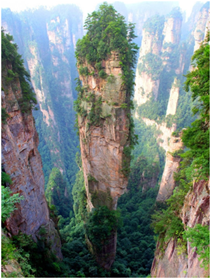
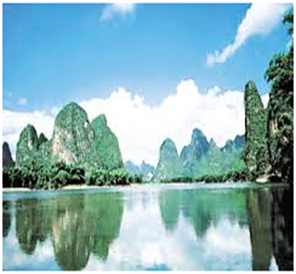
(Photos of natural landscapes in Vietnam and China)
When modern humans reached East Asia and for the first time took on the winter climate, the season of death, they penetrated inland and pioneered what is now the Silk Road, reaching the Mediterranean region and Eastern Europe; and along the coastal road from Africa to East Asia that they had already walked in the past, traffic between East Asia and Africa continued. In summer they advanced into the North and South American continents along the Pacific coasts of Siberia and Alaska, pioneering the Jade Road (jaderoad) by which East Asian culture was carried to the Americas. The ancient culture and civilization of East Asia are well preserved in the Mayan and Inca ruins of the Americas.
In the Hongshan culture period (ca. 4700–2900), the stepped stone pyramids of the Hongshan culture, before the Xia and Shang dynasties, were 2,000 years ahead of Egypt in pyramid-building technology, and East Asian metal culture was 3,000 years ahead of Mediterranean metal culture. The process by which East Asian civilization and culture grew and evolved is consistent, but the history of Europe — Egypt, Greece, Rome, and the modern era — is not connected. The reason seems to be that European culture and civilization have depended on changes in East Asian history. Egyptian culture arose under the influence of Xia and Shang culture, and Greek culture seems to have begun under the influence of Buddhist culture. In the time of Qin Shi Huang, the Huns opened the Silk Road and carried East Asian culture to Europe, and Roman civilization began.
The modern history of humankind began in the 12th century, when Genghis Khan of East Asia conquered Europe and brought East Asian civilization and culture to Europe. Marco Polo's Travels compared the development of medieval Europe and East Asia. Modern history awoke from the long sleep of the Middle Ages through Genghis Khan's invasion. Europeans, seeing the bows and gunpowder explosions of East Asians, came to invent guns and cannons. They took the lands of the bow-shooting Asians and made the world map we have today. New nations founded by Europeans arose on the continents of the Asian peoples, and among them the United States went through two world wars, invented electricity, the automobile, and the airplane, and has led in political and economic influence.
Humankind is still so uncivilized that it could not prevent the slaughter of six million Jews, and it cannot stop religious wars, so killing continues. Here in East Asia, the Korean Peninsula still cannot rescue 20 million North Korean people from the dictatorship of the Kim family. This is the immaturity of modern humanity, confusing creationism and evolution and committing slaughter for the sake of its own religion. The confusion of spirit, emotion, and intellect we are experiencing now is humanity's immature face, and we have not escaped the global conflicts that come from religion. Humanity's population explosion continues and nature is seriously polluted, so it is predicted that within the next fifty years, 50% of the living things that now survive alongside humankind will disappear.
When we talk about history, isn't it common sense for modern people to look back at the past and think about where humanity is now and where it is going? Modern humans are the youngest child among the animals of our family on earth. I find myself wondering: if we compare modern humanity to a single person's lifetime, how old is it, and how much time is left? And I wonder how the life of this youngest child on the earth will end. The secrets of how humankind came into being up to today can be seen in the process of a baby growing inside its mother's body. We can see the process of human evolution. I want to compare the history of humankind to one person's lifetime and share with readers what age we are at and what kind of world the future holds.
I tell how Atlantis, which the Greek philosopher Plato described as the source of all the world's civilizations, was in fact East Asia, and how the center of human culture and civilization that began in East Asia moved westward, went around the globe once, and is now returning to East Asia again. Humanity's age has now reached sixteen, the age of puberty. From modern history we can look down into the future. Before long, a more mature humanity will see an age of good family life in which it begins raising children who are space travelers.
If life on earth began in the form of the amoeba, we will see its ultimate end as a process of returning again to the age of germs. Now is the time when modern people must recognize their duty: while understanding the past fairly and uniting by finding what we have in common, to set a direction in which the world's people are one family and the world's religions have one Creator, keeping a balance of progressive and conservative functions within it, and living while protecting the environment for the sake of a beautiful future family. I hope this book, built on that recognition, becomes an occasion for establishing a new worldview and view of life, that the effort to build a right concept of living for modern people begins now, and that, made more complete, it becomes a guidebook for modern people.
Contents
1. Why All of Humanity's Civilizations Began in East Asia
1.1 The Origin and Growth of Earth Mounds
1.2 The Evolution of Agriculture in East Asia
1.3 The Evolution from Dolmens to Stone-Mound Tombs
1.4 The Evolution and Distribution of Pyramids
2. The Global Position of East Asians Seen on the World Genetic Map
2.1 East Asians Are the Earliest of Modern Humans
2.2 The Beginning of Culture and Civilization
2.3 The Ancestors of Goguryeo and the Ancestors of Baekje on the Korean Peninsula
3. The Emergence of Language and the Development of Writing
3.1 The Development of Language
3.2 The Development of Writing
4. Egyptian Culture Came from East Asia
4.1 The Liaodong Civilization and the Hongshan Culture
4.2 The Metal Culture of the Shang Dynasty
4.3 The Development of the Rickshaw and the Chariot
4.4 The Chariots of East Asia
4.5 Tutankhamun and Egyptian Culture
4.6 City Planning That Began with the Wheel Culture of East Asia
4.7 The World's First Empire: the Qin Dynasty and Qin Shi Huang
4.8 How the Week Came to Have Seven Days
4.9 The Beginning of Chinese History in Sima Qian's Records of the Grand Historian
4.10 China's Northeast Project
5. The Beginning of the Silk Road and the Great Wall
5.1 The Silk Road
5.2 The Great Wall
5.3 The Beijing–Hangzhou Grand Canal
5.4 The Story of the Huns
6. The Culture of the Native Peoples of the Americas Began in East Asia
7. The Beginning and Distribution of Religion
7.1 Yin-Yang and the Five Elements
7.2 Cave Temples and Sculptural Art of East Asia
8. East Asian Science and Inventions That Moved the World
8.1 Bronze and Steel Weapons and Tools
8.2 Astronomy
8.3 Music and Musical Instruments
8.4 The Use of Chariots (車馬) and City Planning
8.5 Sundials, Water Clocks, and the Abacus
8.6 Liquor, Tea, Vessels, Metal Cups, Celadon and White Porcelain
8.7 The Compass
8.8 Bronze Metal
8.9 Paper, Movable Type, and Printing
8.10 The Crossbow (石弓), Gunpowder, and Cannon
8.11 Thread, Cloth, Silk, the Loom, and the Umbrella (Parasol)
8.12 The Wheel, the Rickshaw, the Oxcart, and the Horse Carriage (車馬)
8.13 Traditional East Asian Medicine
9. The Puberty of Modern Humanity Brought On by Genghis Khan
9.1 Europe's Advance into the World
9.2 Japan's Invasions
9.3 The First and Second World Wars
10. If We Compare Human History to One Person's Lifetime
10.1 Humanity's Past Hidden in the Mother's Womb
10.2 The Appearance of the Universe and of Life
10.3 The World of Things That Have Life
10.4 The World of Things That Feel
10.5 The World of Things That Think
10.6 The World Seen with New Eyes
10.7 The Genetic Position of East Asia
10.8 Modern Humanity Is at the Age of Puberty
10.9 The Three Languages and Personalities of Modern People
10.10 The Position of the Korean Peninsula in East Asia