 Yong Wan Bryan Choi한국어
Chapter 2: The Global Position of East Asians Seen on the World Genetic Map
Translated from the Korean original. Read the Korean original
2. The Global Position of East Asians Seen on the World Genetic Map
The world map below shows the genetic lineage of humankind that genetic genealogists published in SCIENTIFIC AMERICAN in July 2008 (The Migration History of Humans: DNA Study Traces Human Origins Across the Continents.). The history of the distribution of the world's peoples through genetics (Evolution's Genetic Footprints) was published by the DNA research team of Cavalli-Sforza in Italy. Paul Slopek, who serialized its contents in the Chicago Tribune in 1998, received the Pulitzer Prize. The report on prehistoric human migration (Prehistoric Migrations) published in the science magazine in July 2008 announced the new first migrations of modern humans as seen through genetic relationships (new genetic evidence reveals clues to the first human journeys), and National Geographic (national geography) publicized it extensively.
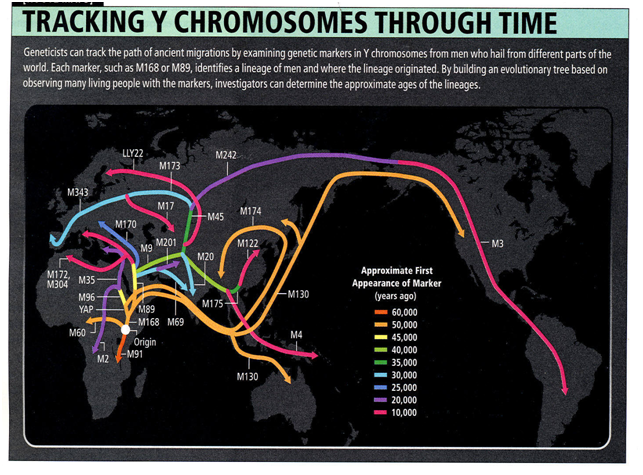
The humans who stood and walked on two feet in Africa two million years ago kept evolving until at last, around 100,000 years ago, modern humans were born, and around 50,000 years ago they headed toward the rising sun in the east along the shores of the Indian Ocean, reached Southeast Asia, and found a haven for human life. When they continued along the coastal road, north along the Pacific coast, and reached the Korean Peninsula, they met winter, the season of death. Here, for the first time, modern humans challenged nature, gained the human ability to overcome nature, and found a way of life adapted to the four-season climate of the interior. Afterward the seafaring people changed into an inland people: the M174 group advanced inland, and the M130 group advanced along the coastline through Siberia and Alaska into the North and South American continents.
Because all modern humans began from a single set of parents and are connected by genealogy, if we look first at genetic relationships, next from the viewpoint of archaeology, and then at the written record of history, a picture of world history seen with new eyes is drawn. History until now has been a view of history dependent on records, so it could not escape prejudice. In this new information age, if we look at these three fields together, we see that modern humans moved eastward from Africa, and we easily see that the culture and civilization of modern humans began in East Asia and spread west to the Mediterranean and to the North and South American continents.
Humans, who from two million years ago began to stand up and walk on two feet, grew up in Africa, warm as a mother's embrace, eating the food nature provided as one drinks a mother's milk. Modern humans appeared a mere 100,000 years ago, and they, having no language yet, communicated with sounds, facial expressions, and gestures and began moving along the sea route toward the rising sun in the east. At first they stayed in the basins of the Tigris and Euphrates, but the climate was not suitable for settled life. It seems the ice-age temperatures of the European continent clashed with Africa's tropical climate, making a desolate climate that created the Sahara Desert.
Again moving east, past the Indian Ocean, around the time they passed the Indus and the Ganges, the population grew because Southeast Asia's climate was good and food was abundant. At that time what is now Indonesia was a single landmass, and the Australian continent was also connected to the Asian continent. It seems that when human life reached this place, people took land where it was easy to gather food and hunt animals and began to form villages as settled clan societies. Settled life began for the first time, and language began to appear in a life that until then had communicated by making sounds like animals and by expressions and gestures.
Just as animals search for food all day long, people too began to find and store food within their families, and just as animals find mates and protect their young, a collective climate of attack and defense must have formed in human life. On reaching Southeast Asia, the population grew even more, social language began to develop for the first time, and there must have begun a time of finding and storing the necessities of life harvested from sea and land.
Archaeologists say this was 50,000 years ago, and linguists say the roots of the world's languages converge in Southeast Asia. As they moved north along the Pacific coastline and came to settle in the Yangtze and Yellow River basins, they reached the Liaodong Peninsula in Manchuria and their way ahead was blocked. The Korean Peninsula blocked the way, and for the first time they took on winter, the season of death. From here the people who penetrated inland were the M174 lineage, and the people who passed the Yalu and Tumen Rivers of the Korean Peninsula, went through Siberia, and reached the North American continent were the M130 lineage. Divided into M174 and M130, M174 appears to be the ancestors of the inland peoples extending to Manchuria, Mongolia, and Tibet, and M130 appears to be the ancestors of the seafaring peoples who passed through Siberia and Alaska to reach North, Central, and South America.
That the Yellow Sea existed between the Korean Peninsula and China 50,000 years ago has not been confirmed geologically, but considering that the Yalu River and the Yellow River flow into the Yellow Sea and the cultures of the two rivers are completely different, and inferring from the fact that Dongyi culture was isolated from the Chinese, we come to understand that the Yellow Sea existed. The phenomenon of modern humans who left Africa dividing into M174 and M130 on reaching the Yellow Sea is evidence that they fell into a trap and suffered hardship. That hardship was meeting winter and being unable to keep advancing.
In Korea, M174 people are called the ancestors of Goguryeo, and M130 people appear to be the ancestors of Baekje. The roots of the East Asian peoples who overcame winter — developing many fermented foods such as kimchi, doenjang, and liquor from 50,000 years ago, forming earth-cave dwellings, and developing the ondol room to warm the floor — must have ripened from this time. The great artery of human lineage divided here, and it seems humanity's first household life had already begun in East Asia around 50,000 years ago, before the world's other lineages multiplied on the earth around 35,000 years ago. The M122 lineage, as the Han Chinese expanded from Central Asia and migrated to China's east coast, dates from 10,000 years ago, and at this time the M4 lineage dispersed to Southeast Asia.
In the ancestral religion of East Asian clan society, when parents died they were buried in the earth and a round grave was built of earth. That custom continues even now. People dug village reservoirs to store water and piled up the soil to build large graves shaped like small hills, or made them into altars for offering sacrifices to heaven. The custom at the southern tip of the Korean Peninsula of digging ponds, building earth mounds, and building great tombs connects with the remains of some 3,000 earth mounds built along the Mississippi River. Earth-mound culture, carried along the coastline, reached Western Europe and can be seen in the Denmark region. Archaeological excavations in North America show remains of human habitation from around 40,000 years ago.
Before the glaciers began to melt on European land 20,000 years ago and before the population of the fair-haired, blue-eyed Western Europeans grew, East Asian culture had already extended to the North American continent and the Mediterranean region and grown there. When we see the commonalities between the customs of the native peoples of the Americas and East Asian customs, we come to understand that the native peoples, including the Maya civilization of the Yucatán Peninsula in Central America, are of East Asian blood and have interacted with East Asia over a long history, from before the Western European peoples appeared. On the Jusan ridge at Jisan-dong, Goryeong County, North Gyeongsang Province, on the Korean Peninsula, some 200 tombs of the kings and royal family of Daegaya spread along the ridge, making a magnificent sight.
A life adapted to the four seasons brought regular effort and discipline in preparing necessities such as food, clothing, housing, and fuel before winter came. East Asia is the place that had the environment to build large houses and large ships with metal tools and to mass-produce chariots whose wheels, fitted with metal axles, ran fast and far. Carts for carrying heavy loads were made, and all industries flourished along with the transport industry. People discovered the magnet and invented the iron-needle compass, and ocean navigation developed; they made paper, and written records flourished, so that the exchange of information and the linking of records transcended the limits of place and time.
While a large population lived on a wide, great continent from tens of thousands of years earlier, the culture of ancient society began in Southeast Asia together with language, and all inventions and discoveries were made in the competitive society of East Asia. Because East Asia's farming culture and nomadic culture had already spread across the whole temperate zone of Southeast Asia while Europe and North America were going through the ice age, we can easily imagine that culture and civilization developed there tens of thousands of years ahead of any other part of any continent. This is how world history looks different in the information age.
2. 1 The Roots of Koreans Are Not Northern but a Mixed Southern Lineage
032008 After the genetic lineage of humankind published in SCIENTIFIC AMERICAN in July 2008 (The Migration History of Humans: DNA Study Traces Human Origins Across the Continents.), on February 2, 2017, Korea's JoongAng Ilbo, under the byline of reporter Choi Jun-ho, introduced an announcement by Park Jong-hwa, director of the Genome Research Institute.
Under the headline "Where are the roots of the Korean people?", [the article noted that] some in anthropology and archaeology have presumed that the Korean people were a northern people who set out from the Altai Mountains, passed through the plains of Mongolia and Manchuria, and entered the Korean Peninsula. The basis was that the people of these regions have much in common in language, customs, and appearance.
But the judgment of the scientific community announced this time is different. According to the Genome Research Institute of UNIST (Ulsan National Institute of Science and Technology) on the 2nd, it reported that the Korean people were formed by the mixing of the blood of southern hunter-gatherers, who flowed into the Far East 30,000–40,000 years ago by way of Southeast Asia and the eastern coast of China and became northerners, and southern farming peoples who came in by the same route 10,000 years ago when the Neolithic began. In 2009 UNIST had published in Science that the Korean people belong to a great southern stream that moved northeast from Southeast Asia, and this time it made that more specific.
The clue was the skulls of two women, one in her twenties and one in her forties, from 7,700 years ago, found in a cave called "Devil's Gate" in the Primorye region above Vladivostok, Russia. Primorye is the land of old Goguryeo, Dongbuyeo, and Okjeo in Korean history. The Genome Research Institute used a supercomputer to decode and analyze the genomes of these skulls.
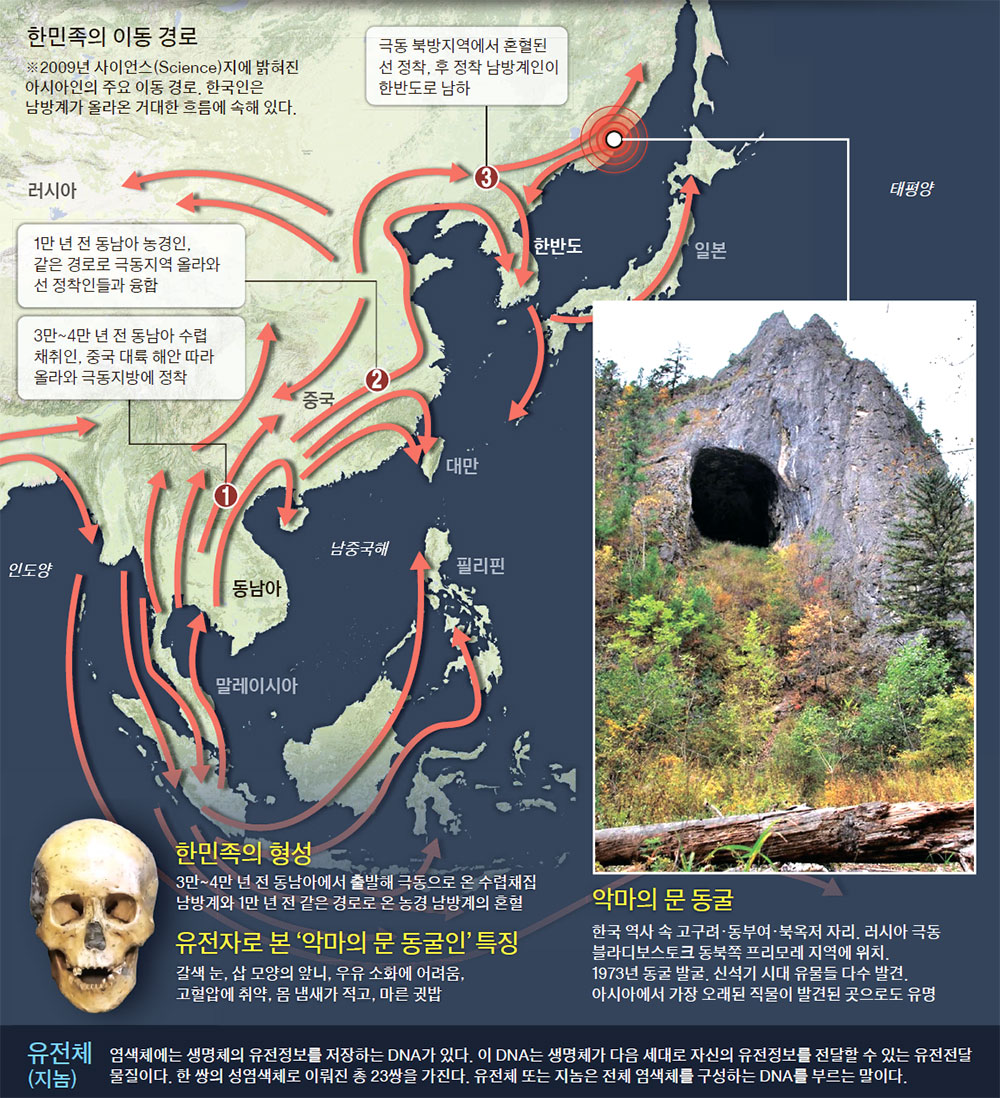
DNA analysis revealed that the Devil's Gate cave people were southern people who settled there 30,000–40,000 years ago and, like Koreans, had brown eyes and the gene for "shovel-shaped incisors." They also had the typical genetic traits of modern East Asians. Representative ones are the genetic variant for being unable to digest milk, a gene for vulnerability to high blood pressure, a gene for low body odor, and a gene for dry earwax. The Devil's Gate cave people are regarded as the ancestors of the Ulchi people who live nearby today. Excluding the nearby indigenous people, among modern people Koreans were found to have the genomes closest to theirs. It was reported that their type of mitochondrial genome was also the same as the one Koreans mainly have.
Park Jong-hwa, director of the UNIST Genome Research Institute, said, "Having the same type of mitochondrial genome means having the same maternal line," and "Even considering the long time gap between the two populations, the genomes are very close, so the Devil's Gate cave people can be said to be almost the same as the ancestors of Koreans."
That does not mean the genome of the Devil's Gate cave people matches every part of the Korean people. To calculate the exact ethnic origin and composition of Koreans, the researchers compared the genomes of the Devil's Gate cave people with those of some 50 existing ethnic groups in East Asia. As a result, Koreans were best represented when the genomes of the ancient people who lived in Devil's Gate cave and of the isolated indigenous peoples of modern Vietnam and Taiwan were combined. It was the moment of discovering that [Koreans] were a fusion of two southern lineages that differed in era and way of life.
However, the genetic makeup of the modern Korean people is much closer to the southern Asians of the farming age 10,000 years ago. The reason given is that the southern peoples who farmed rice paddies had more children and expanded faster than the Far Eastern hunter-gatherers who hunted, gathered, or herded. It was reported that, in fact, the present population of the old Far Eastern tribes who lived mainly by hunting and gathering does not exceed a few hundred thousand at most.
Director Park Jong-hwa said, "Within the great stream of East Asians, it is presumed that as technology developed, peoples of small branches arose and mixed, and so the Korean people were formed." UNIST's research was published in the international journal Science Advances on the 1st (U.S. local time).
2.2 East Asians Are the Earliest of Modern Humans.
East Asian people have a distinctive look. When you see the people of Korea, northeastern China, Japan, Mongolia, Tibet, Nepal, Vietnam, and so on, they look different from other peoples.
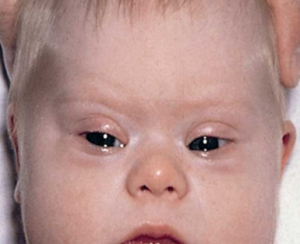
The 19th-century English physician Dr. J. Langdon Down called patients with the symptoms of a degenerative syndrome (Down syndrome) "Mongolism." That was because Dr. Down found the immature appearance of early modern humanity in the appearance of East Asian people. It was because the appearance of patients with this degenerative syndrome (Down syndrome), which all the world's peoples have in common, resembled the Mongolian people of East Asia. Clearly the East Asians, humans of 50,000 years ago, differ in appearance from the people of Southwest Asia or Europe of 35,000 years ago. They have narrow eyes, high cheekbones, small noses, and different tooth shapes. It seems to be because of this historical background that the faces and tooth structure of people in Vietnam, Taiwan, eastern China, Japan, Mongolia, Tibet, Eastern Europe, Siberia, and elsewhere have the features of a Mongolism older than that of any other people in the world.
It is understood that they have preserved the appearance of the immature humanity of 50,000 years ago until now without any great change. The people who began settled life on earth earlier than anywhere else in the world, and who also began culture and civilization early, are our people of East Asia.
Looking at climate change on earth over the past 100,000 years, a warm climate like today's continued from 100,000 to 80,000 years ago, and then from 70,000 years ago the earth's temperature grew cold, and an ice age began on the European continent, the northwest of the Asian continent, and the North American continent. While the ice age continued from then until 12,000 years ago, the sea level was about 100 to 300 meters lower, so the island nations of today's Southeast Asia (Japan, Taiwan, Indonesia, the Philippines) were part of the Asian continent. In particular, it is said that between Indonesia and the Philippines there was a landmass as large as India (Sundaland). Great things are expected from future undersea exploration of the ancient East Asian cultural remains hidden in this landmass that now lies beneath the sea. As this landmass sank into the sea, its culture fled east to Polynesia (Polynesla), and some of them seem to have followed the equatorial current, arrived in South America, and begun the Olmec culture, which later seems to have become the pioneering of the sea route by which East Asians reached South America. The Olmec culture is an unprecedented, highly advanced culture that began in South America and appeared in Central America, and the faces of the Olmecs have large lips, large eyes, and broad noses — the look of Polynesians, closely resembling native Hawaiians.
Of these people from Southeast Asia, those who settled in India are the Dravidians, and those who moved north along the coastline are, in my view, the Neolithic people who settled on the east coast of China and the Korean Peninsula, and who later settled in Manchuria, Mongolia, and Tibet and founded nomadic states. The humans who entered the European continent from Africa more than 70,000 years ago could not survive once the ice age began, but Neanderthal humans survived in Europe until 20,000 years ago and then disappeared.
The people who, after adapting to climate change in Southeast Asia, settled in Southwest Asia and then migrated along the coastline to settle in Europe grew accustomed to long winter living; their black hair became blond, their blue eyes and white skin became vulnerable to the sun's heat and ultraviolet rays, and it seems they came into contact with Asian culture from 9,000 years ago, after the deglaciation. It seems that the people who migrated belatedly from Africa to Southwest Asia merged with peoples who migrated from densely populated Southeast Asia to become the Arabs; that those who advanced inland merged with peoples migrating from East Asia and Southeast Asia to become the Central Asians, who under pressure from the East Asians migrated to northern India, later became the Han Chinese, and in China's Zhou dynasty mixed with eastern China to become Northeast Asians.
2.3 The Beginning of Culture and Civilization
All life is made to compete and fight in order to select and raise good seed. The horns, claws, and fierce temperament of males exist because they have the duty to become strong and pass good seed to the females. In human society too, war has continued, and human history is full of the history of competition and war. When water dries up where it had been plentiful, people migrate in search of water, and when food runs out, fights to seize food begin, so fighting and war have been the way of life of living things. When one wins in culture and civilization through new knowledge and competitiveness, that culture and civilization is passed on in turn to the next winner.
Because human instinct consists of the ability to find food and eat and the ability of men and women to come together and bear and raise children, love became the source of culture and the struggle for survival became the source of civilization. Primitive people, who dispersed fastest along the coastlines, depended on gathering and migrated in search of regions rich in natural foods, and when the food supply dwindled with the seasons, they were accustomed to a moving life like migratory birds. Eating greens in summer, fruit in autumn, and seeds and roots in winter and spring, while catching fish, shellfish, and small animals from the sea, they ate both plants and meat. While matriarchal society, centered on the instinct of the woman who loves man and child, continued for tens of thousands of years, people planted seeds and farming began, and they raised small animals and livestock began.
In tens of thousands of years of gathering, people went from eating seeds to planting seeds and beginning cultivation, and the settled life of matriarchal society began with the mother's instinct to love her children finding joy in plant life growing from the soil and in raised animals bearing and rearing young. In settled life, wood — as fuel to make fire, as the tools needed for living, and as material for building houses — was one of the most necessary living things for human life.
Out of gratitude and fear toward the environment that protected the love of family that had protected one's own life and kept the family alive, religious ritual began, and many kinds of individual or collective ceremonies — joyful rites, sorrowful rites, rites of anger — became part of life. Religious ritual and related cultural activities began, hoping for good weather from heaven, good harvests on earth, and good fortune for the family. The forms of Taoism and Hinduism, which hold religious rites for all natural things — sun, moon, mountains, rivers, sea, rocks, trees — began. The Confucian rites of offering sacrifices to the spirits of parents and ancestors and of society's leaders also firmly established their foundation as clan society grew.
Lighting fires with wood to cook food, breaking stones to use as tools and as weapons for hunting, and growing accustomed to the group life of the Paleolithic, people began language. In East Asia's Neolithic period settled farming began, and people hauled rocks from afar to raise dolmens as shrines to their ancestor gods. They made vessels by shaping clay and firing it to store grain. Wooden tools developed into stone tools and gradually into bronze tools. As they gathered food by the seasons and began to farm, they also acquired the habit of burying dok (large earthenware crocks made of fired clay) in the ground to store the family's food.
The seafaring people who settled on the Korean Peninsula around 50,000 years ago became accustomed to farming, and the fact that rice grains from 17,000 years ago have been excavated at Cheongwon in North Chungcheong Province shows that farming culture developed early here in world terms. The population density was high, and as the population was large, there remains an archaeological legacy of dolmen tombs in heaps, which required many people. At the southern tip of the Korean Peninsula some 20,000 Neolithic dolmens are gathered. Of some 80,000 dolmens on the shores of the Eurasian continent, some 40,000 are concentrated in East Asia.
All life is made to compete and fight in order to select and raise good seed. The horns, claws, and fierce temperament of males exist because they have the duty to become strong and pass good seed to the females. In human society too, war has continued, and human history is full of the history of competition and war. When water dries up where it had been plentiful, people migrate in search of water, and when food runs out, fights to seize food begin, so fighting and war have been the way of life of living things. When one wins in culture and civilization through new knowledge and competitiveness, that culture and civilization is passed on in turn to the next winner.
Lighting fires with wood to cook food, breaking stones to use as tools and as axes for hunting, and growing accustomed to the group life of the Paleolithic, people began language. Meeting East Asia's four seasons, settled farming began in the Neolithic period, and around the time they were melting bronze metal over charcoal and coal fires, they hauled rocks from afar to raise dolmens as shrines to their ancestor gods. They made vessels by shaping clay and firing it to store grain. Wooden and stone tools gradually developed into bronze or iron tools. As they gathered food by the seasons and began to farm, they also acquired the habit of burying dok (large earthenware crocks made of fired clay) in the ground to store the family's food.
East Asia's coal production made metal culture develop earlier than anywhere else in the world, so metal relics of East Asia's Shang dynasty are displayed in every museum in the world. The high heat of coal in East Asia also made iron culture develop first in the world. People raised cattle to farm, raised the ponies of Manchuria at home, raised wolves at home until they became dogs, and raised sheep, pigs, and chickens at home for food. Considering that the Huns, equipped with powerful metal weapons and riding ponies, accompanied by dogs and pigs, rode from East Asia all the way to Western Europe and fought wars with Rome, the Eurasian continent was our ancestors' playground.
The Silk Road (silk soad) was the courtyard path along which East Asian people advanced to the west of the Eurasian continent. As the Huns moved west, a new tribe was born on the Mongolian side, and that tribe's name was the "Göktürks" (돌궐족). These Göktürks came down south and made a country, which became today's Turkey, and this is why Turkey is called a brother nation to us, the Korean people. In Turkish history too, it is said, "We are the Asena people (the Asadal people: the people of the land of light, the Sun people)." The countries that the Huns made as most of them moved west became "Hungary," "Bulgaria," and "Finland," and as they kept pressing westward, it seems the "Germanic peoples" made their great migration.
Even looking at the history of China, where 56 ethnic groups live together, except for the Song dynasty, most of it is the history of empires in which northern peoples ruled, and the Great Wall too is a boundary line where northern peoples fought wars among themselves. That the Great Wall and the Silk Road began around the Korean Peninsula, which had the highest population density in East Asia, and stretched westward shows that this is the starting point of East Asian history, which began 50,000 years ago.
The seafaring people who settled on the Korean Peninsula around 50,000 years ago became accustomed to farming, and the fact that rice grains from 17,000 years ago have been excavated at Cheongwon in North Chungcheong Province shows that farming culture developed early here in world terms. The population density was high, and as the population was large, there remains an archaeological legacy of dolmen tombs in heaps, which required many people. Looking at the distribution of Neolithic dolmens at the southern tip of the Korean Peninsula, of some 80,000 dolmens on the shores of the Eurasian continent, some 40,000 are concentrated in East Asia.
In the past, European historians believed that the oldest cultures in the world were in China and India. But in the 1960s American scholars argued that the source of world culture lay in Southwest Asia, and recently, as DNA research has made it firmly believed that humankind began in Africa, it has come to be regarded as a matter of course that human culture began in Southwest Asia, close to Africa.
This is because European and American scholars' knowledge of East Asian culture is very limited. Because it depended on Western observation, it differs greatly from our own view of our culture. During the First and Second World Wars, Asian nations were invaded, went through civil wars and turmoil, lived in poverty and want, and went through upheavals such as China's Communist Cultural Revolution, which eliminated scholars. Japan's political distortion of history during World War II blurred the identity of Asian culture even further. In such a reality, the history and culture of Asia as seen by American and European scholars cannot but be vague.
In step with the recent movements to see history rightly in Southeast Asia, including India, China, and Korea, I hope that a movement to see world history rightly can also unfold. It was only in the 1990s that academia confirmed that the native peoples of the Americas migrated from East Asia from about 35,000 years ago. Moreover, comparing the culture of the native peoples of the Americas with East Asian culture and explaining their commonalities is introduced for the first time in this book.
I want to trace what contribution East Asia's Stone Age culture made — in raising dolmens and pyramids, accumulating astronomical knowledge, and developing religion — while the earliest of modern human lineages went from Africa to East Asia, and their descendants advanced into the North and South American continents and, through the Asian interior, into Manchuria, Mongolia, Tibet, and Eastern Europe.
Because the Greek scholar Plato of the Mediterranean recorded that Greek culture came from Atlantis, European scholars and explorers are still searching for Atlantis. I want to point out that Atlantis was in East Asia. As an architect, I compare archaeological plastic arts and architectural relics, and also materials from before written records. I explain the commonalities between the native cultures of the Americas and the historical relics of East Asia's Xia, Shang, and Zhou dynasties across 2,000 years, and compare their customs. By explaining the possibility of a history connected from even longer ago, from 30,000 years ago, I want to explain that the connection between East Asia and American cultures existed together with the connection between Asia and Europe.
2.4 The Ancestors of Goguryeo and the Ancestors of Baekje on the Korean Peninsula
The phenomenon of modern humans who left Africa dividing into M174 and M130 on reaching the Yellow Sea is evidence that they fell into a trap and suffered hardship. That hardship was meeting winter and being unable to keep advancing. On the 50,000-year journey from Africa to East Asia, there must have been times when they met sudden climate changes and suffered cold, but they could avoid them rather than confront them and continue the journey. But when they reached the Korean Peninsula there was no direction in which to flee, and no way but to confront it. Here the roots of the southern people of Baekje and the roots of the northern people of Goguryeo divided.
M174 people are called the ancestors of Goguryeo, and I see M130 people as the ancestors of Baekje. On the Korean Peninsula there is a North Korean temperament and a South Korean temperament. Just as Europe has a German temperament and a French temperament, the northern temperament is rough and hard in speech, while the southern temperament is soft and gentle. Goguryeo civilization was progressive, and as its tombs show, it displays a continental culture including science such as yin-yang and the Five Elements and metal culture. Baekje culture centered on maritime industry and farming and dominated the Chinese coast including the Shandong Peninsula, the Japanese archipelago, and the waters of Southeast Asia.
Baekje culture originally derived from the Honam and Chungcheong regions, which preserved well the character of a seafaring people, and Goguryeo culture, a pioneering culture of inland life, holds the cutting edge of world civilization, opening onto Manchuria, Mongolia, and the Central Plains. The astronomy and yin-yang and Five Elements shown in Goguryeo tombs are the beginning of science in human civilization. This is the place where the current of world civilization began, in which Dongyi culture awakened the Chinese people and, pioneering the Silk Road, awakened Europe. Because the Huns, the northern horse-riding people, reached the Korean Peninsula and settled in Gyeongsang Province and the Japanese archipelago, M174 is the dominant lineage in these regions. But the civilizations of the Three Kingdoms period of the Korean Peninsula mixed and grew close to one another.
Around the time Baekje was conquered by Silla, Baekje's government and nobility moved to the Japanese archipelago, which was Baekje territory, and so Japan's civilization and culture began from Baekje. The time when Japan's language and culture separated from the Korean Peninsula is the result of Goryeo belonging to the cultural sphere of the Yuan dynasty and acquiring continental culture, while Japan did not change and preserved the culture of the Three Kingdoms period of the Korean Peninsula. The Japanese are Baekje people, and with a disposition bent on revenge against Silla they ceaselessly harassed the coasts of the Korean Peninsula, which led to the Imjin War and to the invasion of the Korean Peninsula in modern history.