 Yong Wan Bryan Choi한국어
Chapter 3: The Emergence of Language and the Development of Writing
Translated from the Korean original. Read the Korean original
3 The Emergence of Language and the Development of Writing
3.1 The Development of Language
When humankind left Africa, language was still no more than a few kinds of emotional communication, like the sounds of animals. On reaching Southeast Asia along the coastline, people formed settled villages amid a nature rich in natural products, and social life took shape. For the first time, a language capable of social communication began to form. Among the languages of Southeast Asia, the Dravidian language of India connects to the Korean language of the East Asians and is the oldest form of language among living modern humans. The original language of the Indo-Aryans in India is called Sanskrit (sanskrits), and research is under way suggesting that Korean belongs to Sanskrit.
In East Asian yin-yang and the Five Elements, the five sounds (五星) were divided into the shout (呼), which cries out; speech (言), which communicates by sound; song (歌), which is joyful; wailing (哭), which gives voice to sorrow; and groaning (呻吟), which gives voice to pain. Before there was language, there was sound (song). Korean has verse (韻文) and prose (散文). Verse has rhythm like the melody of a song, expresses many meanings implicitly, and became the sijo and the poem (詩) of Korean literature. Korean song has chang [the sung narrative of pansori], and the chang of the Honam region has been handed down in two schools, Dongpyeonje and Seopyeonje. The Korean language, in which verse is handed down within speech and chang within song, seems to be the original home that has faithfully inherited the ancient East Asian culture of modern humanity.
Just as a single person grows up learning language in childhood, so in human evolution language began to develop as the modern humans who had lived on the coasts of Southeast Asia from 50,000 years ago began village life. The linguist Johanna Nichols pointed out that human language began in the coastal regions of Southeast Asia before the ice age. The beginnings of Southeast Asian language divide into Austronesian in the south and Austro-Asiatic in the north.
The southern languages connect to the island nations, to the Dravidian of southern India, and to Hamito-Semitic in Arabia and North Africa, and are used as modern languages. The northern languages were used as Sino-Tibetan throughout the east and Central Asia, then grew northward into Ural-Altaic and southwestward into Indo-European, becoming the languages used by the largest population in the modern world. Because the metal culture of the northern peoples, as the beginning of civilization, grew earlier than that of the southern peoples, when northern peoples migrated into southern language areas there was a strong tendency for the southern languages to be replaced by northern ones.
Johanna Nichols explained the historical relationship among three kinds of language: within language there are two orderly language forms, "subject–modifier–verb" and "subject–verb–modifier," and a third language form that is still disorderly and unsettled. The languages of our country, Japan, and Mongolia are of the first form (subject–modifier–verb), while European and Chinese languages belong to the second form (subject–verb–modifier). It is said that the whole east coast of China was originally of the first form, but from 10,000 years ago, as Central Asian peoples migrated to the northeast, it was replaced by the second form. The languages of undeveloped regions have many of the disorderly third form, the northern languages have many of the first form, and the southern languages have many of the second form. It becomes clear that all the world's language forms are found in Southeast Asia and that their roots also lie in Southeast Asia. Among them, the languages of East Asia carry on the tradition of the first form of modern language, the one formed earliest.
On the Korean Peninsula, before a child grew into an adult and was given a name for their social role, they were called Gaettong-a ("dog dung") or Sottong-a ("cow dung"). The cow comes from farming life and the dog from nomadic life, and so East Asia's culture of the cow and the dog began; the arrangement in which a cow and a dog are together in Tutankhamun's tomb in Egypt is an extension of East Asian culture.
3.2 The Development of Writing
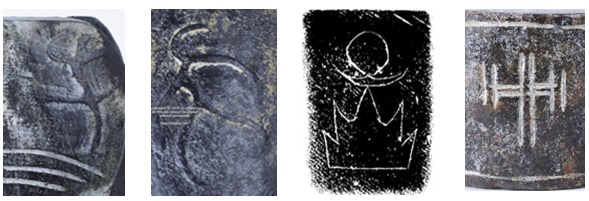
The shapes of pictographic writing first appear in East Asia's Hongshan culture (4700 to 2900 BC). This is 1,500 years before the writing of the Sumerians (BC 3200–2000) and 500 years ahead of Egyptian hieroglyphs. The photos below, gathered from Google, are symbols seen on Hongshan culture relics that became the origin of writing.
The beginning of writing by drawing the meaning of language as pictures (Paleography of the study of ancient writing) — writing appearing on bamboo, animal bones, tortoise shells, tree bark, cloth, silk, earthenware, stone slabs, Neolithic metal pieces, and so on — is commonly seen in East Asia as it is nowhere else in the world. Cloth and paper were invented there, and the greatest number of records on paper have accumulated in East Asia. The forms that evolved from pictures to letters are countless in Southeast Asia, and the kinds of scripts are many and varied. The existing scripts are from 7,000 years ago, but it is surmised that writing was used from before the deglaciation. The writing of East Asia's Shang dynasty (ca. 1600–1050 BCE) became stable along with its culture, and in the Zhou dynasty (ca. 1050–771 BCE) writing reached its golden age.
The records that the Sumerians (BC 3200–2000) left baked in clay are also interpreted as descriptions of the East Asian dragon. The shapes of the thousands of Chinese characters were also established before 600 BCE and published in the I Ching (Book of Changes), the Taoist scripture, and it is said that Confucius loved to read the I Ching when he was young. If we imagine the evolution of writing over the thousands of years before that, it leads us to imagine that in Southeast Asia, before Europe's deglaciation, the form of writing already existed in tribal society. East Asia's Taoism and the Analects recorded and popularized knowledge that had developed early. The fact that around 200 BC Qin Shi Huang buried scholars alive and burned countless books was a clash between politics and popular knowledge.
The language, writing, and science of the nations of Southeast Asia were the capacity for intellectual growth in modern humanity's childhood. We can surmise that, as people lived in clan societies gathering along the coasts from 50,000 to 20,000 years ago, and then, between 6,000 and 4,000 years ago, the population expanded into tribal societies settled through gathering and farming, East Asian writing moved along the coastline into the Maya script of the American continent and, at the same time, into the Phoenician script of those who migrated to the coasts of Europe.
Large numbers of records in Shang dynasty oracle-bone script (1600–1050 BC) are still merely stored in museum storerooms and have not been read. But for 20,000 years before the Xia dynasty, many city-states and feudal states existed at the river mouths of Southeast Asia, and among them the city-state of Ur was founded in the Indus River basin.
In the excavation records of the Ur region, religious relics bearing the features of East Asian people were unearthed from the oldest layer. After that, the Sumerians appeared in the Mesopotamian region with the language and pictographic writing of Southeast Asia, the Code of Hammurabi was introduced in Babylonia, peoples who worshipped birds and cattle appeared in the Mediterranean, and soon after, metal culture appeared. I think these cultures were not sudden inventions but the result of the spread of Southeast Asian culture, which had a larger population and a longer history and appeared through an evolutionary process of more than 10,000 years.