 Yong Wan Bryan Choi한국어
Chapter 7: The Beginning and Distribution of Religion
Translated from the Korean original. Read the Korean original
- The Beginning and Distribution of Religion
Just as every animal grows up receiving its mother's love, religion begins with a baby's dependence on its mother. Because there is love, life lives on. As people lived together in families, they learned rituals for sharing the family's joys and sorrows and came to serve the spirits of the family, and so ancestral religion began. When we were young, the family would gather, set up a ritual table before the memorial tablets of our ancestors, light incense, and bow down to the floor. After the ceremony was over, the times we shared the food that had been laid out and ate it with relish were happy ones too.
Long ago, as children grew up, they came to know that all the lives living on the earth are one great household, depending on one another and living together, and as adults they sought the parent of that great household. Seeking the master of nature, they began a religion of nature that worshiped the sun god, and learned rituals that respected the spirits of all living things around their lives. The miracle of waking the dark night, when fearsome beasts of prey ran wild, and bringing the bright dawn taught them the greatness of the sun; they felt that all life was alive by receiving the sun's energy, and they could not help but worship the sun. Our ancestors were the modern humans who, looking toward the east where the sun rises, left Africa and migrated east along the coastal road.
I still remember how, when we were young, my mother would rise at dawn, look at the sun rising in the east, and bow down in prayer. And I also recall my grandmother wrapping strings of colored paper around the village zelkova tree, and the villagers gathering to hold rites there.
When I was young, one of my siblings fell into a drainage ditch by the main road and came down with tetanus. When we went to the hospital, the doctor said tetanus was a disease for which there was no medicine, and his only prescription was to nurse the patient at home. We followed my grandmother to see the old man at the herbal medicine shop. He explained the patient's body in terms of yin-yang and the Five Elements and wrapped up five packets of herbal medicine. The patient, tormented by fever, was delirious, and the whole household was gloomy and full of worry. Three days later, after taking three packets brewed into medicine, the patient's skin color brightened and the fever came down. A week later, after brewing and taking the rest of the five packets, the patient recovered, and when we went back to the hospital, the doctor was astonished and called it a miracle that modern medicine could not explain.
Grandmother and Grandfather sometimes took us to visit a fortune-teller. They told him the family's birthdays and asked about our fortunes. The fortune-teller also talked about yin-yang, the Five Elements, and pungsu (feng shui), and told us many stories of the world. Yin and yang explain the contrasts of things—night and day, woman and man, water and fire—and the Five Elements divide things into five, the four directions of east, west, south, and north plus the center, explaining life and environment together; this was the belief of the people of old, and the beginning of science. Just as the old man at the herbal medicine shop saw life and the structure of the body divided by yin-yang and the Five Elements, the fortune-teller also explained the relationship between people and nature and the relationships among people by yin-yang and the Five Elements.
On my grandfather's bookshelf was a book called the I Ching (周易). It is said to have been written by sages 3,000 years ago and that Confucius loved to read it 2,600 years ago. My father explained to me that the I Ching is one of the Five Classics of Confucian learning (儒學) and a book describing the principles of change in the world. The four directions of yin-yang and the Five Elements were further divided into eight directions and represented as the eight trigrams. Our country's flag, the Taegukgi, has yin and yang drawn in a circle at the center and four trigrams marked at its four corners—a diagram representing yin-yang and the Five Elements through the eight trigrams. For the meaning of each of the eight trigrams, the I Ching explains eight more detailed situations of time and space, dividing all the cases that occur between heaven and earth into 64 cases.
The murals inside the Goguryeo tombs depict the sun, the moon, and the Big Dipper on the ceiling. Around the four sides are the symbols of the Five Elements—the Blue Dragon (靑龍) on the east, the Vermilion Bird (朱雀) on the south, the White Tiger (白虎) on the west, and the Black Tortoise (玄武) on the north—and the body at the center was adorned in gold. With black and white and the three primary colors they formed the four directions and four seasons: it is the wisdom of building a small universe to create an environment for life. It is said that yin-yang and the Five Elements, a fusion of ancestral religion and nature religion, later carried on into Confucian learning (儒學), and so East Asia's Taoism (道敎) and Confucianism (儒敎) began. Goguryeo culture is a record that has purely preserved the oldest part of East Asia.
According to recent theories that study human genes and have published the lineages of the world's peoples, the ancestors of Goguryeo (lineage M174) stayed in the Liao River region of Manchuria from 50,000 years ago, began adapting to the winter season, and migrated inland into Mongolia and Tibet. The ancestors of Baekje (lineage M130), from 40,000 years ago, passed through the North American continent and connect to Maya culture in Central America and Peruvian culture in South America. Meanwhile, archaeologists say that our people created the Hongshan culture in the Liao River region of Manchuria, earlier than anyone else in the world.
The bloodline of our people is the trunk of the great artery by which modern humans wound around the Indian and Pacific Oceans from Africa to South America. The Liaodong Peninsula region is, in East Asian history, the beginning of the Great Wall and the beginning of the Silk Road connecting Asia and Europe. This region is where religion grew as farmers and nomads began living together. It is the crossroads of the passages of human lineage and of the world's culture, civilization, politics, history, and more. In East Asian history, Shang dynasty culture is the culture of our ancestors, known as the Dongyi, and it seems that until the founding of the Zhou dynasty of the Chinese (Zhonghua) people 3,080 years ago, it transmitted metal civilization and the culture of building pyramids to every continent of the world. It seems the ancestors of Baekje on the east coast of China maintained the state of Qi in China's Shandong Province and brought about the renaissance of the Spring and Autumn and Warring States periods, so that waves of religion, philosophy, and science were transmitted to every continent of the world.
The primitive nature religion of Southeast Asia built a foundation over thousands of years in the forms of East Asian Taoism, which worships the heavenly bodies and the ancestors, and the Hinduism of eastern India. As the vassal states of East Asia developed into an imperial system under a Son of Heaven, Confucianism appeared with the growth of Confucian learning. Taoism and imperial thought were transmitted to eastern India, and an imperial religion was formed. In 600 BC the Buddhism of Shakyamuni began. Indian Buddhism, like the religions of East Asia, early on created scriptures, set standards for living, and explained the order of nature. When Buddhism spread vigorously to western India, the Greek kings of the Mediterranean came to Buddhist temples in India and East Asia, trained as Buddhist monks, and learned Asian philosophy and culture to take home. This fact appears in both Chinese and Indian Buddhist records at the same time. Six hundred years later Christianity was born, and so early Christianity—Catholicism—and Buddhism have much in common. Judaism is the religion of the Old Testament, and that 600 years later again Islam began from the Old Testament also shows that the roots of the world's religions lie in the basins of the Yellow River and the Ganges.
East Asian religion, having settled on the Ganges in eastern India, welcomed the birth of Shakyamuni of Buddhism, and, passing the Indus in western India, 600 years later Jesus was born into the culture of the Tigris–Euphrates basin. After the Christianity of Jesus was founded, another 600 years passed and Muhammad, the founder of Islam, was born, and the endless conflict between Christianity and Islam continues to this day. Christianity, which carried on into Eastern Europe and Russian Orthodoxy, gave rise to Protestantism in western Europe with Martin Luther's Reformation in 1520. English Protestantism was transmitted to the American continent, and, strengthened by America's economic power, Christianity at last came to its original religious homeland, East Asia. Modern religion, having come home against the turning of the Earth, has now reached a new starting point.
Modern humans, having won the struggle for survival on Earth through the development of science, are under the illusion, with their humanist thought, that they have become the masters ruling all life in nature. Saying "Man is the lord of all creation," "Man is the Creator's masterpiece," and "God is dead," they manipulate nature into a human-centered environment. Countless animals that have lived alongside us are vanishing forever from land and sea, and the air we breathe and the water we drink are being polluted.
Humankind is destined never to part from religion. On the path of life, seeking truth and trying to realize our dreams, relying on a power that transcends humanity and nature is like a helpless baby depending on its mother, and it is the most beautiful part of our lives. We must recover the origins of religion and science that began in East Asia and return to a foundation of faith that protects nature with a mother's love and cares for our neighbors. Like yin-yang and the Five Elements, nature and human life must regain their balance, so that there is a future that saves humankind and the Earth. Might not such efforts bring world peace and be the framework for raising the next generation of humankind in health?
7.1 Yin-Yang and the Five Elements
This is the beginning of East Asian religion and science. Human senses can perceive existence when there is something to contrast it with. Because there are women, we know there are men; because there is night, we come to recognize that there is day. Because there is the moon, whose shape changes with time, people believed there was the sun, which gives light without change. That is the meaning of yin and yang.
The Five Elements explained the natural environment surrounding people by dividing it into five components. As the table below sets out, around the house where people live, spring contrasts with autumn and summer with winter, and the four seasons—spring, summer, autumn, and winter—turn, explaining the time and space of East Asia, where people live by farming. People are placed at the center, directions are set as east, west, south, and north, and the cyclical time-space is defined. There is the earth where people live, and water, fire, wood, and metal are provided, explaining the materials needed for life.
All the animals that live with people were classified into creatures that swim in the water, fly in the air, run about on four legs, or crawl on the ground. Light makes colors visible: the explanation is that it is bright and so white, or dark and so black, or that the three primary colors—red, blue, and yellow—mix to make all colors visible. Our ancestors already knew the three primary colors. Five Elements thought is a system of thought that appeared after the dragon and metal were already present in East Asian life, religiously and scientifically. The dragon and metal had been applied to life since long, long before.
Knowledge of the stars counted every night was the earliest to develop in human knowledge. People understood the astronomy of the planets of the solar system that cycle along with the Earth. This is evidence showing that the level of knowledge of East Asia's intellectuals stood at the leading edge, guiding human civilization and culture.
| Season | Spring | Summer | Autumn | Winter | House |
| Direction | East | South | West | North | Center |
| Material | Water | Fire | Wood | Metal (stone) | Earth |
| Creature | Blue Dragon (fish) | Vermilion Bird (bird) | White Tiger (four-legged beast) | Black Tortoise (snake, turtle) | Human |
| Color | Blue | Red | White | Black | Yellow |
| Star | Mercury | Mars | Jupiter | Venus | Saturn |
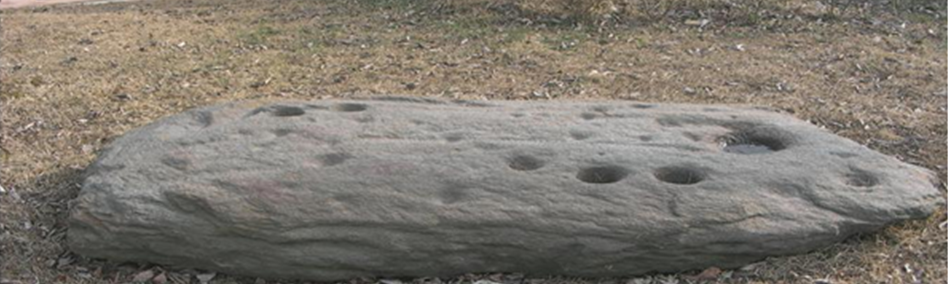
People lived by the lunar calendar, dividing the year into 12 months, with the moon becoming full after three passes of seven days in a month. They observed and studied time and the positions of the stars above the earth, where the season changes after three months and the year changes after four seasons. The carving of cup marks for the seven stars of the Big Dipper on a flat rock, among the very earliest of the Neolithic dolmens, is the first appearance of the number 7 in human knowledge. The belief that there is a kingdom on the earth, the heavenly palace of the North Star in the sky, and the dragon palace in the sea was the knowledge of a maritime people. They divided the space of the universe into seven parts, divided each part again into three, and observed all of space in the universe in 28 divisions.
Yin and yang together with the Five Elements make the number 7. The number 7 is a sacred symbol. We see the origin of the number 7 carrying on through Taoism, Buddhism, and Christianity. The seven heavenly bodies—the sun, the moon, and the five planets—were transmitted through the thought of yin-yang and the Five Elements to Egypt, the Maya, Greece, and Rome, and appear in many similar myths and religious rituals. Beginning with the legend of the Cowherd star and the Weaver Girl star meeting on the Milky Way on the seventh day of the seventh lunar month, it appears frequently in religious scriptures and is cited some 400 times in the Bible as well. The sacred number "7" is applied in all of today's religions. (The photo below shows a rock preserving the cup marks of the Big Dipper.)
Dividing the year into 12 parts gives 12 months, and dividing the day into 12 parts and then doubling them gives 24 hours. East Asia's twelve earthly branches (十二支) refer to the twelve characters that come second in the sexagenary cycle used in the calendrical system. While the ten stems that come first are called the heavenly stems because they are said to signify heaven, the twelve branches are also called the earthly branches (地支) because they are said to signify the earth. The twelve earthly branches are 子 (ja), 丑 (chuk), 寅 (in), 卯 (myo), 辰 (jin), 巳 (sa), 午 (o), 未 (mi), 申 (sin), 酉 (yu), 戌 (sul), 亥 (hae). Divided by zodiac animal, they are the rat, ox, tiger, rabbit, dragon, snake, horse, sheep, monkey, rooster, dog, and pig. Thus a cycle of twelve parts was formed. The East Asian zodiac is made up entirely of animals. The Western zodiac, although the origin of the word "zodiac" carries the meaning of animals, has several signs that are not animals. It seems the East Asian zodiac was altered as it was transmitted to Europe.
7.2 The Cave Temples and Sculptural Art of East Asia
The representative cave temples of East Asia are the Yungang Grottoes, the Longmen Grottoes, and the Mogao Caves of Dunhuang. These cave temples were built after Buddhism arrived, but even before that, countless caves large and small were scattered throughout East Asia. Metal tools, which began with the dolmen culture of the Stone Age, started to carve wood, dress jade, and dig into rock walls to make sculpture. People expressed their imaginings in sculpture as they would in painting. Because it was an effort demanding much time and patience, it was, like most art in high antiquity, a religious activity.
People sought out natural caves to live in and painted pictures on their walls, and then, with the appearance of metal tools, they began to dig into the caves and carve. East Asian sculpture was transmitted to eastern India, and the wooden sculptural art of eastern India flourished from long ago. Sculptural art passed over the Indus and was transmitted to Southwest Asia. Because they imitated wooden buildings in carved stone, cave sculpture shows the architectural style of its time. As cave sculpture was transmitted to Southwest Asia, stone architecture began, and Greek stone architecture began with the Doric style, modeled on the wooden architectural style of East Asia. From then on, it seems, it developed into the Ionic style and then the Corinthian style.
East Asian religious architecture begins with the "square in front, round in back" (前方後元) layout. In yin-yang and the Five Elements, the square form was distinguished as the space of humans on earth and the circular form as the space of the gods of the universe. The tombs of the southern Korean Peninsula and the tombs of Japan have the square-front, round-back form, and the plan of Unified Silla's Seokguram Grotto is square-front, round-back.
The square-front, round-back form is commonly seen in the plans of Indian religious temples and caves. From the 2nd century BC to the 7th century AD cave sculpture was popular throughout Asia, and countless cave temples are scattered about, such as China's Mogao Caves of Dunhuang (敦煌 莫高窟), the Yungang Grottoes, and the Longmen Grottoes, and India's Ajanta Caves. And Korea's Seokguram can be cited as an example.
Ajanta is a Buddhist cave temple complex located in the northwest of the state of Maharashtra, India. Of its 29 caves, there are the early caves built over about a century beginning around the 1st century BC, and the later caves built from the 5th to the 7th centuries. Indian customs and matters relating to Buddhism are depicted in rich and varied brushwork, not only on the walls but in every corner of the vast space, including pillars, beams, and ceilings. They range from works of the aniconic period to murals from the period when Mahayana Buddhism was developing. The painting of Padmapani, the Bodhisattva with a lotus in hand, is especially famous. As Buddhism declined in the 8th century, the caves were abandoned for more than 1,000 years. They were discovered in 1819 by a British soldier, John Smith, and became known to the world when Person investigated and excavated them in 1893.
The Mogao Caves of Dunhuang, popularly called the Caves of the Thousand Buddhas (千佛洞), are located at the western end of the Hexi Corridor (河西走廊) in Gansu Province, southeast of the city of Dunhuang, and are arranged as caves tier upon tier on a high cliff of some 50 meters at the eastern foot of Mingsha Mountain (沙山). They are located at the most important point on the Silk Road, a relay point for trade between East and West. It is a place where all the religions, cultures, and knowledge connected with Buddhism fused. The 492 caves of Mogao, with their sculptures and murals, are today the world's largest and most perfectly preserved treasure house of Buddhist art. The Wang ocheonchukguk jeon [Record of a Journey to the Five Indian Kingdoms] by the eminent Silla monk Hyecho was discovered here.
The Yungang Grottoes (云冈石窟) are a cave temple complex formed of about 40 caves, 20 km west of the city of Datong in China's Shanxi Province. It is said they began with the so-called "Five Caves of Tanyao" (Caves 16, 17, 18, 19, and 20), started on the cliffs of the Wuzhou River in 460 (the first year of Heping) after Tanyao, the Northern Wei's superintendent of monks, petitioned Emperor Wencheng. The colossal stone Buddha of Cave 5 is said to have been a symbolic presence of the project to revive Buddhism after Emperor Taiwu's persecution of Buddhism. These are works from the period, called the Yungang period (460–494), that formed a pinnacle in the history of Chinese Buddhist sculpture. The Yungang style can be said to have its origin in the cave temples of Liangzhou (Gansu Province), but Yungang's influence reached a wide range of cave temples, including Longmen, Tianlongshan, and the northern and southern Xiangtangshan. Because of the invasion by King Dongseong of Baekje, the cave work was moved to Luoyang and continued as the Longmen Grottoes. King Dongseong of Baekje created the occasion for Buddhism to pass into Baekje.
The Longmen Grottoes (龍門石窟) are cave temples on the hills on both banks of the river 13 km south of the city of Luoyang in China's Henan Province. They begin in 494 (the 18th year of Taihe), when Emperor Xiaowen of the Northern Wei, having been attacked by Baekje, moved the capital from Datong in Shanxi to Luoyang. Historically, it is the cave temple complex where construction interrupted at Yungang was continued. Of the three caves cut into the hills and fields in accordance with the plan of the previous emperor, Xuanwu, only one was actually completed under the Northern Wei. Most of the caves were completed in the early Tang dynasty. Another representative cave of the Northern Wei period is the Lotus Cave. Even after the fall of the Northern Wei, the construction of caves continued generation after generation, and these are caves built from the Northern Qi through the Sui dynasty. There is a legend that the face of the principal image, the Vairocana Buddha, was carved in the likeness of Empress Wu Zetian, who at the time already held real power.
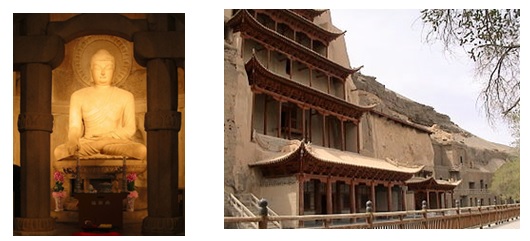
(Photos: Seokguram in Gyeongju and the Mogao Caves of Dunhuang)
Korea's Seokguram—the Seokguram Grotto of Gyeongju (慶州 石窟庵 石窟)—is a stone grotto (石窟) halfway up Tohamsan Mountain (891 Jinhyeon-dong) in Gyeongju, North Gyeongsang Province, Republic of Korea. Kim Daeseong, then 51 years old, began building it in the 10th year of King Gyeongdeok of Silla (751), and it was completed some 20 years later. This grotto, representative of Silla architecture and plastic arts, is small in scale, beyond comparison with the cave temples of China or India, but it is an artistic masterpiece in the square-front, round-back plan of East Asian religious architecture and a perfectly preserved world cultural heritage. Seokguram's original name was "Seokbulsa (石佛寺)," but since the Japanese colonial period it has been called Seokguram. Recognized for its architectural, mathematical, geometric, religious, and artistic value and its unique architectural beauty, Seokguram, together with Bulguksa Temple, was designated a UNESCO World Cultural Heritage site in 1995.
The interior of the grotto is round, and the ceiling is a domed stone chamber covered with earth. It measures about 6.7 meters from side to side and about 6.6 meters from front to back, with an entrance 3.35 meters wide, and in front of it is a square antechamber (前室). The principal Buddha at the center, the seated Shakyamuni Buddha (釋迦如來坐像), is exquisite and full of spirit, a masterpiece among the cave temples of East Asia. In the middle of the wall behind the principal Buddha is a half-relief (半六刻) Eleven-Headed Avalokiteshvara Bodhisattva; on both walls of the antechamber are the Inwang (仁王) guardian kings and the Eight Guardian Deities, a pair of protective gate guardians; on the left and right of the entrance passage (扉道) are the Four Heavenly Kings, Brahma, and Indra; on the grotto walls are the Ten Arhats (十羅漢); there are Buddha images in 8 of the 10 niches above the principal Buddha; and in the upper part of the wall ten Buddha niches (佛龕) were made, enshrining one image of the layman Vimalakirti (維摩居士像) and seven Bodhisattva images. The "Nine-Story Wooden Pagoda of Hwangnyongsa," erected in the 14th year of Queen Seondeok (645) at Hwangnyongsa (皇龍寺) Temple in Seorabeol, the Silla capital, stood 79 m tall, which lets us gauge the scale of Buddhist culture on the Korean Peninsula at the time.
As East Asia's metal tools set off the Neolithic revolution, humankind began to carve rock walls with metal tools. Carving in wood developed rapidly into carving in stone, and because, out of the habit of dwelling in caves, people painted pictures on the walls and set up symbolic sculptures and preserved them, these are important materials as historical records. The development of East Asian metal culture set off stone sculpture, which through Buddhism joined with the wooden sculpture of India's Dravidians. It seems that around the time Indian stone sculpture was flourishing, as at the Ajanta Caves, Greek kings came to western India and China, learned Buddhism and stone sculpture, and took them home, and so Greek stone architecture began. The early architectural style, like that of the Greek Parthenon, called the Doric order, is the style of East Asian wooden architecture. Seeing the well-preserved Chinese furniture carvings, together with the Byzantine murals, at the Meteora monasteries in Greece, where Byzantine culture is well preserved, supports the fact that Greek stone architecture modeled itself on the style of East Asian wooden architecture.
In the architectural style of the East Asian nomadic states, there was the practice of setting up sculptures of sapsal dogs [a shaggy Korean breed believed to ward off evil] in front of palaces, and afterward this was followed as a model in the practice of setting up Alexander the Great's lion sculptures before the gates as guardian deities. It seems East Asian metal tools revived India's sculptural art, and India's sculptural art was transmitted to Greece by the Phoenicians, so that Greek sculptural art developed. In the era of India's Kushan Empire, Buddhist art reached its height, and through the passages developed by Rome, the Buddhist sculptural art of the Kushan state extended as cave sculpture to Africa and the shores of the Red Sea.
India's Kushan Empire, founded by East Asians, became the occasion for connecting the Mediterranean and East Asia, and the height of the culture of humankind's childhood began. Comparing the fact that East Asia had developed metalcraft more than 1,000 years before Europe's Michelangelo carved his stone works, this is one of many examples showing that the metal industrial revolution began in East Asia and was leading human civilization.
8. The Science and Inventions of East Asia That Moved the World