 Yong Wan Bryan Choi한국어
Chapter 8: The Science and Inventions of East Asia That Moved the World
Translated from the Korean original. Read the Korean original
- The Science and Inventions of East Asia That Moved the World
The custom of making round graves of earth to honor the spirits of ancestors began on the Korean Peninsula and led to the building of earth mounds. The pit houses where people lived were floored with grass or animal hides, and the roof was made by laying rafters, binding the ends of the rafters together at the center to form the structure, and then covering it with dry grasses such as branches or reeds, giving it a conical or square-pyramidal shape. That pyramids were later built in a square-pyramidal form developed from the intention of building a stone house for the ancestors, making the ancestors' tomb in the shape of a living person's house.
The development of reservoir and irrigation technology for rice farming produced facilities that dug the ground, raised high embankments to hold large amounts of water, and made channels for that water, regulating the flow as it ran out to water the paddies. Connected with these waterworks, the area of paddy fields was greatly expanded. The building of city walls and bridges, the civil engineering of palaces and temples, and the orderly division and planning of city construction were the highest technology of the day.
With the beginning of farming life, people made reservoirs to gather water. They fired clay vessels to make earthenware, and made knives, sickles, sieves, and grinding stones. They made ox-drawn plows to cultivate fields and paddies. They made wheels and built carts to carry loads. They made spindle whorls to weave cloth, fished from bamboo boats, and made straw boats that would not sink to sail far away. When straw boats were built large, families could keep house aboard and, following the winds and currents, sail the open ocean to island lands. Straw boats, like the thatched-roof houses of the Korean Peninsula, began in farming life and spread throughout the world, and can be found on every continent. In our country, one is displayed at the Jeju museum.
People dug caves into loess walls to make cave houses. They made ondol rooms, where the kitchen fire warms the floor. They made carts pulled by people and then carts pulled by oxen or horses. Over coal fires they made iron knives and tools and began to dress wood and stone. They began to build wooden houses and stone houses and to set up furniture and households, finding for the first time a way of living truly like human beings. By joining iron axles and iron wheels, they made horse-drawn chariots and began using them for hunting and war. They began grid-pattern city planning suited to rolling wheels, built palace-cities, and ringed them with walls and waterways, and so the form of the royal capital first appeared.
From leaves and fruit, or from earth and stone powder, they made dyes and began to paint pictures, and they made written shapes and began writing characters to convey meaning. At first they carved characters on bamboo or animal bones to convey meaning. As they made cloth and paper and recorded with brush and ink, conveying people's thoughts and feelings beyond the limits of time and space, learning developed, and the culture and civilization of humankind began here in East Asia. With barter, market days arose, and as the medium of money advanced to monetary trade, industry developed. It is said that in the 6th year of King Jijeung of Silla (505) ice was for the first time stored for use. An ice house (氷庫) for storing ice was built. At the end of the 5th century a market where all kinds of manufactured and agricultural goods were traded was opened in Gyeongju. The market must have stimulated industry and promoted the circulation of manufactured goods.
Looking up at the heavens, people felt the mystery of the ancestral spirits and of the gods who govern nature, and astronomy developed early as they tried to learn its principles. Understanding and interpreting the balance of yin and yang (I-Ching: Book of Transformations), they drew the taeguk shape as a circle on our country's flag, the Taegukgi. The circle was understood as the realm of the gods and the square as the realm of humans. The round shape of a coin protects one by the power of the gods, and the square hole inside it takes the cord that links person to person; thus in the shape of a coin one can find the East Asian philosophical principle of human beings living within the universe.
Metal culture, which began over coal fires, was from early on the religion, philosophy, and science of East Asian culture, and so it already existed at the time when people counted the Five Elements on five fingers. As the sun glittered on metal surfaces and people came to see their own faces there, the round bronze mirror came to be regarded as a place where the spirit of the gods dwelt. The bronze mirror became a treasure that guarded the house and protected oneself. Yin-yang and the Five Elements—sun, moon, water, fire, wood, metal, and earth—were regarded as the environmental elements that shape time and space and sustain life. The spatial composition and murals of our country's Goguryeo tombs show this vividly.
Charles Higham described how these people farmed rice and described their living area here reaching to the mouth of the Yangtze, and Wilhelm Solheim argued that their agricultural culture had been applied to life since before the thaw (12,000–7,000 years ago). Peter Bellwood, in his book (The Prehistory of the Indo-Malaysian Archipelago, 1985), says that these people beat tree bark to make fiber and wove clothes to wear, made paper, and used bamboo blowpipes, blowing poison darts from inside the bamboo to strike animals, as a hunting weapon.
Gavin Menzies, a former Royal Navy captain, documented in his 2003 book that the navy of the Ming dynasty visited the American continent in 1421 and possessed a world nautical map. Dick Teresi, in Lost Discoveries, published in 2002, while arguing that the roots of modern science began in Babylonia and reached the Maya, explains that East Asia already possessed most technology and science from far earlier.
Our ancestors, who gathered and raised wild horses on the plains of Manchuria so that horses came to pull carts, and who made iron wheels and axles over coal fires to build chariots, began to build wooden boats and sail the seas. Along the coastal road they had left 100,000 years before, they went back to Africa, the homeland of modern humans. That they rode wooden boats and drove chariots to found a nation on the Nile in Africa without hindrance—those were the footsteps of our ancestors. One can see examples of paintings and sculptures of them driving chariots to hunt, and conquering Arabs and Black native peoples and working them as slaves.
Among the kings and nobles who built the pyramids in the Nile basin of Africa, one can see the look of East Asians. Khufu (Gobu), owner of the greatest pyramid, has a small build and the features of an East Asian. The architect Hemiunu, who worked with him, likewise has the look of an East Asian with high cheekbones, and their descendants have the beautiful looks characteristic of mixed-race children, and there are many four-syllable names like those given in East Asia. This is the same phenomenon as the names of the native peoples of the North American continent, and like Yeon Gaesomun and Eulji Mundeok of our country's Goguryeo. Among the furniture used by African nobles, the forms of jade, ivory, and lacquered wood pieces resemble East Asian products.
With the Sanxingdui culture excavated in 1986 in Chengdu, in the southwestern region of China, we have come to understand that the clans of the state of Shu, which lay between the Liaodong Peninsula and the Shang dynasty, migrated to Central Asia around the time of the Zhou conquest, bringing with them a culture and civilization that produced giant bronze masks, bronze human statues, thin gold-leaf objects, and countless jade objects; in this culture we can see commonalities with Egyptian and Greek culture, and later with Persian culture as well.
In Anak Tomb No. 3, splendid paintings show the practical science of the Goguryeo people's daily life. The daily life and dwelling facilities of the Goguryeo people of the mid-4th century—stables, carriage sheds, mill houses, kitchens, wells, and so on—are vividly depicted.
Steel production in East Asia began in 400 BC, and it seems to have become known in Europe around the 14th century, after the Mongol invasions. Among East Asian military weapons, the bow was made by laminating wood and animal bone, and the crossbow—a metal trigger set in a wooden stock with the bow mounted and fixed on it—was used in East Asia for a long time and then, it seems, became known in Rome from the Han dynasty, together with the meaning of the three-legged crow (samjogo) as a symbol of the sun. The nomads of East Asia used leather footholds on their saddles from early on and later used metal ones, but elsewhere in the world these became known only recently; and the horse-drawn chariot, which grew out of the ox-drawn wooden-wheeled cart as bronze wheel axles came to withstand high-speed rotation, seems to have been used for military equipment in East Asia, together with the various iron fittings of the chariot, and then to have become known in Persia and been transmitted to the Mediterranean.
A seismometer made in AD 130 during the Han dynasty is displayed in the Beijing museum together with sundials, water clocks, astronomical instruments, and various metal musical instruments. The seismometer was decorated on the outside of the vessel in four directions with four dragons and four frogs; when an earthquake was detected, a ball dropped from a dragon's mouth, and the pendulum inside the vessel tilted in the direction from which the earthquake came.
In the course of producing metal, East Asians discovered combustible and explosive substances, made gunpowder (black powder) early on, put it in bamboo, and invented the bomb. They put it in light tubes tied to arrows to make rockets, using powerful weapons that flew long distances and set fires as they exploded. Around 1288, during the Goryeo period, soldiers in Manchuria made bronze cannons for the first time and fired cannonballs, and made weapons that exploded at their destination by putting gunpowder inside the cannonball. They made weapons that fired arrows in rapid succession, and in the Ming dynasty there was even a weapon that fired 100 gunpowder-laden arrows at once.
Signals were sent from mountain peaks or watchtowers by raising black smoke, white smoke, and smoke of other colors, and Sun Tzu's The Art of War, which oversees military operations, became the textbook for the military activities of modern great powers. The new inventions and weapons of East Asia were the capability by which the Huns and the Mongols, when they set out to invade the world, conquered it without hindrance in a short time. Most of East Asia's inventions and technologies were transmitted to Europe after the 16th century, along with the compass and maritime technology, printing technology, medical technology, and textile technology, and only then did the modern history of the world begin.
The seven-story iron pagoda, 87 feet high, built in Shandong Province 1,000 years ago, is a symbol of East Asian iron culture, and a bronze bell weighing 46 tons has Buddhist scripture engraved on its surface in 227,000 Chinese characters. East Asian metal culture is well known to the world for the bronze ritual vessels mass-produced in the Shang dynasty (1554–1045 BC), and at the same time there was the state of Shu ( ) between Gojoseon on the Korean Peninsula and the Shang. Around the time the Shang and Shu suffered invasion by the Zhou dynasty (1122–221 BC), it seems the Shu people migrated to the Chengdu area of Sichuan Province, rich in salt and underground resources, in the Chinese interior.
Salt is a necessity of life, a seasoning that lets the human digestive tract digest grain. Heavy and precious, it was regarded like gold. In Sichuan Province, located between the Central Plains and the Kunlun Mountains, people began extracting oil, gas, coal, salt, and so on from underground and making various products—this was the beginning of today's petroleum industry. Salt mines begun more than 2,200 years ago are still in operation. Huge bamboo structures extracted oil, gas, and minerals from thousands of feet underground and manufactured products. Lengths of bamboo were joined to supply gas and oil.
Religious culture and industrial civilization followed the social order, and astronomy and philosophy developed on the foundation of Taoism and Confucian learning. The dualism of yin and yang and Five Elements thought were applied in later ages to science, philosophy, and all the arts. The Sanxingdui culture excavated in 1986—with the unearthing of gold-leaf objects and bronze sculptures, giant bronze gold masks, the tree of life, a style that honors birds, expressions emphasizing the eyes on faces, winged dragons, and countless jade objects—showed the possibility that the culture of the Chengdu area in Central Asia connected from East Asia through Central Asia to India, Mesopotamia, and the Mediterranean coast.
The theories published in the past by European historians that Babylonian culture influenced Chinese culture were made in a state of no knowledge of Chinese history. In Early China 37, published by Cambridge University in 2014, they cite the records of the Chinese historian Sima Qian's Records of the Grand Historian, yet explain that the cultures of China, Babylonia, and Greece were cultures of nearly the same time. Now, as Chinese history is actively studied, we will come to know that Babylonia and Greece were influenced by Chinese culture. Around 4000–3000 BC, as copper and bronze were produced in East Asia over charcoal and coal fires, metal culture began and brought revolutionary change to human history. As tools made of wood or stone and vessels made of fired clay were replaced by metal products, change came to every aspect of life. Soon afterward cast iron was produced, and with bronze and cast iron, cave sculpture began in India in South Asia, and metal culture and sculptural art seem to have been transmitted to Mesopotamia and then to the Mediterranean.
East Asian invention was the driving force of the development of human civilization. Improvements in living, health and disease prevention, the balance of mind and body, mathematics and science, paper, cloth, drums and bells, the ship's rudder, sundials and water clocks, bridge building for crossing water, techniques for finding water, salt, and metal deep underground, the seismometer, the compass and navigation and mapmaking, paper money, printing, making and flying kites, fireworks, making tea, liquor, noodles, and food, ....... East Asia kept on inventing endlessly many things needed in daily life, and so Marco Polo, who visited the Song in 1271, recorded in his Travels that it was an advanced civilization such as could be seen in no country of Europe.
8.1 Bronze and Steel Weapons and Tools
On the Korean Peninsula, villages that began building dolmens appeared among the Stone Age villages that farmed and made earthenware. Northern Korea being rich in coal, people smelted metal out of stone powder, and bronze daggers and ornaments appear among the dolmen artifacts. The Korean-type bronze dagger, which appeared after the lute-shaped bronze dagger, and the coarse-line and fine-line bronze mirrors with two knobs are bronze objects unique to Korea.
As people built wooden houses and launched wooden boats with metal tools, changed the shapes of stones, and turned wooden wheels into iron wheels, human civilization began here. Bronze, an alloy of copper and tin, was the protagonist of metal culture from 3,000 BC. Among the bronzes of the Korean Peninsula, from the earliest ones, zinc–bronze alloys appear along with bronzes of copper, tin, and lead. They developed the technique of mixing zinc with copper, tin, and lead to make bronzes for ornamental or ritual use shine with a golden light.
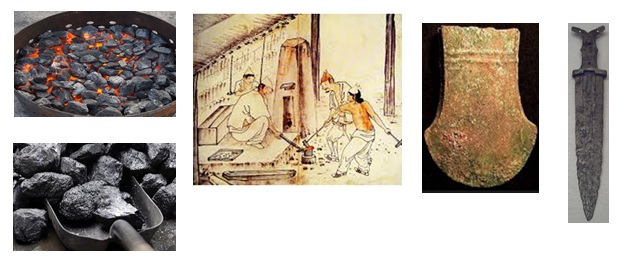
Among the iron objects unearthed from East Asian tombs, the sturdy weapons, armor, horse gear, and production tools are of very high quality. The many weapons used by the generals and soldiers painted in Goguryeo tombs—swords and spears, bows and arrowheads, armor and helmets—and the fittings of iron chariots, and above all the paintings of craftsmen forging iron and of craftsmen making cart wheels, are evidence of iron production and technology and of a creative science producing cutting-edge products.
According to the Nihon Shoki (日本書紀), King Geunchogo of Baekje gave 40 iron ingots (鐵鋌) to a Japanese envoy. The iron ingots of the Gaya state at the southern tip of the Korean Peninsula were exported in large quantities to Japan as raw iron for ironware, becoming the foundation on which Japan's iron culture unfolded. The Chiljido [Seven-Branched Sword], product of Baekje's metal culture developed over thousands of years, is a 75 cm iron sword that well shows the excellence of Baekje metal technology in the early 4th century through its outstanding iron-forging technique, its inscription of 61 characters inlaid in gold, and its unusual design that seems to take the form of a deer's antlers. As its inscription says, the Chiljido was made of iron like steel (鋼鐵). Iron like high-carbon steel (高炭素鋼)—the sharp ironware unearthed on the Korean Peninsula such as iron axes, arrowheads, and swords, together with the Chiljido—represents the wealth and cutting-edge technology of the state at that time.
The revolution of metal culture began in war and agriculture. As people drove off enemies in the struggle for survival and developed land so that life flourished, a change began in which the population grew. They developed the technology to make excellent iron tools. The making of strong, sharp iron tools—from axes and knives to hammers, chisels, planes, and saws—brought innovative change to human life. The metal culture that began in East Asia formed the cutting edge of a scientific civilization that conquered human society and nature.
With coal fires at temperatures of 1130 C to 950 C, people easily produced steel (iron) and made swords and plows for farming, but it rusted easily and was not preserved. In East Asia, the production of steel weapons became common from the time of Qin Shi Huang in 300 BC, but in Europe it was 800 years later, when the East Asian Finnish people migrated to the Scandinavian Peninsula, that steel weapons were produced and the mighty Viking culture of Europe began.
8.2 Astronomy
As East Asian agriculture developed, observing the heavens and understanding climate change was an inevitable process. In the star chart made in East Asia's Goguryeo period, 1,467 stars in 90 constellations are drawn in different sizes according to their brightness. It is said that on the celestial sphere (天球) centered on the North Pole the constellations are marked accurately in their positions, that the celestial equator (赤道圓), the ecliptic (黃道圓), and the north polar circle (北極圓) are marked together with lines of longitude (經度線), and that the Milky Way is drawn as well. Astronomical observers observed rain and snowfall, the strength and direction of wind, clouds, temperature, earthquakes, halos of the sun and moon, fog, frost, rainbows, and so on, and a cosmic story by Dr. Park Seok-jae, a research fellow at the Korea Astronomy and Space Science Institute, was reported in the Chosun Ilbo as follows.
The Korean Amateur Astronomical Society announced that its member Hwangbo Seung confirmed records of the five-planet conjunction (五星結集), in which Mercury, Venus, Mars, Jupiter, and Saturn gather in one place, in the histories of Baedal, Goguryeo, and Goryeo! I had already written, in the 24th installment of "Park Seok-jae's Cosmic Stories" in Premium Chosun on October 1, 2014, about Gojoseon's record of a five-planet conjunction, Oseong Chwiru (五星聚婁). A summary of that column follows.
In the national history textbooks, the period from the founding of Gojoseon in 2333 BC by the Dangun named Wanggeom until the founding of Goguryeo is a "black hole" with almost no content. Yet right in the middle of that historical black hole is a record of astronomical observation. It is the record "Mujin osip-nyeon oseong chwiru (戊辰五十年五星聚婁)" in the Hwandan Gogi (桓檀古記). Here "Mujin osip-nyeon" refers to 1733 BC, the 600th anniversary of the founding of Gojoseon; "chwi" means to gather; and "ru" is one of the 28 lunar mansions of the Eastern constellations. That is, the sentence is interpreted as "In 1733 BC the five planets gathered around Ru."
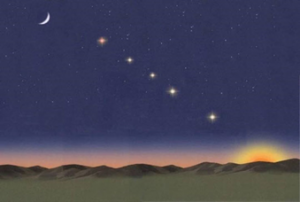
(An imagined view of Oseong Chwiru. From the left: Mars, Mercury, Saturn, Jupiter, Venus.)
When I ran astronomy software, in the western sky on evenings in mid-July of 1734 BC, the five planets lined up, from left to right, in the order Mars, Mercury, Saturn, Jupiter, Venus! In particular, on the evening of July 13, 1734 BC, the five planets lined up "like strung jewels" between the moon and the sun. There is an error of one year, but from the standpoint of estimating an event 4,000 years ago, it is seen as Oseong Chwiru. However, it has already become so widely known as Oseong Chwiru that it seems unlikely to be corrected to Oseong Chwiseong. The important fact is that the five-planet conjunction actually took place and the old record is correct. It is impossible to match an astronomical phenomenon like Oseong Chwiru arbitrarily or to calculate it by hand without a computer. Therefore we can know that in 1734 BC our ancestors possessed the organization and culture to leave records of astronomical phenomena. That is, Gojoseon, possessing an observatory, was an ancient state.
The astronomers who first verified Oseong Chwiru were the late Dr. Ra Dae-il and Dr. Park Chang-beom. The results of their verification were written up as a paper, "On the Astronomical Records of the Dangun Joseon Period," and published in the Journal of the Korean Astronomical Society in 1993. In this paper they announced that during the 550 years from 2000 BC to 1450 BC there was one more five-planet conjunction, in February 1953 BC.
Because this was 219 years before Oseong Chwiru, it planted the prejudice that five-planet conjunctions occur only once every 200 years at least. They said a five-planet conjunction could recur in as little as one year. This is because it is entirely possible if Mercury, Venus, and Mars quickly gather again before Jupiter and Saturn, whose orbital periods are relatively long, draw apart after gathering in the sky.
Astronomical and meteorological observation was carried out in Silla, Goguryeo, and Baekje, with particular attention to anomalies. That observations of eclipses and comets are the most numerous in the surviving records is also similar among the three kingdoms. For solar eclipses, the Samguk Sagi has 19 records from April 54 BC to October 256. Among Goguryeo's observation records are an anomaly on the sun's surface, thought also to be sunspots, in the 9th month of the 23rd year of King Yeongnyu (640)—"The sun had no rays, and only after three days did it grow bright again"—and an entry for the 30th day of the 11th month of the 11th year of King Yangwon (555): "Venus was seen in the daytime." There is a record that, according to the research of Joseph Needham, famous for Science and Civilisation in China, the Hanlin Academy (翰林院), established in 754 in the Tang period, was a thousand years ahead of any academy that existed in Europe.
According to Eden in the East by Stephen Oppenheimer (1998), recent excavation reports by archaeologists trace agricultural remains in Thailand to 15,000 years ago and rice-farming remains to 9,000 years ago, and Vietnam's bronze artifacts go back 6,000 years. The round millstone that grinds grain to strip the husks and make flour—when dry grain is fed between the upper and lower stones and turned, the husked flour is pushed out between the pressing stones, so it is also called a dorikkae—was used 26,000 years ago among the ancient artifacts of the Indonesian islands, and has been used until recently as a necessity in the lives of Southeast Asian nations and the native peoples of North and South America. These farming tools are said to have been used in Egypt and Southwest Asia 12,000 years ago.
8.3 Music and Musical Instruments
Singing and dancing are an instinct of higher animals that have emotions. In people, too, one can see singing and dancing in a baby's growth even before it learns to speak. From primitive times it was essential to humankind's communal life. As East Asian states were established and court music was formalized, music policy appeared. The Han dynasty historian Sima Qian wrote the "Treatise on Music" (樂書) in his Records of the Grand Historian. He said that music is the root that changes customs; right music is found in an environment of right living, and lewd music is seen in a decadent society.
When music attains harmony, even birds and beasts are moved. In animal husbandry, milking is easier when the cows are played music they like. How much more so for human beings, endowed with the Five Constant Virtues (五常: 仁, 義, 禮, 智, 信) and having feelings of liking and hating: an environment in which to enjoy music, engaging sight and hearing, was an important policy. It is said that in the Xia–Shang–Zhou era, beginning in 2070 BC, music was used where people gathered to regulate human emotion. It is said that when good music was played, good people gathered and did good things, and when government was stable and the royal enterprise accomplished, ritual and music (禮樂) arose, restraining pleasure and upholding propriety and virtue. It is said that musicians from each region were summoned and good melodies collected and standardized nationally, bringing about communication and unity among the people. Music always accompanied national festivals, rites, and solemn ceremonies.
It is recorded that King Shun of the Yao–Shun era (the Gojoseon era, before Chinese history) made a five-stringed geomungo [zither] and sang of the wind blowing from the south, and that the former kings made instruments of metal, stone, silk, and bamboo (金石絲竹), composed scores according to the five tones (音) and twelve pitches (律), and performed them. They formed a choir of 70 singers and achieved harmony through the fusion of yin and yang, hard and soft (陰陽剛柔). It is said that wine, song, and dance went together, and poems were recited.
8.4 The Use of Carriages and Horses (車馬) and City Planning
The murals of the Goguryeo tombs show intact a tradition carried on for thousands of years. The city maps seen among the Goguryeo tomb murals—the fortress map of Yodong Fortress, the fortress map in the Yaksu-ri mural tomb, and the fortress map in the Yonggang Great Tomb—show the look of Goguryeo cities in the 4th–5th centuries. The terrain inside and outside the walls, roads, city walls, pavilions, and tile-roofed houses are drawn, and rivers and streams, mountains and roads are shown using pigments of red, blue, purple, white, and so on. They fulfill the six principles of mapmaking set out by Pei Xiu (裵秀), the famous 3rd-century Chinese cartographer.
In farming life the ox-drawn plow was made, and loads were moved with one-wheeled barrows. Two-wheeled carts were pulled by people, then by oxen; iron wheels were made; and the origin of the horse-drawn chariot is seen only in East Asia—so wheel culture began in East Asia, and from wheel culture the grid-pattern city plan was born. Steve (Stephen) Roberts, a professor and historian at the University of Birmingham in England, announced on September 15, 2013, that while there is a record of a Battle of Chariots between Egypt and the Hittites in 1,300 BC, the chariot war of East Asia's Xia dynasty in 2,100 BC is not yet known.
Chang'an (Xi'an) was a grid-planned city of unprecedented scale in history, reaching 9,721 meters east to west and 8,651.7 meters north to south. The circumference of its outer wall reached 37.7 kilometers, and its area was 84.1 square kilometers. Its population reached about one million. Considering that Baghdad, a world city of the time, was 2.3 kilometers in diameter and that Constantinople was 5 kilometers east to west, we can surmise that Chang'an's enormous scale was the scale of an advanced nation.
The Mohenjo-daro ruins are the remains of the city that formed the center of the Indus civilization, which flourished from 3000 BC to 1500 BC. They were excavated from 1921 to 1931 by J. H. Marshall, E. Mackay, and others, and in 1950 R. Wheeler also investigated them. The city was divided like a checkerboard by great thoroughfares with a north–south main axis. It seems grid cities developed on level ground through East Asia's wheel culture, and East Asia's science and civilization were transmitted to South Asia.
8.5 Sundials, Water Clocks, and the Abacus
Recording the hours of the day and the times of the seasons by the position and angle of a needle's shadow while the sun was up in the daytime was known from early on. Records of making water clocks at court to tell the people the hours of the day are said to appear from the Western Zhou period in the 6th century BC. Among the water-clock artifacts now displayed in museums are the Jagyeongnu of Deoksugung Palace, made in 1536 (the 31st year of King Jungjong), and one can also see a water clock in the Forbidden City in Beijing, China. The hours of the day were announced by beating drums or ringing bells.
The abacus was the beginning of the modern world's computer. It was made after the way five fingers on two hands count. Calculating in the decimal system of ten fingers, one can add and subtract limitless numbers, and several different calculations can be done at the same time on the same abacus. According to records, it appears from around the turn of the Common Era.
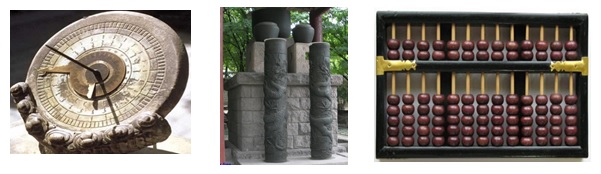
Before the abacus, numbers were expressed by making knots in straw rope, a primitive method of calculation that appears in many places around the world. Using the abacus marks the beginning of calculating by machine, after numbers had been expressed in symbols and characters. As barter began in farming life, the language of numbers and writing were invented and mathematics began. As mathematics began, people recognized the fact of something being there and the fact of nothing being there; since "0" expresses the number of nothing, the recognition of "0" also began in East Asia along with mathematics.
8.6 Liquor, Tea, Vessels, Metal Cups, Celadon and White Porcelain
East Asian earthenware was produced from 12,000 years ago, and comb-pattern pottery on the Korean Peninsula appears from 8,500 years ago. The oldest liquor jars and liquor found so far are 9,000-year-old remains excavated in Henan Province, China, by researchers from the University of Pennsylvania. Liquor and many liquor jars at the site of a 5,000-year-old brewery were found on the Shandong Peninsula. Written records concerning liquor record that 4,000 years ago liquor was made from grains such as rice, corn, and millet, or from fruit, as food used in religious ceremonies.
From the time of grain farming 10,000 years ago, people began drinking the liquor left when grain spoiled. The habit of drinking and getting drunk has persisted since then too. That people made earthenware vessels to store food and liquor, picked food out of the vessels by hand, and then developed the spoon and later chopsticks, can also be seen in East Asian culture. The first vessels were sometimes bamboo tubes; then, as earthenware began to be made, it was used for ritual vessels or wine cups, and as production grew it must have come into use in the daily life of the nobility.
Settled farming life requires storing food for a long time. Neolithic people solved the problem of storing grains and other plant foods well by making "jilgeureut" [earthenware]. Earthenware was used not only for storage but for cooking food. In the appearance of our country's Neolithic earthenware, the outer surface is sometimes only smoothed with no pattern at all, but there are many examples finished by adding geometric patterns combining dots and lines, or by incising and stamping them.
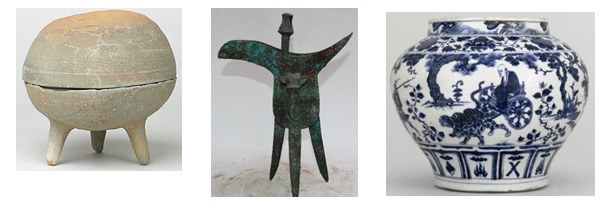
When earthenware was first made, it was made as festival ritual vessels set on wooden stands, and then made in the shape of vessels set on a flat floor with flat bottoms. Around the time three-legged stands appeared, the samjogo (three-legged crow) appeared, and the idea symbolizing religious stability became popular. Bronze wine cups were made and used as ritual vessels. After bronze appeared in Liaodong culture, it appeared in the Yellow River civilization around the Xia dynasty (Xia BC 2,300), and it was from the Spring and Autumn and Warring States periods (BC 470–221) that bronze came into use in the daily life of the general public. The fact that Korea's bronze technology differs from China's appears also in the alloy composition of the bronzes. The main components of Chinese bronze are copper, tin, and lead, but the bronzes made by Koreans, from the earliest ones, include zinc–bronze alloys along with bronzes of copper, tin, and lead.
Just as metal culture began over East Asia's coal fires, porcelain (dojagi) refers to ceramic ware made in a kiln at high temperatures of 1,100–1,400℃. Just as East Asia's earthenware civilization was transmitted to Sumerian civilization, when East Asian porcelain was first transmitted to the Roman Empire, China came to be called "China."
East Asian ceramics have a history of more than 10,000 years. In the Yangshao culture period of the Neolithic, painted pottery fired with color on the surface, red pottery, and white pottery were made, and in the Longshan culture period black pottery flourished. In the Shang dynasty there was glazed gray ware, also called proto-celadon. From the end of the Spring and Autumn period through the Warring States period, hard-bodied stoneware with patterns stamped by something like a seal, and glazed gray ware, were made. In the Warring States period, coarsely made ash-colored earthenware, represented by the terracotta warriors of Qin Shi Huang's tomb, and figurines buried with the dead were made in great quantities.
Among the products of the ceramic technology that developed especially in Silla on the Korean Peninsula, glass beads were made in large quantities, and not a few glass comma-shaped jewels (gogok) have been unearthed from tombs from the 4th century on. These glass beads and comma-shaped jewels were used as necklaces, earrings, or decorations on gold crowns. With their variety of colors and glassy texture, different from jade-type stones such as jadeite, crystal, and amber, glass beads and comma-shaped jewels were the ornaments of the Three Kingdoms period. The glass artisans of the Three Kingdoms period developed glasswork technology independently. The excavation of some 130 glass beads from the Geumgwanchong tomb alone shows that by the late 5th century their manufacturing technology had reached the preparatory stage for making celadon.
Celadon first appeared in northern Zhejiang Province; celadon production flourished from the Three Kingdoms period through the Southern Dynasties; in the Northern Dynasties lead-glazed ware and celadon were produced, and in the Northern Qi in particular we can see the beginning of white porcelain. In the Tang period, the influence of an international culture is seen in patterns and forms. In the Sui and Tang periods, the production of white porcelain began. Celadon production continued at the Yue kilns, and from the late Tang the finest pieces were called bisaek (秘色, "secret color") and became a byword for celadon. In the Northern Song period, the white porcelain of the Ding kilns, characterized by its glaze color and by patterns made with techniques such as carving deep and wide with a flowing blade laid on its side, was popular and influenced kilns everywhere.
In the Southern Song period, official kilns were set up in Hangzhou, the capital, and celadon characterized by thick glaze and dark clay body was made; distinctive ceramics were also produced in various places, such as qingbai (bluish-white) porcelain, well known in Japan too as heirloom pieces. In the Ming period (1391), porcelain for court use was fired at Jingdezhen. Later, in Europe, the Ottoman Empire produced ceramics in the 15th century, and Ming ceramics were transmitted to Europe in great quantities.
**\8.7 The Compass
 **
**
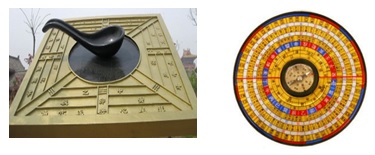
Making a compass by giving steel the directional property of a magnet appeared in the Han dynasty in 200 BC. When a steel magnetic spoon is placed on a bronze plate, it points north and south, and on the bronze plate are engraved divisions of yin and yang, east, west, south, and north, and the 8, 16, 24, 28, and 32 directions.
East Asian navigation opened the way to travel back and forth to Africa and began the making of world maps. Gavin Menzies of Britain announced in his book 1421 that the Ming admiral Zheng He traveled to and from America.
8.8 Bronze Metalwork
Baekje's metal casting and gilding technology is best represented by the making of the 7th-century Baekje Buddhist image, the gilt-bronze pensive Maitreya Bodhisattva (National Treasure No. 78). The giant bronze Buddha of Tōdai-ji (東大寺) in Nara, Japan, was cast by the descendants of Baekje craftsmen using the technology those craftsmen passed on. It was cast in wax molds using about 490 tons of bronze and finished with a gilding method using mercury amalgam—the largest Buddha image, in which the finest metal technology of the 8th century was concentrated.
Ornaments made of gold—the gold crowns of Gaya, together with personal ornaments of gold, silver, and bronze—show the high level of East Asian metal technology. Gaya's metal technology was the world's advanced, cutting-edge technology. Among the many metal products unearthed from Silla tombs, including Buddhist images, the various gold crowns that achieve a harmony of Silla's formal beauty and high technology include ones made of pure gold and ones of gilt bronze. Various bronze vessels have been unearthed from 5th–6th-century tombs and sites.
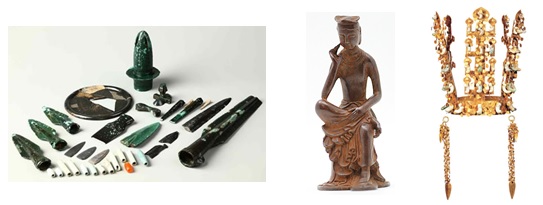
This bronze vessel, which developed into the representative tableware of Koreans in the Joseon period, was made of a bronze alloy of copper and tin only, not the general East Asian bronze alloy whose main components are copper, tin, and lead. The brass (bangjja yugi) bowls and lidded bowls called "not" in the Joseon period were yet another of the cutting-edge metal technologies developed in Gaya and carried on into Silla: the technique of forging metal.
8.9 Paper, Movable Type, and Printing
The picture above is an imagined view of papermaking in the Han dynasty. East Asia's textile civilization was one of hemp and silk clothes: when people began farming life 10,000 years ago, they took off clothes of animal hide and made and wore clothes of hemp cloth. The hemp cloth transmitted to Egypt in 2,200 BC was called papyrus, and this was the transmission of East Asia's techniques for producing hemp clothing and paper. When hemp was boiled, its fibers teased out and wound into thread, and woven into cloth, it made clothes to wear and documents on which to write and preserve texts. Later, when silk came to be made, hemp and silk were exported to the less developed countries of Southwest Asia and Europe, and so the Silk Road opened.
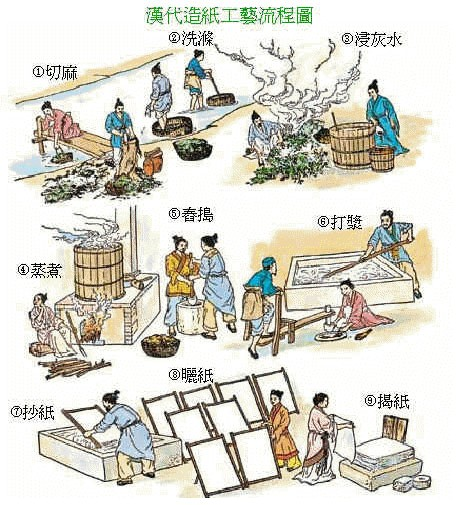
East Asian paper was made in AD 105; in 700 official documents were written on it and made known to the world; and in 868 woodblock printing was done. Wooden movable type was made in 1,041, and metal movable type was made in Korea's Goryeo period in 1,234 and transmitted to Europe in the 14th century. Paper money began in the Song dynasty in 1024 as records of receipts for coins, and in the Yuan dynasty paper money was made and circulated, so it was recorded in Marco Polo's Travels. It became popular in the Muslim nations of Southwest Asia in the 1,200s and circulated in Europe from the 1,400s.
East Asia's printed information, as a connection of thoughts and feelings transcending time and space, contributed to the globalization of modern civilization, including the European Renaissance.
The shapes of hieroglyphs first appear in East Asia's Hongshan culture (4700 to 2900 BC). This is 1,500 years before the writing of the Sumerians (BC 3200–2000) and 500 years ahead of Egyptian hieroglyphs. The photos below, gathered from Google, are symbols seen on Hongshan culture artifacts that are the origins of writing.
8.10 The Stone Bow (石弓, Crossbow), Gunpowder, and the Cannon
In human history the weapons of war were mostly swords, spears, and bows, but in East Asia, besides drawing the bowstring by hand to shoot arrows, there was the stone bow, which loaded a stone on the bowstring and launched it. The composite bow used a bow stave made by gluing together wood, animal sinew, horn, and so on. Being shorter than existing bows, it is said to have been just right for use in confined spaces such as a chariot. Bows compounded of animal bone or metal were small and powerful, accurate and far-reaching, and became Genghis Khan's new weapon.
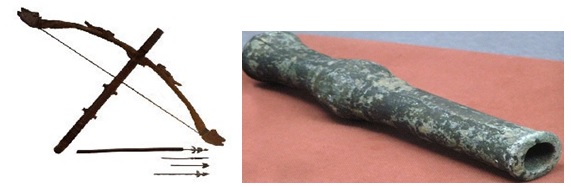
From early on, East Asia's combustible substances were put inside bamboo and exploded as firecrackers in war, their noise provoking the terror of battle. Fireworks were a festival adorning the sky with sparks, and people enjoyed life with them. A weapon that fired an iron ball far with the explosive force of gunpowder packed into an iron tube developed in the Tang dynasty (AD 618–907), was used in the wars of the Song and Yuan, and, as it became known in Europe as Genghis Khan's weapon, led Europe to make modern weapons.
8.11 Thread, Cloth, Silk, the Loom, and the Umbrella (Parasol)
The cloths of the East Asian people were silk, fine silk (myeongju), hemp, leather, and the like. Many people appear in the murals of the Goguryeo tombs, and the clothes they wear vary in color and shape. According to documents, high-grade textiles such as five-colored silk and blue, red, and white woolens were produced in Goguryeo. In Goguryeo dwellings, from the household living spaces and reception rooms to the bedrooms, the spaces for preparing food lie close by. There are carts and the oxen and horses that pull them, and the kitchen facilities are splendid. One can see that cauldrons hung over hearths and steamers were used, that livestock were raised, and that much meat hangs in the meat store, so food was being cooked well.
The first clothing materials, common to all humankind, ran from fur hides to garments made of grass. With the beginning of farming came the invention of thread and, soon after, the devising of the primitive loom. Ramie and hemp are drawn from the stalks or bark of plants. East Asian silk developed from the farming life of the Stone Age, and so it appears from 3,630 BC in excavated ancient sites in Henan Province. When silkworms were raised, thread drawn from the cocoons, cloth made on the loom, and dyed, silk clothing was made. Silk was transmitted along the sea road to the Mediterranean, and then, with Qin Shi Huang's advance into the Western Regions, the Silk Road opened by land, and the Huns raced to Europe in one stretch and brought down the Roman Empire. Roman culture and politics belonged to the East Asian sphere of influence, so much so that it came to be said that Rome fell through the luxury of Roman nobles who loved silk too much.
Umbrellas and parasols combining bamboo and cloth were made in farming life and widely used. The folding umbrella appears from the Zhou dynasty (BC 6th century) as a necessity for royal processions. In the Song dynasty (1270) umbrellas and parasols like today's appeared, and in Southwest Asia they were transmitted to Persia and became widely known.
8**.12 The Wheel, the Rickshaw, the Oxcart, and the Horse Carriage (車馬)**
In light of the historical facts that East Asia's earthenware of 10,000 years ago appears with a history 5,000 years earlier than that of Southwest Asia, and that East Asia's metal culture developed 2,000 years ahead of Southwest Asia's, it is only natural that wheel culture began in East Asia. In farming, people made and turned the yeonja-maetdol [animal-driven millstone] and turned water wheels, and the concept of the wheel began early. The wheelbarrow carrying loads on one wheel, the rickshaw with two wheels pulled by a person, the oxcart with two wheels pulled by an ox, and the carriage and chariot with two wheels pulled by a horse—East Asia is the only region where this evolution of the wheel existed and was all transmitted down to modern civilization.
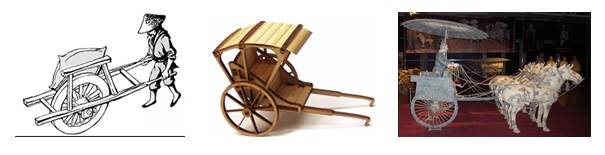
The horse-drawn chariot, grown out of the ox-drawn wooden-wheeled cart, requires the cutting-edge technology of metal culture, as its bronze wheel axles must withstand high-speed rotation. Its invention was possible only in the social environment of East Asia, where nomads who had lived with horses came to know the wheel culture long used in farming life, and where the benefits of metal culture were present.
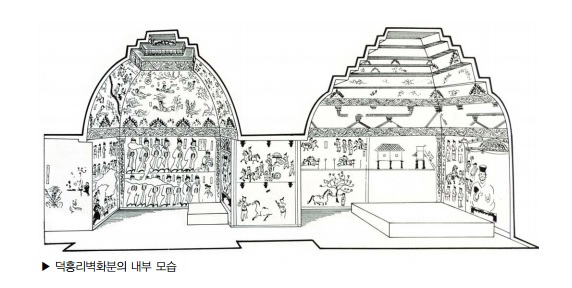
In an essay on the murals of Goguryeo's Anak Tomb No. 3 by Jeon Ho-tae, professor in the Department of History and Culture at the University of Ulsan, the Goguryeo chariot is depicted in two places. We see a scene in the procession painting of the master riding along, and a cart standing in front of the kitchen. The guard carrying a parasol who follows behind in the procession walks alongside, ready for when the master steps down from the cart. The large iron wheels let us understand its use in processions and hunting. In the kitchen's meat store, the bodies of animals brought back from the hunt are hanging, and food being made in iron cauldrons is depicted. In front of the cooking hearth, the forms of domestic animals such as dogs or chickens are faintly visible. Hunting on horseback is depicted, but hunting from a chariot is not seen. We can only imagine it.
Although the Goguryeo murals are records from after the start of the Common Era, they are a cultural history that has preserved intact the long, indigenous traditions of East Asia. Goguryeo culture has well preserved, without foreign alteration, the process of the birth and evolution of human culture over tens of thousands and thousands of years. It shows that the evolutionary process of the cart, the oxcart, the carriage, and the chariot lies in East Asia.
8.13 East Asian Traditional Medicine
I will summarize and explain as follows what has recently been explained by the Association of Korean Medicine in Korea, the Gyeore Sarang Life and Health Society, and specialized websites related to Korean medicine. From the Neolithic period, the medical arts of East Asian traditional medicine have developed in various ways. The theory of yin and yang (陰陽) is the natural philosophy (自然哲學) that is fundamental to East Asian thought. We live within the universe, along with the universe's changes. In such an environment, the activity of the human body too is called a microcosm (小宇宙). Korean medicine (韓醫學), following natural philosophy, was developed through the wisdom of our ancestors. It diagnoses and treats our human body as an organism like the universe, and manages the activity and functioning of the body's organs through the balance of yin and yang.
Everything in the universe is one and yet has two sides. These two sides are classified as yin and yang respectively: heaven and earth, sun and moon, sea and land, day and night, man and woman, body and spirit, life and death, water and fire, light and darkness, and so on. Just as there can be a back only if there is a front, yin and yang are not absolute but always relative concepts, and things develop and change through their opposition and harmony.
A man is yang compared with a woman. But even in the case of a yang man, the upper body is yang and the lower body yin. The front is yin, and the back is yang. The chest is yang within yin (陰中之陽), and the lower abdomen is yin within yin (陰中之陰); each becomes yin or yang by the existence of the other. On the physiological side within the body, matter (理) and energy (氣) mutually restrain and cooperate, and through this the equilibrium of yin and yang is maintained, which is called "the waxing and waning of yin and yang (陰陽消長)."
In East Asia there was medicine to treat and prevent measles in children. Wang Dan (AD 957–1017), having lost a son, developed treatment for the disease of measles and prevented it. There are records that a Taoist monk developed it again in the 16th century and treated children. In Europe it first became known through Dr. Louis Pasteur in the 1,800s. In the learning we brought back from [the West], we did not know our own and learned only what belonged to others. An age is now approaching when we must find what is ours and teach it to others.
Korean Medicine and Yin-Yang
The body is treated, protected against illness, and diagnosed according to the basic philosophy of yin and yang. When yin overflows in the body, the inside of the body, which corresponds to yin, becomes cold; when it is lacking, a slight fever arises in the body. Hectic fever (潮熱) arises because yin is too deficient, so food or medicinal herbs that strengthen the body's yang, or yin, are prescribed to restore the balance of yin and yang in the body. In Western medicine, if the stomach hurts, medicine is administered directly to the stomach and direct treatment is given, but Korean medicine, as Eastern medicine, is an indirect medicine that treats by removing the root cause of the disease through restoring the body's balance.
Baekje medicine on the Korean Peninsula is discussed in various Chinese and Japanese historical records (史書). A 6th-century Chinese history says there were medical institutions in Baekje, and according to the Nihon Shoki (日本書紀), a doctor of medicine (醫博士) of Baekje crossed over to Japan in 554. Baekje physicians crossed over to Japan in the 6th–7th centuries and established the Japanese medical system. Various Chinese and Japanese medical books and documents relate that many Baekje-produced medicines were excellent medicinal materials with good efficacy.
Korean Medicine and the Five Elements
The Five Elements theory (五行理論) in Korean medicine explains the movement of the universe, the changes of time, and the changes of living things according to the seasons through five interlinked mutual relationships. There are generating relationships and overcoming relationships. The Five Elements are wood (木), fire (火), earth (土), metal (金), and water (水), and among these five there are mutually generating (相生) relationships: water nourishes wood, so water generates wood (水生木); wood can kindle fire, so wood generates fire (木生火); when fire dies down it becomes earth, so fire generates earth (火生土); metal comes out of the earth, so earth generates metal (土生金); and water is produced from metal, so metal generates water (金生水). These are called the generating relationships.
On the other hand, what exists in a relationship of mutually restraining and checking one another in opposition is called the overcoming (相克) relationship. Because wood is stronger than earth, wood overcomes earth (木克土); because metal is stronger than wood, metal overcomes wood (金克木); because fire is put out by water, water overcomes fire (水克火); because metal is melted by fire, fire overcomes metal (火克金); and because water is blocked by earth, earth overcomes water (土克水)—so it is understood.
The Five Elements and the Organs of the Body
In the term "five viscera and six bowels," the organs corresponding to the viscera (臟) are the organs that, from the birth of life, keep functioning constantly and automatically, and the organs corresponding to the bowels (腑) are those that are active only when needed. Distinguishing the five viscera by the attributes of the Five Elements: the liver (肝臟) is wood, the spleen (脾臟 and 胃) is earth, the lungs are metal, the kidneys (生殖器官 and 膀胱) are water, and the heart (心臟) is fire. The physiological activities of the five viscera in the body sometimes cooperate with one another and sometimes restrain and check one another, maintaining balance.
The five viscera (五臟) are the liver (肝), heart (心), spleen (脾), lungs (肺), and kidneys (腎), and the six bowels (六腑) are the gallbladder (膽), small intestine (小腸), stomach (胃), large intestine (大腸), and bladder (膀胱). The five sense organs (五官) are the eyes, tongue, mouth, nose, and ears, and the five bodily tissues (五體) are muscle, vessels, flesh, skin and hair, and bone. The five emotions (五志) are anger, joy, worry, sorrow, and fear, and the five climates (五氣) are wind, heat, dampness, dryness, and cold. The five colors (五色) are blue, red, yellow, white, and black, and the five tastes (五味) are sour, bitter, sweet, pungent, and salty. The five voices (五星) are shouting (呼), speaking (言), singing (歌), weeping (哭), and groaning (呻吟), and the five secretions are breath, tears, sweat, saliva, and nasal mucus.
The Five Elements and the Attributes of Things
The liver, which belongs to wood (木) as shown above, is in the same column as the gallbladder, the eyes, the muscles, anger, wind, the color blue, the sour taste, exhaled breath, and tears, and so these are held to share the same attributes.
Bile, the digestive fluid secreted by the liver, is stored in the gallbladder, and if the liver is not well, the eyes, which have the attribute of wood, may turn red or yellow, or eyesight may decline. Symptoms such as trembling of the muscles may also appear. Also, when liver function worsens, one becomes quick to anger, and even when the liver is in good condition, getting angry too often raises blood sugar and worsens liver function. Vegetables, fruits, and grains (by the color of their skins) with the blue-green color that shares the same attribute tonify (補) the liver, and among the tastes, the sour taste can tonify the liver.
That a pregnant woman in early pregnancy wants to eat sour things like apricots is a natural phenomenon: because the fetus's growth has weakened her liver function, she instinctively wants to eat sour foods to boost her liver function. But eating too many sour things, since wood overcomes earth, lowers the function of the spleen (脾臟), which corresponds to earth. Also, when liver function is poor, the complexion may turn dark or sallow, and tears increase.
Yin-Yang, the Five Elements, and Natural Health
Natural living therapy is likewise, like Korean medicine, a philosophy of yin-yang and the Five Elements. For our bodies to be healthy, maintaining balance in the activity and function of all the organs in the body is how one maintains one's health. Natural living therapy, based on natural foods, appropriate exercise, and a peaceful state of mind, emphasizes a life of balanced eating and, through exercise therapy and special therapies, keeps the organs functioning without abnormality. To keep maintaining these basic conditions at all times, one must strive in ordinary life so that there is neither excess nor deficiency in the causal relationship between internal predispositions (內的素因) and external factors (外的要因)—thus I have summarized Korean medicine and yin-yang and the Five Elements.
Acupuncture
Among the medical arts of East Asia, the part most applied in modern medicine is acupuncture. According to Wikipedia, acupuncture (鍼術) is defined as the technique of stimulating certain parts of the human body with thin, sensitive needles or similar instruments to regulate the body's qi and blood and treat disease. It is a medical art used in East Asia since the Neolithic period, and the etymology of the character chim (鍼) in acupuncture is said to have developed from the pyeomseok (砭石) to the jamseok (箴石), and from the jamseok to the chim (鍼).
In the Tang dynasty, Wang Bing supplemented the Huangdi Suwen Jing, several volumes of which had been lost, with the Huangdi Zhenjing (or Zhenjing) presented by Goryeo, bound it together with the Huangdi Zhenjing, and named it the Huangdi Neijing, which has been handed down to the present. Originally the Huangdi Suwen Jing and the Zhenjing were separate books. For the needle processed as fine as a hair, the character combines 咸 ("all") with 金 ("metal"), a form in which the iron needle was finally perfected thanks to the development of Iron Age culture. That is, it developed from the pyeomseok (砭石), a stone chip of the Neolithic, to the jamseok (箴石) of the Bronze Age, and then to the chim (鍼) of the Iron Age. Therefore, as is known through artifacts and documentary evidence, acupuncture began in the Neolithic period; it is an ancient medical art that began together with East Asian civilization.
Korea is the region where 50% of the world's dolmens are concentrated, and documents and artifacts prove that it is the birthplace of acupuncture, together with the stone needles and bone needles excavated among the Neolithic artifacts unearthed in 1923 in Songpyeong-ri, Unggi-myeon, Gyeongheung-gun, North Hamgyong Province, which have been designated treasures. Also, on June 18, 2008, the World Health Organization adopted the Republic of Korea's acupoint system as the international standard for acupuncture point locations. Artifacts and documents prove the long tradition and history of acupuncture in the Republic of Korea.
Because acupuncture is concerned with qi (氣), which corresponds to living energy, it is also called "qi (氣)" medicine. It is said that since qi (氣) circulates through the "meridians (經絡)" to every part of the body along with the blood and body fluids (津液), if this qi (氣) circulates well, the body is in a healthy state, and if the circulation loses its balance through stress, emotions (感情), poor eating habits, changes of climate, and various other environmental factors, the body falls ill.
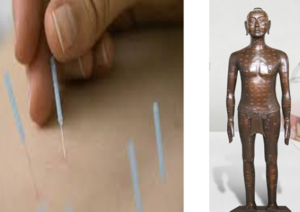
Acupuncture treatment basically places fine needles at specific places on the body, the "hyeol (穴)" [acupoints], with the aim of restoring the balance of the patient's circulation of qi and blood (氣血). The "hyeol (穴)" points used in acupuncture regain a state of "balance of qi (氣)" through the best circulation of qi (氣). The needles used in treatment were of gold, silver, or bronze metal containing no chemical substances at all. Acupuncture treatment itself is not painful, and because it usually has a calming (鎭靜) effect that relieves tension and brings ease, the treatment takes effect immediately. Acupressure and moxibustion are medical arts that have been used throughout the long history of East Asia.
9. Genghis Khan Brought Modern Humankind into Its Adolescence