 Yong Wan Bryan Choi한국어
Chapter 4: Egyptian Culture Came from East Asia
Translated from the Korean original. Read the Korean original
- Egyptian Culture Came from East Asia.
Egyptian civilization appeared in human civilization like a miracle, and scholars still speak of it only as a mystery. Looking at the characteristics of that culture, there are the pyramids above ground, the tombs of the pharaohs who ruled Egypt, and there are also tombs of nobles like Tutankhamun built underground. They have much in common with the Goguryeo culture shown in the pyramids around Jilin Province, once Goguryeo territory, and in the tumuli of the Korean Peninsula. The pyramids of East Asia show the process by which the earth mound (Mound), the place of sacrifice, and the dolmen (Dolmen), the stone tomb of the ancestors, grew together over thousands of years, until stone-mound tombs appeared and evolved into the square-pyramidal stone tomb (Pyramid).
If we look at the underground tomb of Tutankhamun, it has the same style as Goguryeo tombs, divided into a front chamber and a rear chamber. It is the same as the form of Goguryeo tombs, in which the front chamber keeps scenes of life during one's lifetime and the rear chamber preserves the state after death. The murals of Anak Tomb No. 3, in Anak County, South Hwanghae Province, North Korea, excavated and surveyed in 1949, depict the customs of Goguryeo life well. It was built in AD 357, in the time of King Gogukwon, but it shows a way of life handed down from thousands of years earlier. In the murals of the front chamber we see a procession scene of the master riding in a cart, and a cart standing in a kitchen where animals brought back from the hunt are hung. We see a commonality: in Goguryeo and in Egypt, nobles rode about in carts drawn by horses.
In East Asia, while farming, people made and turned the great millstone and turned the water wheel, and the concept of the wheel began early. We can see the evolutionary process from the single wooden-wheeled wheelbarrow to the two-wheeled handcart, the rickshaw, the oxcart, the carriage, and on to the chariots of Qin Shi Huang. Because the development of the East Asian cart has been preserved into modern life, it can still be seen today. From the metal weapons and ornaments that appeared in Neolithic dolmens to the jade relics carved with metal tools, iron wheels were produced as a result of the steel production smelted over coal fires in North Korea and Manchuria.
Raising wild horses at home also began in the Manchurian region. The many horse farms on the Manchurian plains are said to have the breed that appeared earliest among horse breeds. We can see the long ages in which the mule was born between the horse and the donkey. The mule cannot bear young, but it is a horse born in East Asia that is stronger and more patient than the horse or the donkey. The horses that Tutankhamun rode seem to have come from East Asia.
Tutankhamun's front chambers are two, and in them are painted pictures of the pharaoh riding a chariot and subduing Black Africans and Arabs. The rear chambers are also divided into two: the burial chamber and the shrine. The custom of covering the body with a mask in the burial chamber is also seen in Shang dynasty tombs in East Asia. The cow and dog guarding the reliquary in the shrine are also East Asian domestic animals. The cow accompanied East Asia's long farming life, and the dog is an animal that lived together with people in the nomadic life of Manchuria. Just as in Korea little children without a name were called "Gaettong-a" or "Sottong-a," this is East Asian culture formed through tens of thousands of years of evolution in which farming and nomadism joined together. Such an evolutionary process cannot be seen in the environment of Africa.
Because bronze relics were first excavated in Neolithic dolmens, these are also remains showing that metal culture appeared first in East Asia. The steel dagger and the iron wheels and axles of the chariot (Chariot) in the front chamber of Tutankhamun's tomb are also products of East Asian metal culture. As iron and bronze were made over coal fires in the dolmen age, the life of the Metal Age began in East Asia. The chariot warfare of East Asia's Xia dynasty, 2,100 BC, was the heyday of chariot culture, when thousands of chariots gathered to wage war. The nobles of the states defeated then fled far, far away. I wonder whether the model of an ocean-going wooden boat kept along with Tutankhamun's remains might be the sailboat on which the pharaoh came from East Asia.
Genetic genealogists say modern humans reached the East Asian region from Africa 50,000 years ago, so a coastal passage was already open between Africa and East Asia and there was cultural exchange. Because East Asia is where humans first met winter, began farming, and increased in population, it is still the region of highest population density. We can see the historical facts that East Asian pottery from 10,000 years ago appears 5,000 years earlier than that of Southwest Asia, and that East Asian metal culture developed 2,000 years ahead of Southwest Asia.
The Egyptian remains are buildings from before Christ and the Goguryeo tombs are buildings from after Christ, but Egyptian culture appeared briefly as a mutation and then vanished. Goguryeo culture, however, was formed through tens of thousands of years of evolution: dolmens, begun from before Egypt by hauling rocks from afar, grew into pyramids, and there were carts, oxcarts, carriages, chariots, and so on. It continues into the history of driving back the great army of the Sui dynasty, and into the history of East Asia's Huns and Mongols invading Europe.
East Asia's Hongshan culture began building stone-mound tombs 2,000 years before Egypt. The name Tutankhamun too is a four-syllable Goguryeo name, like Eulji Mundeok or Yeon Gaesomun. The front chamber is full of East Asian furniture like mother-of-pearl lacquerware. If you look closely at the chariot Tutankhamun loved to ride, its whole body is wrapped and decorated with the "coiled-thread pattern" commonly seen on East Asian bronzes.
Howard Carter, who excavated Tutankhamun's tomb, saw a picture of a chicken on a broken piece of pottery and told the world that the pharaoh's food included chicken, which did not exist in Africa. [Compare] the picture of a chicken painted on the ceiling of the Goguryeo Muyongchong (Tomb of the Dancers). Egyptian culture, as the Greek philosopher Plato said, is a foreign culture that came from Atlantis (the mother of all cultures). Historians are still searching for where Atlantis is, but if they learn and understand East Asian history, they will come to understand that Atlantis was East Asia.
4.1 The Liaodong Civilization and the Hongshan Culture
The Hongshan culture is a Neolithic culture first discovered northeast of China's Great Wall in 1908 by the Japanese anthropologist Torii Ryūzō. It dates from about 4700 BC to 2900 BC, and there are sites excavated at some 500 places so far, including Chifeng (赤峰, then Rehe Province at the time of discovery), Lingyuan (凌源), Jianping (建平), and Chaoyang (朝陽). As the human genetic map shows, it is the place where modern humans first took on winter and a seafaring people settled into inland life. It seems to be the cutting edge of modern human civilization and culture, which appeared as people passed through the Neolithic farming life from 10,000 years ago and entered metal culture from 8,000 years ago.
At present the Chinese government has finished building new museums at Aohan Banner (敖漢旗) and Linxi (林西) near Chifeng and moved into them in the second half of 2010, and the Hexigten Banner (克什克騰旗) History Museum and the Liao Shangjing (遼上京) Museum in Bairin Left Banner (巴林左旗) had already been newly built and opened before that. They exhibit, with a focus, the Liao River civilization, chiefly the Hongshan culture discovered centered on the Liao River.
It is the place where, from 50,000 years ago, people lived by hunting and began living together with wild animals such as cattle, horses, dogs, pigs, sheep, and chickens. It is the place where people built earth mounds, raised dolmens, made metal weapons and tools over coal fires, and began a revolutionary improvement of life, and it is right here that they began building stone-mound tombs (Pyramids). It is the place where people began making carts using metal wheels and axles, and where transport drawn by people, cattle, and horses began. It seems that, through the long habit of worshipping celestial and ancestral religions, building shrines, and designing site plans (가람, Site Plan), grid-pattern villages suited to life on wheels began to develop here.
The ornaments excavated from Hongshan tombs — jade carvings of pigs, tigers, and birds, as well as carved animal forms including dragons — are marked by a high level of craftsmanship. The form of the Hongshan jade dragon (a bead carved as a dragon) is simple, and the dragon is circular; in the later period distinctions appear between the coiled dragon (盤龍) and the patterned dragon (紋龍). I regard it as the source of dragon worship. Here begins the Metal Age, in which, for the first time in human culture, people left behind the habit of using stone tools and carved stone with metal tools. From the dolmen building that piled natural stones, people began to dress rocks with metal tools and build stepped stone-mound tombs. It is the source of the culture of the Korean people (韓民族), or the Dongyi — Gojoseon, Goguryeo, Baekje, Silla, and so on — in which stone-mound tombs have been found in large numbers since the Hongshan culture, and it is the starting point of modern human culture and civilization, which began before Chinese civilization.
At the "Niuheliang site" (牛河梁遺跡, Niuheliang), discovered in Lingyuan City, Liaoning Province, in 1983, a huge ritual complex different from the known Hongshan culture was found. A temple with stone floors and painted walls was discovered and came to be called the "Goddess Temple," representing matriarchal society. It is thought that 5,500 years ago there was already a prehistoric chiefdom kingdom that had all the conditions for becoming a state.
In 1982, dozens of jade objects, including jade earrings, were excavated at Xinglongwa village in Chifeng City and identified as relics from around 6,200 BC; they were introduced as the Xinglongwa culture, and they are said to be the same as those excavated from the shell mound at Munam-ri, Goseong County, Gangwon Province, in Korea. It is said the jade is of the quality buried in the Xiuyan area along the Yalu River. The Chahai culture, Fuhe culture, and Zhaobaogou culture excavated around the Liao River are gathered into the world-famous Hongshan culture (BC 4500–BC 3000), which represents the Liao River civilization.
The features of the Hongshan culture include a refined pottery culture; carving with metal tools jade brought from distant Baekdusan Mountain; breaking large rocks with metal tools into the needed sizes and shapes, hauling them far, and building stepped stone-mound pyramids; and making small, delicate stone coffins in which to lay the dead. Hongshan jade carving was 1,000 years ahead of the Yellow River civilization, and its stepped stone pyramids were 2,000 years ahead of Egypt. It leads to the reasonable imagining that the dolmen (Dolmen) culture of the Neolithic Korean Peninsula combined with the earthen-mound (Mounnd) culture to begin building stepped pyramids in Manchuria, and passed pyramid building on to Central America and as far as the Nile basin to the southwest [of Asia].
Jade objects of the Xinglongwa culture are also being excavated in many places on the Korean Peninsula. Professor Deng Cong of the Chinese University of Hong Kong, a jade expert of recognized world authority, is reported to have said: "The jade jue [slit earring], which began in the Xinglongwa culture of the Liaoxi region around 6000 BC, spread to the Yangtze basin around 5000–4000 BC and reached the Pearl River basin near Guangzhou, Guangdong Province, around 2500 BC. The jade jue spread farther south to northern Vietnam around 2000 BC and, with a time lag, spread across Yunnan Province and southern Vietnam around 1000 BC."
With the recent development of Japanese, Korean, and Chinese archaeology, according to relics excavated in the 1970s and 1980s, the oldest relics of East Asian culture so far are being excavated around the Liao River, located at the northern end of the west coast [of the Yellow Sea]. In 1987, at Xiaohexi village northwest of Chifeng on the upper Liao River, clay faces and many relics were introduced as the Xiaohexi culture, BC 7000–BC 6500, a culture 3,000 years ahead of the Southwest Asian culture (BC 4000) excavated so far. It is 2,000 years ahead of the Yellow River civilization (黃河文明).
The Yellow River civilization (黃河文明), too, is a civilization raised by the Korean people (韓民族), before the Han Chinese, in the Central Plains (中原) and the Yellow River (黃河江) basin, where they highly developed calendrics (曆法), astronomy and geography, medicine, law, and the life of food, clothing, and shelter. The Neolithic pottery culture of East Asia was carried along the coastline to the Americas and the Mediterranean, and when Greece reached the height of its pottery culture, East Asia was already at the height of its metal culture. In the Spring and Autumn and Warring States period (*c.*550 BCE), coins engraved with writing were in circulation.
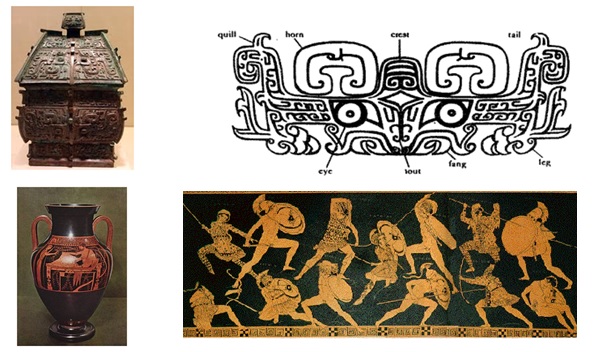
(Photos of Greek pottery and Shang dynasty bronzes)
The People's Republic of China has defined the Liao River civilization, earlier than the Yellow River civilization (黃河文明), as the root of Chinese civilization, and has defined the long history of East Asia, rooted in the history of the Dongyi, as follows. (Wikipedia has organized the record from 10,000 years ago to the present as follows, combining the Neolithic/Bronze Age cultures of the Liaoning region and the excavations of major sites.)
8000 BC – 7000 BC, Neolithic (新石器時代): Xinle culture site (a settled village of matrilineal clans), 新樂 文化 (Xinle), northern Shenyang City, Liaoning Province.
7000 BC – 6500 BC, Neolithic: Xiaohexi culture site, 小河西 文化, Aohan Banner, Chifeng City, Inner Mongolia.
6200 BC – 5200 BC, Neolithic: Xinglongwa culture site, 興隆洼 文化 (Xinglongwa), Aohan Banner, Chifeng City, Inner Mongolia.
6000 BC – 5200 BC, Neolithic: Chahai culture site, 査海 文化, Chahai basin on the Inner Mongolia border.
5200 BC – 5000 BC, Neolithic: Fuhe culture site, 富河 文化, Fuhe basin, Aohan Banner, Chifeng City, Inner Mongolia.
5000 BC – 4400 BC, Neolithic: Zhaobaogou culture site, 趙宝溝文化 (Zhaobaogou), Luan River valley in Inner Mongolia and northern Hebei Province.
4500 BC – 3000 BC, Neolithic: Hongshan culture site, 紅山文化 (Hongshan), Inner Mongolia, Liaodong, and the Hebei region.
3000 BC – 2000 BC, Chalcolithic (銅石倂用時代): Xiaoheyan culture site, 小河沿 文化, Xiaoheyan basin, Aohan Banner, Chifeng City, Inner Mongolia.
2000 BC – 1500 BC, Early Bronze Age: Lower Xiajiadian culture site, 夏家店 下層 文化, Mengke River (孟克河) basin, Aohan Banner, Chifeng City, Inner Mongolia.
The Qing dynasty too — the longest-lasting dynasty and the last empire in Chinese history — was a Manchu state founded by Nurhaci, who grew up at Baekdusan Mountain on the Korean Peninsula. China calls it Changbaishan as a sacred place; it borders the Korean Peninsula, and the south side is Baekdusan and the north side is Changbaishan. Chinese archaeology already acknowledges the fact that the culture of a people who used the language of the Korean Peninsula developed thousands of years before the Yellow River civilization.
4.2 The Metal Culture of the Shang Dynasty
The metal culture that began in the Neolithic dolmen culture of the Korean Peninsula continues into the culture of the Liaodong region, where metal production became abundant over the plentiful coal fires of North Korea and Manchuria. As the distribution of dolmens shows, the East Asian clan societies that lived around the Korean Peninsula and the Yellow Sea and at the mouths of China's Yellow River and Yangtze were spread throughout China's coastal regions, becoming the seed and root of Chinese culture, so that Chinese culture began and the golden age of East Asian culture, which awakened the world, was achieved. Metal culture brought explosive change to human life, and the industrial revolution of human civilization took place in the Shang dynasty era.
The metal technology of East Asia's coal-producing regions inherited the cutting-edge skills of Bronze Age and Iron Age metalworkers and developed to a high level from early on. The bronze and iron objects, the exquisite gold ornaments, and the splendid gilt horse trappings unearthed at many sites on the Korean Peninsula show this. The technique of making gold objects was especially excellent and is assessed as having surpassed the level of any other people in the world. The famous 6th-century Chinese natural-history book Bencao Jing Jizhu (《本草經集註》) records that Goguryeo gold was so well refined that it could be taken as medicine. This confirms the excellence of Goguryeo's gold-refining technology.
From an agriculture that mainly used hoes and mattocks, people made iron farming tools on the basis of metal technology and used ox-drawn plows to till paddies and fields, achieving an epoch-making turn in agricultural development. As these new, improved iron farming tools were developed and supplied in large quantities, East Asia's agricultural output greatly increased, bringing a population explosion as a result. People expanded from the densely populated east coast into the western interior.
Iron production was a very important national industry in East Asia. The Korean Peninsula and the Manchurian region had many sources of abundant iron ore. Iron technology developed there earliest in the world. Goguryeo tomb murals explain East Asian science and technology accurately, picturing the history of science and technology. The figures of a craftsman forging iron and a craftsman making cartwheels show the cutting-edge technology of East Asia. The production of iron and the manufacture of good-quality iron goods were national enterprises, as seen in East Asian weapons, armor, horse trappings, and tools of production.
Iron weapons and horse trappings in particular were the origin of the invasions of the world that began from East Asia. People dressed wood to make furniture, cut stone to build stone houses, and made horse-drawn metal carts (chariots), bringing a prosperity of hunting and victory in war. Household life became convenient, the nation's armies grew strong, and East Asia's influence in the world expanded. East Asian culture was carried to North and Central America, and along the coastal road already opened 50,000 years ago, waves of civilization were carried to India and the Nile basin in Africa.
The Shang dynasty, founded in Liaoning on the Liaodong Peninsula, the home of metal culture, conquered the Xia dynasty (夏, Xia Dyhasty, c. 2070 BC – c. 1600 BC) in the Yangtze and Yellow River basins, and when it migrated south and reached Anyang, it left its name as the Yin dynasty. Its history of some 400 years, from about 1,600 BC to about 1,046 BC, has been handed down through the records of the Shiji (史記, Records of the Grand Historian) of Sima Qian of the Han (漢代) era and through the oracle-bone script of the Shang ruins.
The Yinxu site, where oracle bones were discovered in Anyang, Henan Province, in 1899, and which was excavated and surveyed in fifteen campaigns from 1928 to 1937, was confirmed to be the palace and residential area of the Shang (Yin) dynasty and the Yin capital. There are palace foundations built on raised earthen platforms (土壇) and remains of pit-style (竪穴式) dwellings. The large tombs are square or 亞-shaped, and the grave goods surrounding the central coffin that were excavated include bronze vessels, weapons, musical instruments, and jade ornaments.
In 1976, the intact tomb of Fu Hao (婦好) was excavated in the palace and ancestral-temple area, and many bronze relics of the highest level were unearthed. Fu Hao is the first woman general mentioned in East Asian history, and her sons succeeded to the Yin throne after the death of Wu Ding. This tomb's date of construction is certain and the name of the person buried is also clear, so it conveyed the history and culture of Yin. The recovered relics numbered 1,928: 468 bronzes, 755 jades, and 564 bone objects were excavated. Sixteen human skeletons and six dogs showed that Shang culture had a system of human sacrifice at burials.
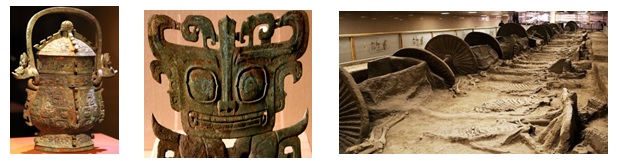
The photos above are taken from Google's collection related to the Shang dynasty. The advanced production technology of metal ritual vessels, faces that emphasize the eyes, and the chariots (chariot) buried with the dead show the level of East Asian culture and civilization. The Shang dynasty's system of burial sacrifice carries on into the cultures of the Maya, the Inca, Peru, and others in the Americas.
4.3 The Development of the Rickshaw and the Chariot
Carts were used as a means of transport for the farming life that developed early and for the wide lands of the Liaodong region. Ox-carts and horse-carts were made. Making carts that were sturdy, light, and able to carry ample loads, and improving cart harnessing suitable for strong livestock to pull, were an important field of technology. As farming began, the great ox-driven millstone and mill, powered by the wheel, appeared. Among the sites on the Korean Peninsula there are the mill picture of Anak Tomb No. 3 from the mid-4th century and pictures of carts painted in tombs from around the 5th century. The wheel spread as the source of power for mills and millstones.
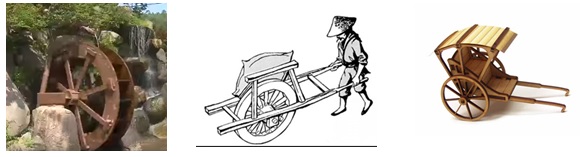
The form of the Goguryeo cart can be seen in the ox-drawn cart painted in the murals of Muyongchong and the cartwheel painted in the murals of Ohoebun Tomb No. 5. These beautiful paintings depict the Goguryeo cart of around the 5th century splendidly and realistically, vividly showing us the carts and yokes of that period. And they show that the so-called iron wheel, with an iron plate fitted over the rim, had appeared.
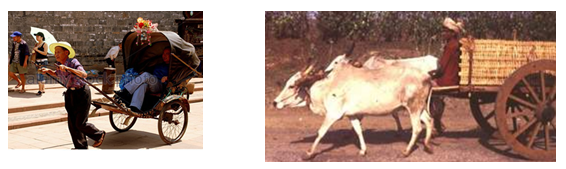
In East Asia's farming life, the wisdom of making and using the plow and making carts to carry loads began early. Starting from the one-wheeled cart made of wood, people came to make two-wheeled carts. From making round wooden wheels with metal tools, as metal axles and metal wheels came to be made, the rickshaw, carrying people, developed. The East Asian rickshaw shows thousands of years of the history of the wheel.
Carts pulled by people began to be pulled by oxen, and then by horses. From tens of thousands of years ago in East Asia, people raised cattle, dogs, and horses at home: the ox plowed the fields and carried loads, the dog guarded the house, and the horse was ridden on long journeys. This began earlier than among other peoples of the world and became the driving force that put their culture and civilization ahead. Among horses, Przewalski's horse (Prezwalski's Horses) is known to be the horse that first survived alongside nomads, in the Manchurian region, earliest in the world.
The horse-riding peoples of East Asia rode horses and roamed the world from early on. That horse was the mule. It is a working horse that East Asians discovered. The mule, born between the horse and the donkey, is known as one of the strongest of the world's animals. It is born between a well-built mother horse and a father donkey whom none can beat for tenacity. Resembling only the good points of its parents, it is strong and very patient. In appearance it resembles its father, with a short neck. The mule lives much longer than its parents, sometimes 50 years, but never sees offspring born and grow. The mule doesn't mind somewhat cold or hot weather, and it crosses steep mountains and makes long, long marches without falling ill. But in thousands of years of living, no mule has ever given birth.
As the two-wheeled ox-drawn cart developed into the four-wheeled cart, agriculture industrialized, and as metal came to be used for the wheel's axle, the two-wheeled horse-drawn cart (chariot) that began in Manchuria appeared. The oldest chariot known so far is estimated to have been made around 2000 BC by the Andronovo culture discovered in the Krasnoyarsk region of Russia. It is said this chariot was drawn by two horses, along with bronze weapons.
As the horse cart, faster than the ox, appeared, the chariot with its tremendous power appeared as a weapon. On September 15, 2013, the British historian Stephen Roberts (스티브 로버트), a professor at the University of Birmingham, announced that while there are records of a battle of chariots (Battle of Chariots) between Egypt and the Hittites (히티티) in 1,300 BC, the chariot warfare of East Asia's Xia dynasty in 2,100 BC is still not known. Even looking at the evolution of the Chinese characters we use for horse (馬) and cart (車), we can imagine that wheeled carts existed before there was writing.

There are countless remains of horse-riding peoples on the Korean Peninsula and the Japanese archipelago. The royal family of the Egyptian empire, who rode horses and drove chariots to subdue the Black Africans and the Arabs of the Mediterranean coast, seem to have been East Asian people. The Huns rode horses to the Mediterranean and subdued Rome. The cavalry that Genghis Khan drove to conquer Europe rode mules. And later, it is said, what Napoleon rode over the Alps was not a white horse but in fact a mule, a descendant of the Mongol army's.
In The Art of War by Sunzi, recorded in 700 BC, the light chariot, the chiju (馳車), is an attack cart drawn by four horses and is said to be a match for 100,000 soldiers. One chiju was a combat unit made up of one officer, 10 cavalrymen, and 5 combat personnel, and together with 2 cooks, 1 equipment keeper, and 2 stable keepers and grooms, four horses and 21 soldiers formed a chiju platoon. The heavy chariot, the hyeokgeo (革車), is a cart that transports provisions and weapons, and is called hyeokgeo [leather cart] because it was covered with leather. It is recorded as a two-wheeled cart pulled by one ox, forming a hyeokgeo platoon made up of one officer, 10 infantrymen, and 3 non-combat personnel. In The Art of War, the chiju (馳車) and hyeokgeo (革車) of each state of the Spring and Autumn and Warring States period to which Sunzi refers all mean chariots drawn by four horses. In his lectures on The Art of War, Professor Li Ling of Peking University explains that a state had to possess a thousand of each to enter the ranks of feudal states contending for hegemony.
The chariot was the most advanced weapon, the first to appear in large-scale human battles and wars. Also, around 1500 BC, the fall of the Indus civilization, the fall of China's Shang dynasty and the founding of the Zhou dynasty, and the historic Battle of Kadesh between Egypt and the Hittites are all related to the chariot. The Indus civilization (BC 2500–1500) fell to the invasion of the Aryans. The Aryans, nomadic peoples who lived in the Manchurian and Central Asian regions, possessed chariots and early iron weapons.
What King Wu of the Zhou (周) dynasty used when he punished the Shang dynasty was also superior chariots. The Jinxin (盡心) chapter, part two, of the Mencius (<맹자>) states that King Wu conquered the Shang dynasty leading 300 hyeokgeo and 3,000 brave soldiers. A civilization of the Yellow River region, famous for Yinxu, was conquered by a rising state armed with new chariots of improved performance. In this battle, in which the Egyptian pharaoh Ramesses II faced the Hittite king Muwatalli II, the use of chariots decided the course of the fighting. It is recorded in cuneiform that the two countries, each declaring victory, finally concluded in 1270 BC the first peace treaty that remains in the records.
Humans soon discovered and tamed the horse, a faster domestic animal. The horse's ability of great speed was the main purpose driving its domestication. With the appearance of the horse cart, humanity's invention of the chariot brought a revolution in weapons of war. It became possible only with the invention of wheels and axles that turned at high speed for military use. The Book of Songs (<시경(詩經)>) records that birch (박달나무) was used as the material of the first chariots. That is, a hard wood such as birch was heated over fire, bent, and joined to make round wheels. It explains that bows and spears were improved so as to deal heavy blows to targets even from atop a chariot, which led to the invention of the composite bow (合性弓, composite bow). The composite bow, whose stave was made by gluing together wood, animal sinew, horn, and so on, was shorter than earlier bows, so it came to be used within a confined space such as a chariot.
The Andronovo chariot, made around 2,000 BC in the Manchurian region of East Asia, must soon have spread quickly to every region. Through the chariot's speed and striking power, the Aryans' conquest of the Indus civilization, the confrontation between Egypt and the Hittites, the Zhou dynasty's subjugation of the Shang, and so on were achieved. The chariots shown in the pits of Qin Shi Huang's terracotta army are the mobility that founded the first empire in the world. When we look at the cavalry and chariots of Qin Shi Huang, who founded an empire 500 years before the Roman Empire, it proves that East Asian culture has always been ahead of Mediterranean culture.
4.4 The Chariots of East Asia (車馬 Chariot)
The chariot was humanity's first mobile weapon, widely used in the early days of world civilization in China, the Middle East, India, Egypt, and elsewhere. On grasslands and plains it wielded power like the tank (Tank) of modern warfare. In Chinese history, records of chariots are found from the time of the Xia (夏) dynasty (21st–16th centuries BC); in the Han-era Records of the Grand Historian by Sima Qian, the Basic Annals of Yu of Xia say that ancient battles were fought with chariots and that three warriors rode in each chariot. It describes the warrior in the center as driving the horses, the warrior on the left as shooting the bow, and the warrior on the right as thrusting with the spear.
In the Confucian records of the Spring and Autumn and Warring States period, the chariot had two or four horses in front and usually carried three people: the commander on the left, the one who fought with weapons on the right, and the one who drove the chariot in the center. Because driving a chariot required training, it is said that the Confucians (儒家) called the skill of chariot driving eo (御) and counted it among the six arts [六藝] a scholar had to master.
In September 2013, the British historian Stephen Roberts (스티브 로버트), a professor at the University of Birmingham, announced that while there are records of a battle of chariots (Battle of Chariots) between Egypt and the Hittites (히티티) in 1,300 BC, the chariot warfare of East Asia's Xia dynasty in 2,100 BC is still not known. The chariot war between Egypt and the Hittites (the Xia steppe army?) was a gigantic battle in which some 6,000 chariots clashed. Comparing the two armies' chariots, it is said that the Egyptian chariot had its wheel axle not in the middle of the body but at the rear and long from side to side, making turning much easier; the three men in the Hittite chariot wore leather armor, defended themselves with shields, and attacked the enemy with bows and spears — shooting arrows at long range and, on closing in, attacking each other with spear and shield as the two chariots passed — so it is said the Xia steppe army was more advanced.
Generally, if two horses pulled, one or two people rode: with one rider it was simply for transport, such as for a messenger, and with two it was for regular combat; if four horses pulled, three or four people rode. One was the driver, who often held a shield, and the rest used weapons such as bows or spears. With four-horse chariots the driver is said to have been paid more than the fighters, because handling several horses at once was hard and required skill. In Chinese writing, the word sa (駟) means the four-horse chariot, which developed even before Chinese writing. There is an Egyptian picture of a two-man chariot in which the driver, too, has the reins tied around his waist and shoots a bow; it seems this is because Egypt did not develop the three-man chariot.
The chariot, a tactical weapon that flourished in East Asia's Spring and Autumn and Warring States period (8th–3rd centuries BC), was a yardstick by whose numbers national power was measured. With 3 riders per chariot, 72 infantrymen, and 25 support troops, a total of 100 men formed one unit. The expression "a thousand chariots" (千乘) in the historical records means the national strength of a feudal state that possessed 1,000 chariots — a large country commanding about 100,000 troops. In his book The Art of War, Sun Wu defined the Son of Heaven as having ten thousand chariots (10,000 chariots) and an army of one million. Usually three soldiers in armor rode, and the chariot was fitted with offensive and defensive weapons and a baekpae (白旆, a white banner with a forked end). When conducting operations with chariots, battle formation was important. It is said they carried flags and drums and used them as a means of communicating with each other or giving commands. They were deployed mainly in battles on the plains rather than in mountainous areas.
With the image of the chariots shown in the pits of Qin Shi Huang, China's first empire, as the last, as the Han (漢, 206 BC – AD 220) dynasty began, chariots were gradually replaced by cavalry and infantry, which had superior mobility in mountainous terrain, and the chariot disappeared into history, leaving only its wheel ruts behind.
It seems to have been a way of war of the East Asian nomads, achieved through the invention of the metal wheel that began over the coal fires of the Manchurian region, around the time that, in nomadic life on the Manchurian steppe, people began raising wild horses at home. As plains agriculture developed in East Asia following the four seasons, wheel culture advanced and grid city planning developed. It seems that while this growth process took place in East Asia — first one person with one horse, then two people riding with two horses, and, as nations grew, chariots also growing until three people rode with four horses — chariot (戰車 Chariot**)** technology spread to many places in the world.
4.5 Tutankhamun and Egyptian Culture
As grand as the Egyptian pyramids are, the tombs of the pharaohs who were their masters are hidden even more deeply. Over the past 3,500 years most of the tombs fell into the hands of grave robbers, but the tomb of Tutankhamun, excavated by the archaeologist Howard Carter on November 26, 1922, was preserved in the most perfect original state. Among the 120,000 ancient royal relics on display at the Egyptian Museum, the 1,300 or so items displayed in the most precious central position are Tutankhamun's relics.
They were exhibited for the first time in Asia at the Gwacheon National Science Museum in Korea in October 2011. These exhibits are replicas, each reproduced exactly like the original relic by Egyptian master craftsmen using skills handed down in their families for generations.
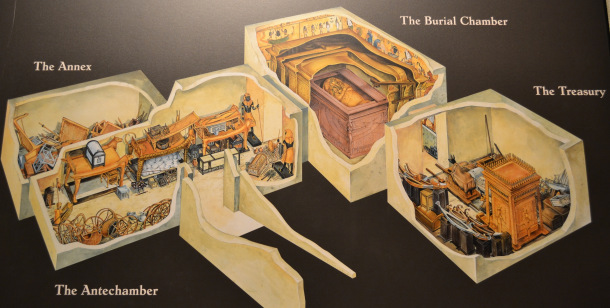
The exhibited tomb of Tutankhamun was divided into four rooms in all: the antechamber, the annex, the burial chamber, and the treasury (the shrine of the remains). Entering the antechamber from the entrance, the annex is connected across from the entrance, and two chariots (chariot) lie scattered in disassembled form along with several wheels. The furniture in the antechamber is furniture used in palace ceremonies, and the furniture carelessly piled in the annex is the king's private furniture. Goguryeo tombs are divided into a front chamber and a rear chamber, the front chamber showing life during one's lifetime and the rear chamber showing eternal life. Here too it is the same arrangement.
The burial chamber is the room where Tutankhamun's mummy was kept; its entrance opens sideways from the antechamber, so that the burial chamber and the shrine of the remains are aligned in a straight line. Inside the burial chamber the mummy was kept in four outer shrines, and inside them three inner coffins, protecting it layer upon layer, seven layers in all. On each inner coffin, masks and ornaments decorated the king's front, preparing for him to gain life again and survive. The shrine of the remains, at the foot end of the burial chamber, is the shrine that kept the organs of the body removed in the process of preparing the mummy.
Around the shrine four goddesses stand guard; the bull god takes its place facing the mummy in the burial chamber, and in front of it the dog god also watches toward the burial chamber. Many animals decorate the tomb in paintings and sculptures, but in the actual tomb only the cow and the dog take their places as companions sharing eternal life with the person. On the Korean Peninsula, until children were given names, they were called "Gaettong-a" or "Sottong-a." Here ttong is a name meaning child (童 dong). The culture of the cow and the dog is East Asian culture formed through tens of thousands of years of evolution in which farming and nomadism joined together. In the environment of Africa there is no such evolutionary process.
The cow has long been a companion of people in farming life, an animal that pulled plows and carts from early on in Southeast Asia. The dog is said to have begun living with people 60,000 years ago when Northeast Asian people began raising wolves. World archaeology has recently revealed that East Asia's Hongshan culture was the place where the world's culture and civilization first took shape, fusing farming life that came in from the south of the Liaodong Peninsula with herding life that came down from the north. It was 2,000 years ahead of Egyptian culture.
The Neolithic dolmen of East Asia is a religious form mixing the heavens and the ancestors, and it is the representative remains of the Korean Peninsula. Because bronze relics were excavated from dolmens, they are also remains showing that metal culture appeared first in East Asia. From East Asia's custom of building earth mounds (mound) and dolmen culture, the custom of building stone-mound tombs (pyramid) begins in the Hongshan culture.
Coal was abundant on the Liaodong Peninsula and in the northern Korean Peninsula, so metal and iron production was easily accomplished; people made compasses and produced the wheel axles of horse-drawn chariots (chariot). If you look closely at the chariot Tutankhamun loved to ride, its whole body is wrapped and decorated with the "coiled-thread pattern" commonly seen on East Asian bronzes. The chariot began earliest in East Asia and passed its heyday in the Shang dynasty, and we can see a perfect four-horse chariot excavated from the pits of Qin Shi Huang. Such a perfect chariot cannot be seen anywhere else in the world.
Howard Carter, who excavated Tutankhamun's tomb, saw a picture of a chicken on a broken piece of pottery and told the world that the pharaoh's food included chicken, which did not exist in Africa. [Compare] the picture of a chicken painted on the ceiling of the Goguryeo Muyongchong. The chicken is said to have originally been a flightless bird that grew up eating insects living on bamboo shoots in Southeast Asia. From the day people began farming, it came into farmhouses, ate the grain people ate, and began to appear on people's tables. That these royals ate chicken when there was not yet chicken in African food suggests that they were East Asians who had come to Africa.
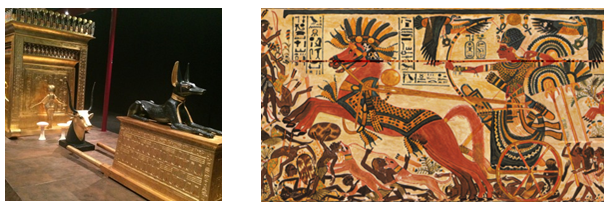
In the pharaoh's furniture and paintings we often see deer-hunting scenes, as in Goguryeo murals, and we also often see him riding a chariot to subdue Black Africans and Arabs. The shrine guarded by the bull and dog gods is called the treasury. It is the innermost place, where the most precious treasures were kept along with the remains of the body. The cow and dog accompanied the soul of the dead, and among the relics kept there are models of large and small boats. Among them, the wooden sailboat is an ocean-going ship built by dressing wood with metal tools. The ocean-going ship kept along with Tutankhamun's remains leads me to imagine that their homeland was a faraway country where people lived together with cows and dogs.
In the pyramids of Egyptian culture, we cannot find the pyramid's process of growth, as in East Asia, through building earth mounds and raising dolmens. After East Asia's stepped stone-mound tombs, which began from the dolmen, were built, [the Egyptians] built pyramids modeled on the triangular form of East Asian pyramids. As metal culture flourished in the Dongyi Shang dynasty, East Asian furniture such as mother-of-pearl lacquerware developed. Tutankhamun's furniture shows the civilization of East Asia. Looking at the chariot that horses pulled and ran, the horse's home was the Manchurian plain, and the chariot's metal axle and wheels were made in East Asian metal culture. The evolutionary process in East Asia — from people carrying loads on a single wheel, to making the rickshaw with two wheels, until the horse-drawn chariot was made — existed only in East Asia.
European archaeologists say that Tutankhamun's dagger too is of metal obtained from a star [meteoric iron], but it is an East Asian metal product not seen in Africa. Among the pharaohs there are East Asian faces, and there are many East Asian appearances and names. Tutankhamun too is a four-syllable name, like Eulji Mundeok or Yeon Gaesomun. We see pictures of riding horse-drawn chariots to subdue Black Africans and Arabs. As in the pictures below, looking at the art emphasizing the eyes on Shang bronze ritual vessels and at Egyptian writing developed from oracle-bone script, we also see the same origin. Riding wooden boats made with metal weapons and metal tools along the coastal road already opened and traveled since 50,000 years ago, and sometimes driving chariots and hunting, it was not hard to travel back and forth between East Asia and Africa.
Among the kings and nobles who built pyramids in the Nile basin of Africa, we can see the looks of East Asians. Khufu (Gobu), owner of the largest pyramid, is of small build with East Asian features. The architect Hemiunu, who worked with him, also has the look of an East Asian with high cheekbones in his face, and their descendants have the beautiful looks characteristic of mixed-race children, and there are many four-character names like those given in East Asia. It is the same phenomenon as the names of the native peoples of North America, like Yeon Gaesomun and Eulji Mundeok of our country's Goguryeo. Among the furniture used by the African nobility, the shapes of jade, ivory, wooden lacquerware, and so on resemble East Asian products.
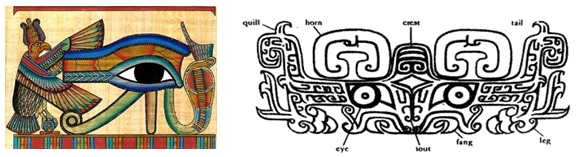 (The Egyptian eye and the Shang eye shown in the two pictures show a commonality.)
In the history of the East Asian nations — which raised dogs and chickens at home, plowed fields with oxen, and rode horses to hunt deer — power struggles among countless nobles have continued. There are also many records of those who fought driving chariots and then fled desperately and went far away. Just as royalty of the Korean Peninsula first founded a state in Japan, we come to understand that East Asian royalty traveled to the Mediterranean and as far as the Nile, and the wisdom of East Asians, tens of thousands of years ahead, met the labor of Black Africans and Arabs to create the splendid history of the great Egyptian pharaohs. The Egyptian civilization of the pharaohs, which appeared like a mutation in the African wasteland where there was nothing, came from East Asia. It is clear that Atlantis (Atlantis), the mother of world civilization that Plato (Plato) sought, was East Asia.
While the modern humans born 100,000 years ago spent 50,000 years reaching East Asia, they ate the abundant food of Southeast Asia and, in settled homes, began for the first time to speak the language of modern humans. They took off the animal-skin clothes they had worn from Africa and took on a human appearance. On reaching East Asia and meeting winter, the season of death, they overcame winter in the contest between humans and nature thanks to coal fires, grew accustomed to inland life, and came to lead a disciplined life. The metal weapons and tools that flowed out of coal fires changed the shape of wood and stone and brought a revolution to the life of modern humans.
The East Asians, who built up pyramids to honor heaven and the spirits of their ancestors and created horse-drawn chariots with metal wheels, went back along the road they had left 50,000 years before to seek out Africa, the land of their mother. They found again the Nile, the milk line, and in their mother's embrace achieved Egyptian culture, the crowning achievement of modern humanity. We see that Egyptian culture began when [East Asians] arrived from East Asia at the mouth of the Nile, and then moved deep into the African interior.
4.6 City Planning That Began with the Wheel Culture of East Asia
Neolithic inhabitants settled and lived along large rivers or seashores rich in food resources. Neolithic houses sometimes used caves or were made by laying stones on the floor, but the common form was the pit house, built on coastal hills or flat ground. The pit house was made by digging a round or square pit 4–6 m in diameter to a depth of about 50–60 cm to make the floor, installing necessary interior features such as a hearth on the floor, and then covering it with a roof; it had no separate walls, the rafters being stuck directly into the ground.
Judging from the fact that the floor was covered with clay or left without any treatment, it seems grass or animal hides were spread on it; the roof was made by resting rafters around the pit, burying the other ends of the rafters at the center to form the peak, and covering it with dry plants such as branches or reeds, making a conical or square-pyramidal shape. Steps or a slope were made so that water would not flow in even when it rained. There were also storage facilities made by burying earthenware.
Neolithic people used the interior of the house appropriately and for many purposes. It seems they generally built houses about 18 ㎡ in size and lived together in family units averaging 4–5 people.
Paleolithic people caught and ate animals and fish and also gathered and ate the fruits and roots of plants. They also moved with the seasons, building makeshift huts in caves or by rivers; living by rivers or seashores, people caught fish or gathered shellfish with bone fishhooks, nets, and so on, and hunted with stone spears, stone arrowheads, and so on. Meanwhile, from a life of gathering and eating the fruits and roots of plants, as they gradually began to farm and raise livestock, settled life grew longer.
Neolithic people who began farming life tilled the ground with stone hoes, cultivated foxtail millet, barnyard millet, and the like, harvested with stone sickles, bone sickles, and so on, and ground grain on stone grinding slabs to make food. They also spun thread with spindle whorls and made clothes with bone needles. Clans gathered to form villages, and further, several clans gathered to form tribes. That is, unlike Paleolithic people, they began a settled life.
At the Neolithic wetland and shell-mound site at Bibong-ri, Bugok-myeon, Changnyeong County, South Gyeongsang Province, the oldest log boat found on the Korean Peninsula, from 8,000 years ago, was unearthed. It was estimated to have been over 4 m long, and it was said that, in light of the circumstances of the time when metal tools such as iron or bronze had not been invented, traces of very meticulous working are evident. It was revealed that to make the boat, the people of the time burned the log here and there, carved it out using sharp stone tools such as stone adzes, and then smoothed the surface again with tools such as grinding stones. As if to prove this, scorch marks (焦痕), traces of working by charring, were found all over the boat.
The straw boats seen at the Jeju Island museum and in many places around the world were made by weaving straw and dry stalks, like our country's thatched roofs, and floated on the water. People tied bamboo or logs together, floated them on the water as boats, and rode them to fish. In fishing on the Li River in Guilin, China, the fisherman unties the cord tied to the cormorant's leg and sends it into the water. The released cormorant dives into the water in an instant, and a moment later bursts out of the water, rushes to the fisherman, thrusts out its beak and bows its head, and the fisherman pulls out from the cormorant's mouth a big fish that looks more than a hand-span long.
It is said they fish by starving the cormorant for several days to make it hungry, tying its neck with a cord so it cannot swallow big fish, and then releasing it on the river; the hungry cormorant dives frantically into the water and in an instant catches a fish and tries to swallow it, but because of the cord around its neck it cannot get it down into its stomach, so it runs to its master and begs to have it taken out, and the fish is pulled out. This is the traditional cormorant fishing method of the Guilin region. Because such bamboo boats and fishing methods can also be seen in Japan, I surmise they also existed in Korea and are an image of an ancient way of life that has now disappeared.
As clan societies grew to form villages and built stone walls around them to protect the villages, that was the first form of a small city. In these societies an experienced tribal chief directed productive activities such as farming and hunting. As villages grew larger, they grew into feudal states, and city-states and the position of king were formed. The stone walls became fortress walls, and the king's residence grew into a palace-fortress. There, free people, excluding slaves, carried out politics, and assemblies of nobles, politics, social life, trade, and so on unfolded. It is the political form that appeared in the transition from primitive society to the ancient state.
There are the Zhou dynasty's Fengjing (酆京), built in 1,136 BC, and Haojing (鎬京), built in 1,133 BC. Banpo village, whose prehistoric dwelling site was excavated and made into a museum, is a village site belonging to the Neolithic Yangshao (仰韶) culture, and it is said carbon dating identified it as a dwelling site more than 6,000 years old. At the Banpo site, a dwelling area of 50,000 square meters built on the basis of agricultural development at the height of matrilineal clan society — "one knew one's mother but not one's father" — houses are distributed around a "big house," 12.5 meters north-south and 10 meters east-west, presumed to have been the house of the clan head and the meeting place of the clan members. Lantian Man (藍田原人) of 800,000 years ago and the Banpo people (半坡人) of 6,000 years ago all lived in matrilineal clan societies near the Chan River (滻河) east of Xi'an.
[The Zhou] dispatched sons of the royal house, clansmen, and men from allied tribes to the vast conquered regions, enfeoffing and stationing them as feudal lords, to keep watch over the common people and guard against rebellions by the surrounding foreign peoples. In this feudal system, which granted fiefs to such lords, naturally the king owns all the land and people under heaven
The relationship of the feudal lords was based on the lineage system, in which clan organization within the original tribal society had developed and changed into an organized system founded on the blood relationship of the feudal lords, the lesser lineage (小宗), to the royal house, the great lineage (大宗). The growth of this system led to the birth of the first empire in world history in East Asia, and it was the driving force of urban growth, applied consistently. If we look at the plan of a religious sacred site, the sanctuary is placed in the center, and a gate is set up facing east, south, or west, and the gate symbolized the boundary of entry into the sacred site. The gate and the sanctuary formed an axis, and on both sides a left-right symmetrical plan was made, symbolizing yin and yang.
The gate began with two pillars, and later a beam was set on top; the gates of Japanese Shinto shrines remain as the tradition of that time. In front of the gate, steps were made or a bridge was made to cross water, separating the sacred site from the secular world. Steps were made in front of the sanctuary to emphasize its higher position. As sacred sites developed and grew, gates were set up on all four sides and surrounded by corridors, completing the grid plan. This grid plan sanctified the position of the living king and was applied to the architecture of palaces and palace-fortresses, and it began to be applied to the arrangement of fortress walls around the palace and to city planning.
In farming life, the ox-drawn plow was made, and loads were moved on one-wheeled carts. Because the origins — people pulling two-wheeled carts, then oxen pulling them, then iron wheels being made and horse-drawn chariots (Chariot) being made — are seen only in East Asia, wheel culture began in East Asia, and grid city planning was born of wheel culture. On September 15, 2013, the British historian Stephen Roberts (스티브 로버트), a professor at the University of Birmingham, announced that while there are records of a battle of chariots (Battle of Chariots) between Egypt and the Hittites (히티티) in 1,300 BC, the chariot warfare of East Asia's Xia dynasty in 2,100 BC is still not known. He explains that East Asian chariot culture reached its height in the Xia and Shang dynasties.
Population gathered on the Liaodong Peninsula, where the farming culture of the East Asian coast and the nomadic culture of the interior fused, and the first competitive society in East Asia was formed. Clan society grew into a system of city-states, and eventually the kings of large and small city-states gathered to elect a feudal lord and establish a feudal state. Around that time, among the region's underground resources, coal gave the capacity to mass-produce metal, and various metal technologies and products brought revolutionary change to household tools and military weapons, so city planning became necessary. With metal tools people built large houses, and wheels fitted with metal axles allowed the mass production of chariots that ran fast and far. Carriages for carrying heavy loads were made, and all industries flourished along with the transport industry.
The architectural and construction technology of East Asia can be gauged from palaces, fortress walls, tombs, and the like. Judging from the remains and relics, we can see that their design and construction were at a high technical level. In particular, the advanced state of Goguryeo's palace and temple building technology, seen in remains such as Jangan Fortress, Gungnae Fortress, and the Tomb of the General, can be surmised from the huge house sites, the pictures of buildings painted in the murals of many tombs, the bricks, roof tiles, and stones found at the sites, and other building materials.
The Nihon Shoki (日本書紀) records that in 602 the monk Gwalleuk crossed to Japan with books on astronomy and geography (天文地理書) and selected and taught 24 students (書生). This connects to mapmaking, the planning and design of cities, and land surveying and arrangement. The orderly city planning of Japan's capitals was guided by scientists who crossed over from Baekje. It shows the level of Baekje geography and mapmaking. And it shows the Baekje geography that underpinned such city planning and design.
Chang'an (Xi'an) is a grid-planned city of unprecedented scale in history, measuring 9,721 meters east-west and 8,651 meters north-south. The circumference of its outer wall reached 37.7 kilometers, and its area was 84.1 square kilometers. Its population reached about one million. Considering that Baghdad, a world city of the time, was 2.3 kilometers in diameter and Constantinople was 5 kilometers east-west, we can surmise that the enormous scale of Chang'an was the scale of an advanced East Asian nation.
The basic form of the royal-city layout realized at Chang'an is common to East Asian cities — Balhae's Sanggyeong (上京府) in Manchuria, Goguryeo's Jangan (長安; Pyongyang) on the Korean Peninsula, Silla's royal capital (王京; Gyeongju), Japan's Heijō-kyō (平城京; Nara) and Heian-kyō (平安京; Kyoto), and others — and to the city planning of the ancient Native American cities of Palenque and Teotihuacan. The city plan of the Mohenjo-daro (Mohenjodaro) site of the Indus civilization, which flourished from 3000 BC to 1500 BC, is also the same model, and the relics excavated there have been presumed to be those of East Asians.
The Mohenjo-daro (Mohenjodaro) site is the urban site that forms the center of the Indus civilization, which flourished from 3000 BC to 1500 BC. It was excavated from 1921 to 1931 by J. H. Marshall, E. Mackay, and others, and in 1950 R. Wheeler also investigated it. The city was divided like a checkerboard by great thoroughfares with a north-south main axis, and in the center of the west side there is a citadel built on a high platform (基壇). The eastern town was divided into nine blocks by four great thoroughfares, and each block was further divided by several smaller streets crossing at right angles, along which the households (戶) were arranged; the houses were built of brick. The citadel was surrounded by walls up to 12 m high, long from north to south, about 430 × 230 m in size. Inside the citadel are a large building thought to be a temple, a great bath (浴場), a granary, and a building presumed to be an assembly hall; the great bath in particular has a tank 19 × 7.5 m and 2.5 m deep. It is said that drainage was arranged so that water flowed through underground drains into the sewers of the main streets.
Looking at the city's districts, the fortress remains, the city remains below it, the workers' quarters, and so on are arranged by function. All the buildings in these districts were built of fired red brick. And wells were dug and lined with bricks stacked neatly in a circle. There were as many as 700 wells. Brick was also used for the waterproofed water supply and sewers. The roads connected east-west and north-south exactly as a compass points today. Mohenjo-daro is precisely a city designed by professional engineers in charge not only of city planning but also of urban civil works. An enormous quantity of bricks went into building this city.
This meticulous city planning suggests that thorough management was carried out, along with the standardization of weights and measures seen in the size of the bricks (standard bricks: 28 cm long, 14 cm wide, 18 cm high) and in the rulers and scale weights unearthed. Besides these, relics such as pottery, copper objects (銅器), seals (印章) engraved with a script not yet deciphered, and ornaments are similar to those of East Asia. These great streets are roads for rolling wheels, and it seems this is because in East Asia there were, from early on, oxen and horses in use and wheels with metal axles.
It is a phenomenon in which the process of East Asian urban growth — from religious architecture to palace architecture, and from palace architecture to walled-city architecture — was carried to many places in the world. According to the report of Professor Han Pil-won of the School of Architecture at Hannam University (Xian, the Model of the East Asian Cities), he explained that the well-field system (井田法), the land system of ancient China that appears in the capital model (九宮格局, the nine-square grid layout) of the "Kaogong Ji" (「考工記」) in the "Winter Offices" of the Rites of Zhou (『周禮』), seems to have been completed in the Zhou era.
As seen in the temple architecture of Angkor Wat in Cambodia, [Chang'an] used its site, surrounded by eight waterways, to build dams to secure water and completed a supply system for city water and garden water. It opened canal transport and began supplying goods through the waterways. [The capital model prescribes:] each side is 9 li square, with three gates on each face. Within the capital, nine roads each run north-south and east-west, and the width of the roads is 9 gwe (軌; the width a carriage can pass, 1 gwe being 8 Zhou feet (周尺)). With the palace at the center, the building for sacrifices to the ancestors is placed on the left and the building for sacrifices to the gods of soil and grain on the right. The court is placed in front and the market behind. The market and the court are a pair.
If we summarize the process of East Asian city building while looking at the city plan of Chang'an in Xi'an, first of all the orientation is fixed, and then the location of the palace and the ceremonial line of the royal capital running south from the palace are determined. That is, the palace is placed at the exact center of the site planned for the royal capital, and a long north-south axis is drawn running due south through the city from Zhaoyang Gate (the Tang Chengtian Gate), the south gate of Daxing Palace, which occupies the core of the palace-city. This north-south axis extends from Zhaoyang Gate Street (the Tang Chengtian Gate Street) to Zhuque Gate Street, passes through Mingde Gate, the south gate of the outer wall, and reaches the Shibie Valley of Zhongnan Mountain in the Qinling range. This axis corresponded to the meridian of the heavens and functioned as the axis of dynastic ceremony.
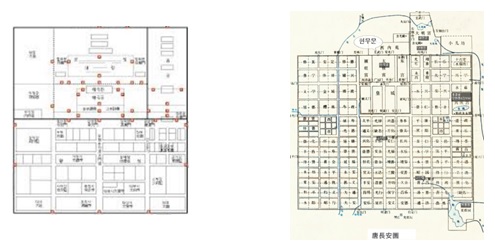
Along with the construction of the imperial city, the main arterial roads connecting the gates of the outer wall were built. There are six great streets — three running north-south and three east-west — which are called the Six Streets (六街). After the great streets were determined, the smaller roads between them, the lesser streets (小街), were fixed. Excluding the roads bordering the outer wall, there are nine north-south roads and twelve east-west roads. The last stage of building the royal capital is building the walls of the outer city. The city of Chang'an was composed symmetrically and in orderly fashion, with the north-south axis running through the palace-city, the imperial city, and the outer city — that is, Zhuque Avenue — as the central axis. Around the axis, palaces, government offices, Confucian, Buddhist, and Taoist religious buildings, markets, and so on were arranged in left-right symmetry. The town was divided into eastern and western parts by Zhuque Avenue
The Rites of Zhou (周禮) is a classic valued by the Confucians and one of the Thirteen Classics, and among its six offices it contains the "Kaogong Ji," which is under the Winter Office (civil engineering works). The model described in its capital pattern seems to have been formed early in East Asia as the city planning (City Plannimg Manual) shown in the ancient cities of all of East Asia, India, and North America. The farming society of East Asia was a fast-growing competitive society, and from the Neolithic period it planned cities of great streets along which wheeled carts moved. The Shang dynasty, which reached the height of metal culture, formed East Asia's finest sphere of civilization and passed it on to the Zhou dynasty.
The capital model recorded in the "Kaogong Ji" of the Winter Office of the Rites of Zhou seems to have followed the form developed longest in yin-yang and Five Elements philosophy in building the capitals not only of China but of Korea, Japan, the ancient cities of the North American continent, and elsewhere. The capital model of Chang'an is a grid-pattern, regular, and standardized capital spatial structure, like the cities excavated in the Indus basin or the ancient cities of North America. It is presumed to be city planning that began in East Asia as a method of building huge cities this quickly.
4.7 The World's First Empire: the Qin Dynasty and Qin Shi Huang (The first Emperor, Qin Shi Huang)
According to Wikipedia, Qin Shi Huang (秦始皇帝, Qín Shǐ Huáng Dì), January 259 BC – the 22nd day of the 7th lunar month, 210 BC, was the 31st king of Qin, one of the seven states of the Warring States period, and the first emperor of China. It is said that he unified China, divided in the Warring States period, and by implementing the imperial system and the commandery-county system created the basic framework of Chinese dynasties for the next 2,000 years. He brought about the "burning of books and burying of scholars," a cultural suppression in which great numbers of books on history, medicine, and agriculture were burned and 460 scholars were buried alive, and together with Emperor Yang of Sui he has been criticized as the greatest tyrant in Chinese history.
From 230 BC he conquered in turn the states of Han, Zhao, Yan, Wei, Jin, Chu, Qi, and so on, and became the king who established the first unified China in history. Taking "Huang" and "Di" from the Three Sovereigns and Five Emperors and combining them, he adopted the title Huangdi (皇帝, emperor) and became Qin Shi Huang. Fearing the Xiongnu, which extended across the Korean Peninsula, Manchuria, and Mongolia, he had the Great Wall built, erected the Epang Palace, and carried out great civil works to build his own mausoleum, so that today we can see with our own eyes the terracotta army pits of the Qin Shi Huang mausoleum near Xi'an, discovered by chance by a farmer in 1974.
The mausoleum of Qin Shi Huang is a huge pyramid made of earth, 76 meters high and covering 350 square meters. The Chinese government has announced that it will wait another ten years to make scholarly preparations before excavating the tomb. It is said that the soldiers of the terracotta army, in the pits excavated about one kilometer from the mausoleum, were made by craftsmen who produced the head, torso, arms, and legs separately and then joined them. Research showed that eight kinds of molds were used for the different faces, and other parts were also combined from several kinds each, producing terracotta figures of various forms. The legs are mostly of the same form and are presumed to have been mass-produced using the same molds. Recent research by historians has confirmed that the same method was used in making everyday goods such as roof tiles.
Since 1974, in the four pits excavated so far, some 8,000 soldiers, 130 chariots, 520 horses, and 150 cavalrymen have been found. Besides soldiers, figures of officials, acrobats, archers, and musicians have also emerged. From Pit No. 1 alone, 6,000 figures and 40 chariots were excavated. In Pit No. 2 there are cavalry and guard troops. According to Sima Qian's Records of the Grand Historian, 700,000 people were mobilized to build the mausoleum of Qin Shi Huang, designed as an underground palace begun in 246 BC. Some 100 rivers of flowing mercury, and a capital with dozens of watchtowers full of treasures and soldiers. It is said that after it was completed, the workers were buried alive to prevent grave robbing.
The terracotta army pits (兵馬俑坑) in Lintong District, Xi'an City, Shaanxi Province, China, were discovered by chance in 1974 when a farmer was digging a well in his field, and four pits have been excavated so far. The site lies about 1 km from the mausoleum of Qin Shi Huang, and the pits preserve countless clay models of soldiers, horses, chariots, and so on, made of fired earth.
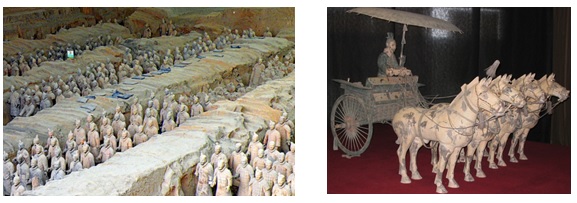
The mausoleum of Qin Shi Huang, a pyramid made of earth 76 meters high and covering 350 square meters, was designated a UNESCO World Heritage Site in 1987. These [people] later seem to have left behind the Turkish and Hungarian peoples of Eastern Europe, and the Viking history and the Finnish people of Northern Europe. The terracotta figures were made life-size, looking as if alive, and there are traces of paint on the faces. The existence of the terracotta army symbolizes the mighty power of Qin Shi Huang. He died without finding the herb of immortality, but the achievements he accomplished left a splendid milestone in world history and in the history of East Asia.
The Dongyi, who began migrating inland from 50,000 years ago, passed through Manchuria, Mongolia, and Tibet and kept advancing westward, pioneering what is now the Silk Road. Around the time the Dongyi of East Asia founded the Qin empire, the Silk Road at last reached the Mediterranean and Eastern Europe, forming the inland passage of the Eurasian continent (intercontinental rout). As the peoples of East Asia and the eastern Mediterranean migrated into the western Mediterranean, the wave of East Asian civilization reached the land of Italy, and 200 years after Qin founded its empire, the Roman Empire was established. That in 453 the East Asian Huns, equipped with East Asian tactics and mobility, under the general Attila, conquered Rome and dominated Europe shows that the Manchurian and Mongol peoples, by the power of cavalry and chariots, were the absolute power of the Eurasian continent.
Around the time Qin Shi Huang succeeded the Zhou dynasty and founded a unified empire, the Yuezhi (예치족), one of the nomadic states of the Liaodong region, migrated to the Ganges basin, founded the Kushan state, and expanded to build the great Kushan Empire, securing territory covering most of northern India and reaching as far as the Caspian Sea in Eastern Europe. Later, trading with China's Tang dynasty and with Rome in Europe, it brought Buddhist culture to its height in India, and the history of unified empires in Indian history began. Europe's medieval stagnation after the Roman Empire continued until 1229, when Genghis Khan of Mongolia awakened Europe. Europe, obtaining once again the civilization of East Asia's Yuan empire, began to stand on its own, and the map of modern world history changed from the time of Genghis Khan.
4.8 How the Week Came to Have Seven Days
The earliest expression of the number "7" in human history is thought to be when, in the Neolithic period on the Korean Peninsula, the seven stars of the Big Dipper were carved as holes on the flat capstones of dolmens. Dolmen culture appeared on the Korean Peninsula in the Neolithic period, and because bronze swords and tools first appeared in dolmens, I come to think that East Asia's metal culture developed earliest in the world and that the revolution in modern human life began here.
Stone Age culture was inherited by Goguryeo culture, and dolmens developed into stone-mound tombs (Pyramids), forming the Hongshan culture, 2,000 years ahead of Egyptian culture. The thought of yin-yang and the Five Elements left in the stone-mound tombs around Jilin Province in Manchuria and in the Goguryeo tombs was the religion and the science of East Asia. Inside a Goguryeo tomb, the sun and moon were painted on the ceiling, the body was laid in the center, a blue dragon was painted on the east, a red bird on the south, a white tree on the west, a black snake and tortoise on the north, and the body in the center was dressed in yellow. The natural environment experienced in life was made into an atmosphere of eternal life inside the tomb.
The sun and moon symbolize yin and yang, and water in the east, fire in the south, wood in the west, metal in the north, and earth in the center symbolize the Five Elements, so yin-yang and the Five Elements make seven elements, and in our culture "7" became a sacred number. There is a legend handed down that on the 7th day of the 7th lunar month, the Herdsman Star (Gyeonuseong), a young man who drives an ox to plow the fields, and the Weaver Star (Jingnyeoseong), a maiden who works the loom to weave cloth, meet across the Milky Way. East Asia long used the lunar calendar. A month was 28 days, and the custom took shape of holding a market three times a month, every seventh day, where people gathered to exchange the things they needed for living. The number 7, made by combining yin and yang with the Five Elements in East Asia, is the Taoist philosophy shown in Goguryeo culture. It leads me to wonder whether it was passed to the Buddhism of the Ganges in eastern India, and from Buddhism to the Christianity of Southwest Asia, with the result that the number 7 appears more than 400 times in the Bible.
Qin Shi Huang founded his empire in 216 BC and ascended as the first emperor in world history, and 200 years later the Roman Empire appeared in the Mediterranean. The Roman emperor Constantine himself officially recognized Christianity in AD 325 and proclaimed the system of observing a seven-day Sabbath cycle, and from then on the week was fixed at seven days. That in the week Sunday became the day of the sun, Monday the day of the moon, Tuesday the day of fire, Wednesday the day of water, Thursday the day of wood, Friday the day of metal, and Saturday the day of earth is also because these words were the names of the gods who, in Roman times, symbolized sun, moon, fire, water, wood, metal, and earth.
It was already an age when goods and culture handed down from East Asia were flooding in along the sea and land Silk Roads. In AD 430, 400 years after Rome was founded, Attila of the Huns, who came riding mules (a cross between horse and donkey) all the way from East Asia to the Mediterranean, even conquered Rome. We come to understand that the five elements of East Asia's yin-yang and the Five Elements appeared in the Roman language as the names of gods and came to be used as the names of the days of the week.
4.9 The Beginning of Chinese History in Sima Qian's Records of the Grand Historian
Sima Qian, who in the Han dynasty (206 BC – 9 AD) compiled the historical records of the Xia, Yin, and Zhou states into the Records of the Grand Historian (<사기>), believed that Chinese history had inherited the descendants of the Huns. He recorded the story of the Big Dipper painted on the ceilings of Goguryeo tombs in the "Treatise on the Celestial Offices" (<천관서>) as follows.
In the center of the heavenly palace, the Taiyi star (the North Star) is the emperor, and around it the stars of the queen and consorts and the stars of the princes form the royal house. Beside it, the Big Dipper was called the carriage (車馬) of the Heavenly Emperor (天帝). It says that when the Heavenly Emperor rides his carriage once around the center of the heavens, the sun, moon, Mars, Mercury, Jupiter, Venus, and Saturn distinguish yin and yang, divide the four seasons, and arrange the 24 solar terms, establishing order in heaven and on earth. In what is told as a heavenly myth, we see Goguryeo culture, with the horse-drawn carriage of the Manchurian nomads, with yin-yang and the Five Elements, and with metal culture. It shows that Gojoseon (Goguryeo) culture was already a completed culture before the Xia dynasty was founded.
In the "Basic Annals of the Five Emperors" of Sima Qian's Records of the Grand Historian, he left the record that Emperor Shun ruled most of the Central Plains from Hebei and Henan to the Shandong Peninsula, founded walled towns through agriculture and fishing, made pottery and held sacrifices, and achieved many cultural accomplishments, greatly raising civilization. Later this was confirmed archaeologically, including the flood records of the era of Emperors Yao and Shun, through the excavation of the Longshan culture (3000–2000 BC). Considering also the fact that the dragon, which represents the emperor, first appeared in the Hongshan culture (4700–2900 BC), the homeland of the Huns, formed the structure of yin-yang and the Five Elements, and became the tradition of the Chinese imperial house, it shows that the civilization of the Yellow River inherited the Liao River civilization.
With the discovery and deciphering of the oracle-bone script of the Yin (Shang) dynasty, no one doubts the existence of the Yin dynasty. Now the world has come to recognize the existence of the Xia dynasty as well. We see that ancient writing, bronze and jade grave goods, tomb building and water-management and drainage works, the system of burial sacrifice, and city planning developed through cart transport are characteristics of the Xia dynasty, which began as a mixed culture in Shanxi Province, later connecting to the Erlitou culture. As for the northern metal culture connecting to the Xia and Yin (Shang) dynasties, the great migration of the northern peoples upon the founding of the Zhou dynasty, mixed with the Chinese people, is recorded in the Records of the Grand Historian.
In the Spring and Autumn and Warring States period, only the state of Yan (燕) remained in the north, and as [the others] scattered — Qi (齊, Baekje) to the east, Chu (楚) to the south, and Qin (秦) to the west — the descendants of the Zhou dynasty occupied the Central Plains. At this time the metal-culture people who came down south carried on as the Sanxingdui culture (三星堆, Sānxīngduī, 3500–1000 BC) around Chengdu City in Sichuan Province, continuing the connection with the Mediterranean Egyptian culture that had continued from the Xia dynasty.
Driving back the powers of the Central Plains, Qin Shi Huang of the Qin (秦) state, around Xi'an in the west, established the first unified empire in world history, and the Silk Road to Europe opened. "Sina," the name by which Europe referred to China from "Qin," began at this time and became the origin of "China." The political repercussions of East Asia reached the Mediterranean, and 500 years later the Roman Empire arose, but 100 years later Attila of the Huns (Latin: Attila) followed the Silk Road and invaded Rome and Europe. Qin Shi Huang's terracotta army pits around Xi'an were excavated in 1974, and Europe came to see East Asian history with its own eyes. The Qin (844–206 BC) state gave up the leadership of Chinese history to the Han (漢) dynasty, descendants of the Zhou of the Central Plains, so Sima Qian's Records of the Grand Historian consists of the records of Xia, Yin, Zhou, and Han.
In Chinese history, the northern peoples and the southern peoples fused in Shanxi Province, and beautiful mixed-blood children were born. It is said that the Four Beauties of Chinese history — Xi Shi, Wang Zhaojun, Diaochan, and Yang Guifei — were born in Shanxi Province, where the two peoples meet. The Great Wall, which passes through Shanxi Province, symbolizes the longest conflict in world history between the world's mightiest nations.
4.10 China's Northeast Project
Chinese history continued through the Han, Sui, Song, Yuan, Ming, and Qing, and the Qing empire — whose Nurhaci, who grew up at Changbaishan (Baekdusan), conquered the Ming dynasty of the Han Chinese — maintained the largest territory and the longest-lasting empire. In 1963 Chinese archaeologists excavated a huge pyramid on the outskirts of Xi'an that was said to be the tomb of Qin Shi Huang. The excavated relics were not from the tomb of Qin Shi Huang. They came to know that they were relics not of the Yellow River civilization but of the Dongyi Gojoseon. Radiocarbon dating attempted in 1973 revealed that the relics were thousands of years older than Qin Shi Huang. Until then they had not known that the regional culture north of the Great Wall, known as that of the Dongyi or the Huns — barbarians without culture — had existed earlier and more splendidly than China's Yellow River civilization. After learning that fact, they banned all excavation surveys and scholarly research in that whole area, including the tomb of Qin Shi Huang, and announced the Northeast Project policy.
China's public security authorities have closed and banned access to all historical sites that are in dispute with the history of the Korean people. They define the history of the 56 minority peoples within present-day Chinese territory as Chinese history, and, breaking away from the limited view of history the Han Chinese have held until now, they are issuing school textbooks stating that the culture of the Dongyi (Gojoseon, Goguryeo, Balhae), which preceded China, is also Chinese culture, beginning with school education. It is just like the political education of Japan, which issues textbooks saying that Dokdo, Korean territory, is Japanese territory and uses them in school education.
According to the explanation in the Korean Wikipedia, the Northeast Project (東北工程) includes the research work carried out by the Center for Borderland History and Geography Research (邊疆史地 硏究中心) from early 2002 to early 2004, and from 2007 until now, concerning the past history of the three northeastern provinces (Heilongjiang, Jilin, and Liaoning) in northeastern China and the resulting state of modern and future history. Its official name is the Serial Research Project on the History and Current State of the Northeast Borderland (東北邊疆歷史與現狀系列硏究工程). It says the Northeast Project is a national project under an official policy of the government of the People's Republic of China, based on the theory of a unified multi-ethnic state.
The Northeast Project begins with the Hongshan culture outside the Great Wall and the tomb of Qin Shi Huang at Xi'an. The Hongshan culture was discovered in 1908 by the Japanese archaeologist Torii Ryūzō (鳥居龍蔵), and in 1935 large-scale surveys were carried out by Hamada Kōsaku (濱田耕作), Mizuno Seiichi (水野清一), and others. After the war, excavations followed one after another in various places. This culture was originally called "Hongshanhou" (紅山後) in 1954 because it lay behind Hongshan (紅山), and gradually, in commemoration of Hongshanhou, it came to be named the "Hongshan culture." In 1984 a clay face of a goddess was unearthed. Known as the Goddess Temple (女神庙) of Niuheliang (牛河梁) in Chaoyang City (朝阳市), Liaoning Province, it was designated a Class 1 national historical relic of China, is held at the Liaoning Provincial Institute of Archaeology (辽宁省考古), and in 2002 was designated one of 64 cultural relics prohibited from leaving the country for exhibition.
China has long prided itself on the Yellow River civilization as the master of Chinese civilization. But as it was revealed that a full-fledged civilization, 1,000–1,500 years ahead of the Yellow River civilization, had existed in Liaoning Province, which had been Dongyi territory, it put forward a "theory of pan-national cultural development." Hiding the fact that the Hongshan civilization belonged to the Dongyi, it called it "China's Liao River civilization." It claims that China's ancient culture is the oldest (最古) in the world. For the Hongshan culture, it has carried out a project called the "Chinese Civilization Origins Project" (中華文明探源工程) since June 2003. It is the Chinese government's effort to make the Liao River civilization the starting point of Chinese civilization, even though it was alien to the Yellow River civilization from the beginning, and to sweep everything — whether the Hongshan culture or the ancient history of the ancient northern peoples — into Chinese history.
Because the area of the tomb of Qin Shi Huang at Xi'an is also Dongyi culture, they have halted excavation and are hurrying education about the Northeast Project. The Liao River Project (遼河工程), being carried out together with it, is one of the projects put forward concerning the history and current state of the Liao River region in northeastern People's Republic of China, and is also called the root-finding movement. However, they are reluctant to announce to the outside world the fact that the Yellow River civilization came into being following the Manchurian civilization. Before announcing it, they are creating an environment in which it is claimed from the start to be Chinese culture and Chinese history.