 Yong Wan Bryan Choi한국어
Chapter 1: The Evolution and Distribution of East Asian Pyramids
Translated from the Korean original. Read the Korean original
- The Evolution and Distribution of Pyramids in East Asia (Pyramid evolution at East Asia)
In the environment and climate of Southeast Asia, where food was abundant, agriculture did not develop. On the other hand, in regions where ice formed in winter and life could not be sustained, agriculture began to develop. Earthen graves in East Asia are round. The culture of heaping up soil to build earth mounds began with the labor of digging the ground to make water channels and moving soil when farming life began. Farming life — planting and harvesting in step with the four seasons — developed in East Asia. People dug ponds to make reservoirs and piled the leftover soil into earth mounds to build altars. Religion began as people regarded the spirits of their ancestors as gods come down from heaven. They brought large stones to their ancestors' graves and set them up, laying a broad stone on top, and so raised the dolmen as a shrine to the ancestors.
Of the 80,000 dolmens in the world, some 40,000 are around the Korean Peninsula, which tells us that this is a religious form that began on the Korean Peninsula. The culture of raising dolmens developed in East Asia, and then, as metal culture began, it developed into a culture of shaping rocks with metal tools and building stone-mound tombs (pyramids) in the Yalu River basin. The culture of building earth mounds spread east to the North American continent and west to Tibet, and dolmen culture, along the coastal road that had been open since 100,000 years ago, went from Southeast Asia to the Mediterranean and on to Europe. Stepped earth mounds spread to South America, and stone-mound pyramids spread as far as the Nile basin in Africa.
1.1 The Origin and Growth of Earth Mounds (reservoir and mound)
In 2008 genetic genealogists announced that the East Asians are modern humans who appeared in Africa, began migrating toward the rising sun in the east, and settled in East Asia over the course of 50,000 years. Because Europe was in an ice age and people could not live there, and Southwest Asia did not have a climate suitable for settlement, it leads us to imagine that settled life began in Southeast Asia and farming life began in East Asia.
As people changed from the days of searching for food and picking it up to eat like animals to the days of farming in East Asia, they needed water to sow seeds and grow crops. To survive droughts by collecting rainwater when it rained, they began making reservoirs. It seems that each time they made a reservoir, gathering the soil to build an altar and beginning to offer sacrifices to heaven was the beginning of building earth mounds. I remember that every earth mound on the Korean Peninsula had a reservoir. An earth mound was a place for offering sacrifices to heaven, and later it became a family grave where ancestral rites were held.
Later, as people made plows to farm, the earth mounds grew even bigger. Graves on the Korean Peninsula are round; round graves grew into large earth mounds, spread eastward to the North American continent, and can be seen at some 3,000 sites around the Great Lakes and along the Mississippi River. Westward they spread to northern China and Tibet, and southward to eastern India, so that the Buddha's tomb in Buddhism is round. It leads me to imagine that the round grave was applied to the architecture of shrines and, as Buddhist culture passed through western India along the Indus River into Southwest Asia, became the round roofs (domes) of buildings. This is because metal weapons and tools produced over the coal fires of the Korean Peninsula and Manchuria brought a new way of life, and the population growth that came with improved living created powerful societies that began passing their culture on to neighboring continents and nations.
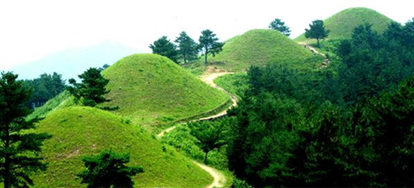
Shandong, Liaodong, and the Korean Peninsula, where Stone Age people kept migrating in from Southeast Asia, became the busiest crossroads of Neolithic human history. People dug embankments to make ponds and collect water, built earth mounds and tumuli to perform rites, and as agriculture began to develop, the population kept growing. The culture of earth fused with the dolmen culture of the Stone Age — hauling great stones from afar to erect shrines — and civilization and culture grew here earliest and fastest of anywhere in the world.
1.2 The Evolution of Agriculture in East Asia (Agricultural evolution at East Asia)
The climate of Southeast Asia has no winter in which water freezes, so people can live by gathering all year round. But in East Asia, once ice forms in winter, food cannot be found, so agriculture began: sowing seeds in spring, growing them in summer, and harvesting in autumn to prepare for winter. Solidarity in group life was necessary. Clan societies formed through bonds handed down from their forefathers, and wishing for the protection of heaven's weather and the spirits of their ancestors, the villagers gathered, hauled rocks from far away, and raised dolmens.
Judging only from the sites excavated so far on the Korean Peninsula, the Neolithic period is said to have begun before 8000 BC. Neolithic sites are spread evenly across the whole Korean Peninsula and are found mainly in the basins of large rivers or in coastal areas. The earliest is the Gosan-ri site on Jeju Island. Artifacts excavated from Neolithic sites include polished stone tools and bone tools such as fishhooks and needles. And it is said that comb-pattern pottery was widely used. We must look with even wider eyes than that.
The pottery of the Uruk people of Mesopotamia appears from 6,000 years ago, and Sumerian pottery appears from 5,000 years ago, so we can imagine that farming life in East Asia developed at least 3,000 years earlier than in Southwest Asia. From 10,000 years ago, East Asia's population expanded through an agricultural revolution; people built houses of straw and made boats of straw, and it seems they migrated to Southwest Asia and Western Europe along the coastal passage that had already been opened between Africa and East Asia from 50,000 years ago. Eastward they seem to have reached the North American continent and to have had exchange as far as the Peru region of South America.
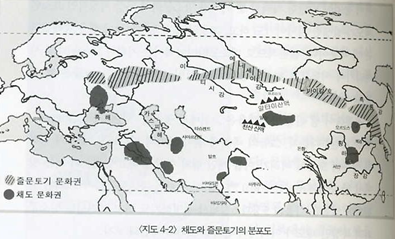
Lee Ki-hoon, author of Dongi Korean History (<동이 한국사>), introduced the world's first pottery in East Asia and said that pottery more than 10,000 years old has been excavated around the Korean Peninsula. Our country's Neolithic comb-pattern pottery appears from 8,500 years ago. Comb-pattern pottery with a pointed bottom appeared 7,000 years ago and, over about 4,000 years, spread westward, showing a distribution like the map below.
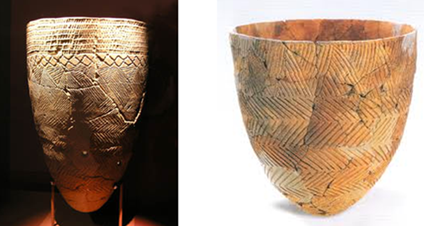
If we observe the life of the Neolithic people who raised dolmens, they used plain pottery made of fired clay, raised livestock such as cattle, dogs, pigs, chickens, and goats, and also used bronze metal tools. Plain pottery is the form that came before comb-pattern pottery, and it is a relic that shows a settled agricultural age. For a long time pots were not set on the ground but placed on wooden stands, so at first their bottoms were pointed; then, as pottery production became common, pots were set down on the ground and their bottoms began to become flat. As bronze metal tools began to be used, comb patterns appeared in pottery making, and the region where comb-pattern pottery is most commonly excavated in the world is the Korean Peninsula.
It is generally called "comb pattern" (빗살무늬) because the design was made by pressing or scoring short lines on the outer surface of the vessel with a comb-shaped tool. These comb patterns take various forms depending on the earthenware; the most characteristic in Korea are short lines drawn in one direction, or with alternating directions. The kinds of vessels range from large and small jar-shaped pots, crocks, and bowls to small dishes. Some are made of clay mixed only with sand, and some are mixed with things like asbestos or talc fragments, and brown is the basic color. They were generally fired at about 600–700°C, which can be done with a wood fire in a pit dug in the ground without any special facility. It seems they were first used as ritual vessels for ancestral rites, and then each came to be used for storage, cooking, and tableware in daily life.
We can see how comb-pattern pottery, which began on the Korean Peninsula, spread widely through the surrounding regions, such as China's Dongbei [東北, the Northeast] and Primorye [沿海州, the Maritime Province], and passed through Siberia to be distributed across northern Europe as Kammkeramik (櫛文土器). Judging from the simplicity of the designs and from radiocarbon dates, the comb-pattern pottery of the Korean Peninsula is estimated to have begun earliest. The places where Neolithic sites are distributed can be broadly divided into four: the northeastern coast, the west coast, the east coast, and the south coast.
[Pottery is distinguished by] material (base clay), color, thickness, hardness, design, and vessel shape. At the Amsa-dong site on the middle Han River, the traditional vessels are of sandy base clay shaped like half an egg and are mostly decorated with herringbone (fishbone) patterns, which shows they are the products of a seafaring people, and by size they divide into about three kinds according to use. At the Jitap-ri site in Hwanghae Province and the Seopohang and Nongpo-dong sites in North Hamgyeong Province, pottery of sticky clay with flat bottoms appears from an early period. Going to the Osan-ri area of Gangwon Province, sticky-clay pottery with flat bottoms and mainly impressed designs appears.
Going to the south coast region, we can see that flat-bottomed and round-bottomed (including pointed-bottomed) pottery coexisted from an early period. So the pottery shapes must also have been varied. There is much plain pottery here, and in particular appliqué-pattern pottery has been unearthed, so it seems to have begun earliest. That early pottery forms — plain pottery and simple comb patterns with egg-shaped bottoms — began at the southern tip of the Korean Peninsula, while the later features of flat bottoms and complex comb patterns appear the farther one goes toward the northeastern Korean Peninsula and Siberia, leads us to surmise that comb-pattern pottery began at the southern tip of the Korean Peninsula.
Oxen pulling plows began in Southeast Asia, and the practice of rolling logs to move megaliths also began in East Asia, so it seems the history of the wheel was a technology that brought great change to human life, just as the world's languages began in Southeast Asia. The history of wheeled things — the spinning wheel and the water mill, the rickshaw, the oxcart, the carriage, the chariot, and so on — is connected to the development of Neolithic farming life. The rickshaw is a two-wheeled cart pulled by a person. It is the earliest form of the cart, and it is still used in East Asia today.
According to "Eden in the East by Stephen Oppenheimer 1998," archaeologists' recent excavation reports trace agricultural remains in Thailand to 15,000 years ago and remains of rice farming to 9,000 years ago. The round millstone, which grinds grain to strip off the husks and make flour — when you turn it while feeding dry grain between the upper stone and the lower stone, the husked grain flour is pushed out between the pressed stones, so it is also called a dorigae — was in use 26,000 years ago among the ancient relics of the Indonesian islands, and it has been used until recently as a necessity in the lives of Southeast Asian nations and the native peoples of North and South America. These farming tools are said to have spread westward and been used in Egypt and Southwest Asia 12,000 years ago. The dorigae too was made after metal tools came into use.
Charles Higham explained that these people farmed rice and described their living area extending from here to the mouth of the Yangtze River, and Wilhelm Solheim argued that their agricultural culture had been applied to daily life since before the earth's deglaciation (12,000–7,000 years ago). It is said that the Stone Age industrial revolution of putting clay into fire to bake vessels occurred in Southeast Asia 12,000 years ago and appeared in Southwest Asia 9,000 years ago. Thailand, Cambodia, and Indonesia were connected by land before Europe's glaciers melted and the sea level rose, and it is said that Austronesians who used Austro-Asiatic languages lived there. Research on their Neolithic life has been reported by many scholars.
1.3 The Evolution from Dolmens to Stone-Mound Tombs (Dolmen building to pyramid building)
The changes in life and the development of culture in the Neolithic period on the Korean Peninsula changed greatly over a long span of time. The matrilineal family that depended on gathering natural foods in primitive times changed into the patrilineal family of productive farming, and plain pottery industrialized into comb-pattern pottery. The process of change in East Asia — from the lying dolmen symbolizing the female, to the standing stone (menhir) symbolizing the male, and then to the shrine with a lying stone (capstone) set on two standing stones — is a prehistoric evolutionary process that can be seen nowhere else in the world. We see that on the Korean Peninsula, where modern humans settled earliest, these prehistoric changes happened in one place alone. Soon after, we also see here the birth of stone-mountain (pyramid) culture, as the earth-mound culture of the south joined with dolmen culture.
Before they could yet build wooden boats, people made boats of straw and migrated from populous East Asia to sparsely populated Southwest Asia and to Europe as it emerged from the ice age. Humanity's shipbuilding skills began as early as the use of fire to cook food. Humans, who can live only where there is water, began tying logs together to float on the water, and weaving bamboo together to use as boats is still commonly seen in East Asia today. The boats made before there were metal tools were straw boats.
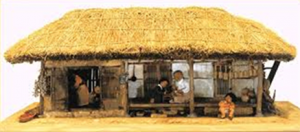
Like the thatched roofs of houses on the Korean Peninsula (photo below), seaside farmhouses were roofed with the straw or reeds left over after the autumn harvest. That boats were made by weaving straw and reeds can be seen at the Jeju Island museum in Korea and in many places in Southeast Asia, and it is the oldest shipbuilding method in human history, commonly seen in Peru in South America, which is connected to Southeast Asian culture. That straw boats remain on each continent leads us to imagine that there was an age of seafaring connecting the continents before the Metal Age. Korea's thatched roofs and straw boats are dwelling and shipbuilding methods handed down from the Stone Age, and they have been well preserved on the Korean Peninsula.
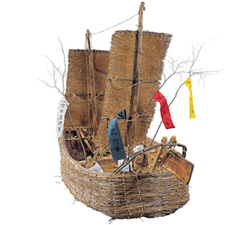
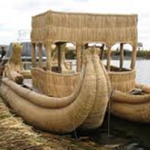
From the Stone Age, before wood was worked with metal tools, until now, people have built ships and understood the seasonal changes in weather and climate and the direction of ocean currents, so they could make ocean voyages. It leads me to imagine that the East Asian forebears, accustomed to the four seasons, were used to long-distance travel like migratory birds, and had the ability to fast and hibernate for longer periods than today's Eskimos, so they had the endurance and survival skills to cross the Pacific from the island nations of Southeast Asia, using currents and winds running parallel to the equator, and reach the Pacific coast of South America (Peru). The phenomenon of East Africans living in New Guinea and Polynesians living in South America is the connection of the equatorial currents. It seems East Asians also began living on the islands of Samoa and Tonga from this time.
As metal weapons and tools first appeared in the dolmen culture of the Stone Age, the technique of making metal over East Asia's coal fires appeared first in the world. The lute-shaped (bipa-shaped) bronze dagger is a bronze artifact unique to Korea, made in the Liaoning region of what is now northern China as well as in many parts of the Korean Peninsula, and it is clearly distinguished from Chinese bronzes. It is thought to be the product of advanced technology different from China's scientific civilization. Metal weapons and tools are the beginning of human civilization and brought revolutionary change to human life. The East Asian custom of building earth mounds for graves and altars began to produce stone-mound tombs from the time rocks were worked with metal tools, so the culture of building stone-mound tombs (pyramids) also began in East Asia.
In his book (The Prehistory of the Indo-Malaysian Archipelago, 1985), Peter Bellwood explains that these people beat tree bark to make fiber and wove clothes to wear, made paper, used bamboo blowpipes — blowing through a bamboo stem so the poisoned dart inside would strike an animal — as a hunting weapon, and raised huge rocks to perform rites; and that the dolmen, a grave made by standing up three huge rocks carried from afar and placing a flat rock on top, was distributed across the island of Taiwan, the Yellow Sea coast, the Korean Peninsula, and as far as Japan. Wilhelm Solheim says these were a seafaring people (Oceanian) who built boats and sailed the seas 7,000 years ago.
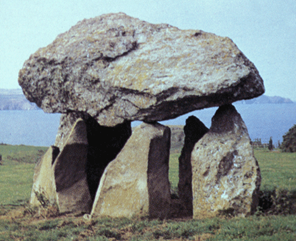
Hauling huge rocks from far away to erect sacred sites was a form of religion, and it was a custom that began between 60,000 and 10,000 years ago in the places of Southeast Asia where population was concentrated, where there was leadership and there was labor. Because the seafaring people with this megalithic culture had already opened the way from Africa to East Asia 50,000 years ago, traveling back and forth from East Asia to the Atlantic was not difficult. I believe that before the deglaciation they passed along the coastline through southern India, Southwest Asia, and the Mediterranean, reached the coasts of Spain and Britain, and left megalithic remains. The cave paintings in caves of southwestern France and northern Spain, painted during the ice age 30,000 and 40,000 years ago, also seem to have appeared through cultural exchange along the Eurasian coastal passage opened 60,000 years ago.
As metal weapons and tools emerged from dolmen culture, natural boulders developed into artificially dressed square blocks. The natural-stone stone-mound tomb changed to square blocks and became the stepped stone-mound tomb (pyramid). Britain's Stonehenge is an evolved form in which dolmen stones were dressed with metal tools and set up. It is said to have been erected between 3,000 and 6,000 years ago by a foreign people who had immigrated 10,000 years ago; it is explained that they brought 30 megaliths from a long distance by land and sea routes, stood them up, laid flat stones on top, and inside it placed five pairs of megaliths facing the sun. The circular layout is a plan already established in East Asia as the realm of the gods. If you look at the plan of Seokguram Grotto in Gyeongju, the front part is square, the space of humans, and the rear is a circular plan, the realm of the divine.
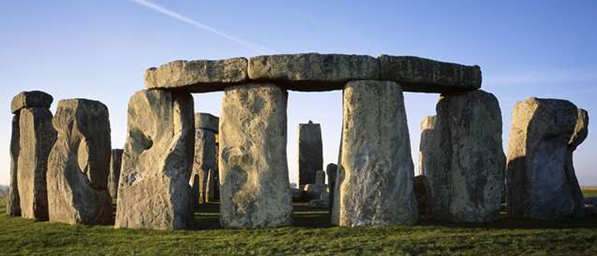
In Korea, Lee Young-moon published The Story of Dolmens (고인돌 이야기), and KNN, a broadcaster under Korea's Communications Commission, produced a documentary titled The Dolmen Route (<고인돌 루트>). Putting together "The Footsteps of the Dolmen," it explains the history of dolmens as follows. Passing through the Paleolithic age, which followed the sun god, ancestral religion and celestial religion appeared, and at the end of the Neolithic, beginning from 8,000 years ago and lasting 3,000 years until the Iron Age, was a time of Bronze Age life using plain and comb-pattern pottery. The early southern-style custom of hauling natural megaliths from afar, laying them down as covers over ancestors' graves, and performing rites later developed into standing up the stones as standing-stone graves. Eventually the northern style appeared, raising the dolmen by placing a flat capstone on top of two standing stones. This evolutionary process of the dolmen can be seen only on the Korean Peninsula.
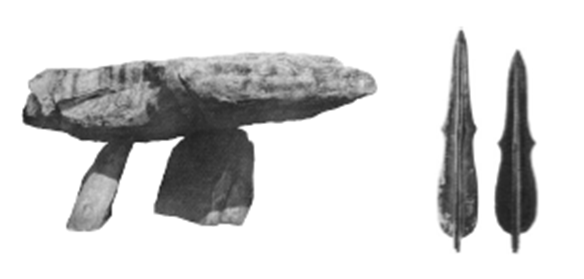
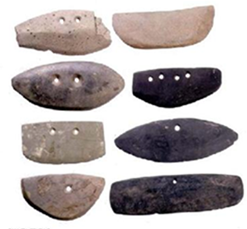
In our country, not only dolmens but also stone daggers (石短劍, 磨製石劍), the prototype (原型) of the sword, have been found in the greatest numbers — uniquely in the world. The bronze cultural relics of Gojoseon in the Manchurian region have been excavated and dated to 4,400 years ago, and the bronze relics of the Yellow River region are from 4,200 years ago. [One type] is the very earliest shape transformed from the stone daggers found in South Korea into a metal bronze dagger; the blade (劍身) and hilt (劍把) of the stone dagger are joined as one piece. We then see a change in form made by attaching yet another hilt to this. It seems the lute-shaped dagger was first made in the south coast region of the Korean Peninsula and then, with the movement of the peninsula's people, was produced in large numbers in Manchuria. The straight-bladed swords excavated in the coastal areas of Britain and Europe are similar in form to the stone daggers made in South Korea. Clearly, when we look at dolmens and the relics found in them, we can see that Europe's dolmens and relics spread with the movement of the seafaring peoples of the Korean Peninsula.
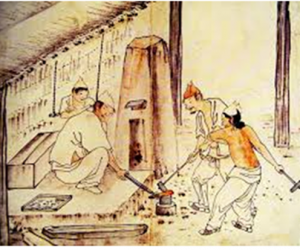
The scene in the painting The Smithy by the Joseon-dynasty painter Kim Deuk-sin shows bronze metal tools in use, which at first was the industrial revolution of prehistoric times. Using wooden implements was the furniture of matriarchal society, but as metal tools came into use, industry developed and men's social role began to stand out. Natural stones came to be dressed into flat slabs, and large stones were made into six-sided rectangular blocks that were easier to transport. In place of the wooden coffins and jar burials of ancestral religion, stone-cist tombs began to appear. Patriarchal society, advancing from the gathering-type agriculture of matriarchal society to industrial-type agriculture that dug the earth with metal tools, emerged as dominant. East Asia's industrial revolution in the dolmen age seems to have begun human history anew, like a mutation.
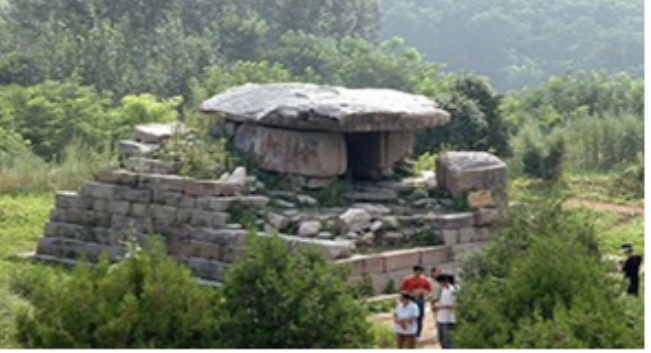
Through KNN's coverage of dolmens at 30 sites in seven countries from the Korean Peninsula to Europe, the vigorous maritime activity of seafaring peoples, including the ancient Hae (Hwan, Han) people, is newly appearing in human archaeology. The dolmens are most concentrated in the world at the southern tip of the Korean Peninsula; including the surrounding areas of the peninsula they number 40,000, and they are linked along the coastline to Southeast Asia (10,000) and on to Western Europe, distributed at some 80,000 sites in all. These are the remains of the route of modern humans who left Africa and reached the Korean Peninsula, moving along the coastline eastward as far as South America and westward along the coastline as far as Western Europe.
The time has come for today's intellectuals, who say that Europe's dolmens are remains made by extraterrestrials (外界人) and imagine that Mediterranean culture came from Atlantis, to wake from that dream. The architectural style of the dolmens scattered across Britain's Stonehenge, the Bretagne (Brittany) region of France, Spain, and elsewhere is a much later, more advanced form compared with the early style of the Korean Peninsula. If the dates of Europe's dolmens go back only 4,000–5,000 years from now, the dates of the Korean Peninsula's dolmens go back more than 8,000 years. In the many places on the coasts of Western Europe where the Neolithic seafaring peoples of East Asia migrated in along the coastline, the language and customs of East Asians remain. I predict that such evidence will appear more and more as knowledge of East Asian history spreads.
1.4 The Evolution and Distribution of Pyramids (Pyramid evolution and distribution)
In his book Voyages of the Pyramid Builders, published in 2003, Robert M. Schoch suggested that the Maya culture of Central America was an extension of the Shang culture of East Asia, thereby suggesting the possibility that the roots of the world's pyramid-building technology lie in East Asia. Just as humanity's past is hidden in the mother's womb, the evolution of the pyramid seems to be hidden in East Asian culture. Because the pyramid is a building, I will try to explain it from an architect's point of view. The people who began building pyramids were a people with the custom of building mounds and raising dolmens. That Neolithic people lived at the southern tip of the Korean Peninsula in East Asia, and from 50,000 years ago they were the first of modern humans to farm through the four seasons and begin a disciplined life of enduring the winter. [Building pyramids] requires religious labor grounded in science, technology, and organizational power, which would be hard to emerge in the tropics. It is the result of a long history of growth, not an event that would appear suddenly. The stone-chamber tomb enshrined inside a pyramid resembles the structure of a dolmen, which shows that the pyramid evolved from the dolmen.
The custom of making graves that honor the spirits of forefathers in a round shape out of earth began on the Korean Peninsula and led to the building of earth mounds. The custom of making graves that honor the spirits of forefathers in a round shape out of earth began on the Korean Peninsula and led to the building of earth mounds. The pit houses in which people lived became conical or square-pyramidal. That pyramids were later built as square pyramids developed from the intention of building the ancestors' tomb as a stone house for the ancestors in the shape of a living person's house.
In 1982, dozens of jade objects, including jade earrings, were excavated at Xinglongwa village in Chifeng City and identified as relics from around 6200 BC; they were introduced as the Xinglongwa culture, and they are the same as those excavated from the shell mound at Munam-ri, Goseong County, Gangwon Province, in Korea. It is said the jade is of the quality buried in the Xiuyan area along the Yalu River. The Chahai culture, Fuhe culture, and Zhaobaogou culture excavated around the Liao River are gathered into the world-famous Hongshan culture (BC 4500–BC 3000), which represents the Liao River civilization.
The features of the Hongshan culture include a refined pottery culture; carving with metal tools jade brought from distant Baekdusan Mountain; breaking large rocks with metal tools into the needed sizes, hauling them far, and building stepped stone-mound pyramids; and making small, delicate stone coffins in which to lay the dead. Hongshan jade carving was 1,000 years ahead of the Yellow River civilization, and its stepped stone pyramids were 2,000 years ahead of Egypt.
A pyramid is a great tomb built of stone. It is made of two elements combined. The first is a religious practice that began in the custom of ancestor worship, believing in eternal life by preserving the bodies of the ancestors or oneself forever; the second is the technology of handling large stones and the management of the devoted labor of the masses. The attitude of filial piety to parents and loyalty to the king in East Asian Confucian thought has the roots of its long history in the moral life of East Asia before Confucianism, and on the basis of the astronomical knowledge of yin-yang and the Five Elements and the science of construction technology, huge stone-mound pyramids could be built. The remains of thousands of stepped pyramids widely scattered around Jilin along the Yalu River and on the outskirts of Xi'an, including the Tomb of the General of Goguryeo, seem to prove that this is the home of the pyramid. It makes me think that the pyramids of Africa or South America, which did not go through an evolutionary process within tens of thousands of years of living customs, are a culture imported from outside.
The cluster of pyramids on the outskirts of Xi'an, first made known to the world by an American transport pilot in 1945, is said to have drawn the interest of Chinese archaeology only in 1963. Together with the pyramid groups around Jilin Province in Manchuria, it is the largest concentration of pyramids in the world, numbering in the thousands. According to Korean-Chinese Archaeological Studies (<한중고고학연구>), 1994, a translation of the original, Wang Zhongshu (王仲殊), "Introduction to Ancient Chinese Tombs" (中國古代墓葬槪說), Kaogu (<考古>) No. 5, pp. 449–458, there is a description of burial mounds of the so-called square-pyramid (方錐形) type — that is, the shape of a four-sided pyramid — in several tombs of the Warring States period (春秋戰國時代, 770 BC – 221 BC). And it was proven that the tombs around Xi'an were already royal tombs of the Western Han period. Some of these styles are also called truncated square pyramids (截頭方錐形).
Because relics of the Dongyi people dating from before 3,000 BC were excavated among these pyramids, it is said that China's Xinhua News Agency at the time even reported, among other things, that "Chinese civilization was formed by accepting the civilization of the Dongyi, the Gojoseon people." At that time the Han Chinese farmed in the Yellow River basin, and the Mongols were beneath their notice. The Khitan, Wuhuan, and Jurchen were regarded as complete nomads, far removed from settled civilization.
The early form is stepped, each tier lower as it rises, like the Tomb of the General (將軍塚) of Goguryeo in Manchuria. It has the same form as the tombs of Goguryeo. Scholars call it the inset-stacking method. It is a Goguryeo building technique not found in China or Japan. No scholar disputes this point. Among the outskirts of Xi'an, a place called Banpocun (Banpo) is also an ancient site of the Yangshao culture where large numbers of relics from 7,000 years ago have been excavated.
The German author HartwigHausdorf's book was introduced as "Das chinesische Roswell (German): Ufo Encounters in the Far East from Ancient Times to the Present." Many of the photos in it are boldly stamped "Photo by Hartwig Hausdorf." Those photos are of the pyramids near Xi'an. The Chinese government expelled him. It is not a rumor with exact grounds, but it is a plausible story.
The following is said to be the testimony, given before his death, of the late Zhang Wenqiu (張汶邱), a Chinese excavation expert who took part in excavating the pyramids of the Xi'an region.
"In April 1963, our antiquities excavation team of 36 people received orders from the authorities to stand by, because we were to survey a site presumed to be another tomb of Qin Shi Huang. Before departure, the head of the survey team told us team members that this site was very important and that we must take special care never to leak anything about the survey and excavation to outsiders. Our group rode trains, buses, and trucks in turns and in two days arrived at our destination, a wide plain. Outside the windows were many huge pyramids like the Egyptian pyramids, and all of us team members, as soon as we arrived, cried out in amazement. It was a mixture of joy and wonder — 'So there were pyramids like this in our China too!' We began excavating this tremendous site, another one belonging to Qin Shi Huang, who first unified China.
"Our survey team was divided into four teams, and over the next three days we began excavating, first designating the three central pyramids in order of size, largest first. All three were of almost the same form, but the middle one was more magnificent than the two on either side. When we went into the underground entrance of the huge brick pyramid, the stone chambers were divided into about three to five levels, and the farther we went into the upper spaces, we found in great quantities: murals splendidly composed with pictures of horses and chariots, paintings, various writings, and some 6,200 carvings; some 1,500 household implements such as millstones, mortars, cauldrons, and bowls; some 400 food items such as animal bones; some 7,800 grave goods including bronze swords, bows, gold crowns, knives, spears, and ornaments; 14 bodies, including one in the very center with a topknot (the hairstyle of East Asians); and some 3,000 guardian figures.
"Faced with these tremendous relics and remains, which we were seeing for the first time, all of us felt as if bewitched, as if we were excavating the world of aliens, the tomb of aliens. My job was to check the relics and make a list, and on the third day of work about 70 percent had been identified and recorded. That afternoon, when I gave an interim report to Professor So-and-so, who was then head of the excavation, he let out a great sigh and said: 'These are not the relics of us Yellow River people; these are the remains of the Joseon people. It is the Joseon civilization before Chinese history!' And he said, 'This is serious. First we must report to the authorities and then receive instructions again, so stop all the excavation so far, leave all the relics where they are, and for today, let's get out!' So we all stopped excavating, came out, and stayed at our lodgings.
"That night, together with the halt to the excavation, an order to withdraw was issued. All of us team members found it strange, but we soon understood it was because the site was not ours; before leaving, at our lodgings, the group wrote and submitted to the local public security officers a pledge to keep the secrets of that place, and since returning that way, I have never heard any more news about those pyramids. That was the last of those pyramids for me, and it is all I know." — so goes the story that circulates of what he said.
Because the Qin dynasty was situated like that in China's northwest, it seems Chinese historians were for the first time put in the awkward position of treating the world's first empire, the Qin dynasty and Qin Shi Huang, as barbarians — that is, as Xiongnu. It seems that when the Chinese government, excavating from the 1960s, found relics of the Dongyi people (Gojoseon and Goguryeo) coming out, it halted the excavation and began the Northeast Project, launching first the policy of including them in Chinese history. The Northeast Project is an effort to include the Qin dynasty, the first unified state of East Asia, within China. The excavation of the tomb of Qin Shi Huang, a Dongyi, remains halted even now.
The path by which the East Asian peoples advanced from the Korean Peninsula to Manchuria, from Manchuria to Mongolia, from Mongolia to Tibet, and on westward, crossing the Asian continent, conquering the steppes, and reaching Eastern Europe and Southwest Asia, later became the Silk Road. The road by which the Huns, pushed out by Qin Shi Huang, invaded Rome, founded 200 years after the Qin dynasty, is the Silk Road along which East Asians had advanced westward over tens of thousands of years. Along the Silk Road, Qin's rule is estimated to have been a great empire reaching as far as present-day Kazakhstan.
From the Neolithic period, in the southern Korean Peninsula, people built small hills from the great amount of soil left after digging the reservoirs needed for farming. Sometimes they became altars for offering sacrifices to heaven and sometimes large burial mounds (Mound), so many still remain at the southern tip of the Korean Peninsula today, and I have already explained that this culture connects to the Mississippi River basin in North America. The pyramid began from tombs built as great hills of earth. The large turf-covered tumuli scattered around Osaka and Nara in Japan are none other than the tombs of the Buyeo people who migrated to Japan from Baekje in the southern Korean Peninsula. Of these, the largest tumulus is known as the tomb of Emperor Nintoku (仁德王). Now only one layer of moat surrounds it, but originally three layers of moats surrounded it, with a total length of as much as about 1,000 meters. This scale reaches half the size of the Egyptian pyramids.
In the Neolithic period, as metal tools from the coal fires of Manchuria began breaking natural stone into square blocks, thousands of stepped pyramids began to be built around Jilin Province in Manchuria and on the outskirts of Xi'an. The Tomb of Dangun that North Korea says it excavated is also entirely a pyramid-style stone-mound structure of seven and nine tiers. And in the "Sanseongha tomb group" below Hwando Mountain Fortress in Ji'an City, thousands of large and small pyramid-style stone-mound tombs still lie scattered. All of them connect with the stone-mound tombs of the Hongshan culture.
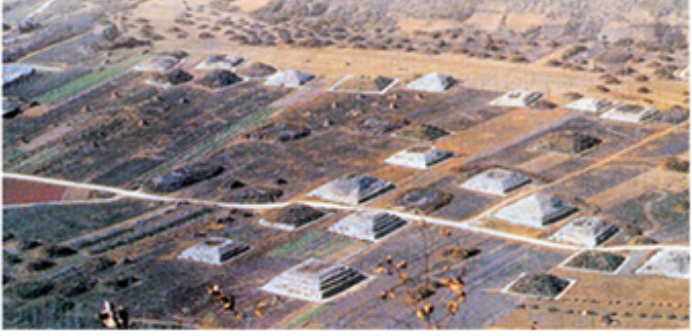
(Pyramid-style stone-mound tombs of the Sanseongha tomb group in Ji'an, China. Courtesy of Professor Woo Sil-ha)
We can see that, in the Neolithic culture of East Asia, thousands of years of metal culture and the social competition of a high population density brought by agricultural development made it the cradle of human culture and civilization. Around the Korean Peninsula there are countless remains of the pyramid's evolution, passing through burial hills built of earth and the megalithic culture of dolmens. The pyramids that appeared on the African continent and the South American continent are a mutation-like phenomenon, and their process of growth cannot be found. The highly refined furniture and craft culture that appeared there suddenly also suggests that its roots lay not in Africa or Central and South America but in East Asia. The roots from which culture and civilization grew earliest are here, where the nomadic life of Manchuria and the farming life of the south joined together in East Asia.
The Aztec culture on the outskirts of Mexico City erected the pyramids of the sun and moon (Teotihuacan Pyramids), and their size is similar to that of the Egyptian pyramids. In front of the Pyramid of the Moon a festival avenue stretches two miles long, and on one of the pyramids a living, writhing East Asian dragon is carved. If East Asia's pyramid culture could be carried across the Pacific, we can easily imagine it being carried to the Mediterranean, which is reached by land and sea routes. The process by which the pyramid was conceived and, through labor pains, born over thousands or tens of thousands of years can be seen around the Korean Peninsula, but it cannot be seen in Africa or Southwest Asia, nor in the Americas.
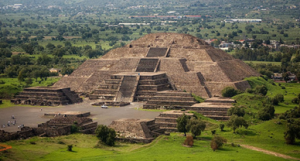
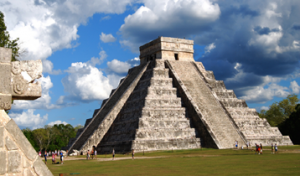
The pyramid carved with the majestic form of a writhing dragon (Chichen Itza & the Pyramid of Kukulcan), near the Mexican resort city of Cancún, is a representative work of Central American culture showing the form of the East Asian blue dragon. Dragon-head carvings are commonly seen in Maya civilization, and the fact that they made elephant faces and carvings like those seen on East Asian bronze relics into pyramid decorations vividly shows the connection with East Asian culture. The tumulus culture and standing-stone culture that evolved in East Asia over tens of thousands of years of the Stone Age were carried to many places in the world over thousands of years. The thousands of stone-mound tomb sites in Jilin, Manchuria, and in surrounding areas including the outskirts of Xi'an in the northwestern interior, including the Goguryeo tomb groups, are a world heritage of East Asian culture.
Culture and civilization pass from places of high population density to places of low density. There are four ways they are carried great distances across the world. The first is the great migration of a clan or a people, which takes place over a long time. The second is commercial connection, a phenomenon of distribution over land or sea routes — as the spices and silk of Southeast Asia were carried to Southwest Asia and Europe, or as the Taoism, Confucianism, and Buddhism of East Asia were carried to Southwest Asia as Christianity or Islam. The third is distribution following abrupt political change. It is the phenomenon of an invader passing its culture and civilization to the invaded region or absorbing the local culture, and it happens over relatively short distances between neighboring regions, as in the relationship among Korea, China, and Japan. The fourth is the way in which a group of the political elite become desperate fugitives and carry the people accompanying them, along with their knowledge and way of life, to the place where they take refuge. Desperate fugitives are formed when a new ruler intends to wipe out the old ruler and all the nobles loyal around him; then enormous, meticulous preparations begin, and they go to a distance beyond any pursuit.
I imagine that the pyramids carried to Central America are the third case, and the pyramids carried to the Nile might be the fourth case. The Han Chinese who lived in the Central Plains on the middle Yangtze conquered the many states of the Korean-Peninsula-descended seafaring people (the Dongyi) who had lived at the river mouths and on the lower Yellow River — Shang, Yin, Shu, Yao, Qin, and others — and established invader states, as when they founded the Zhou dynasty. At this time, along the land and sea routes that were already open, the kings and nobles of the many Dongyi states carried out the greatest exodus in East Asian history so as not to become sacrificial victims or slaves of the Central Asians. According to the records of Sima Qian, when the Dongyi Shang dynasty, at the height of its culture, was invaded by the Chinese Zhou dynasty of Central Asia, about 250,000 people escaped. It seems they had knowledge of the land routes and sea routes to Africa on the Mediterranean coast, and could make a desperate flight by land to the North American continent and along the equatorial sea route to South America.
The enormous structure of the pyramids built 3,000 years ago is all the more astonishing because it is a building made possible only against a religious background, with advanced science and the organized management of vast labor. Meanwhile, around that time many stepped pyramids were also built in Peru on the Pacific coast of the South American continent, and a little later the pyramids of the sun and moon appeared in Central America. When we see the possibility that the people of the Korean Peninsula and the Yellow Sea coast — with a high population density from the Neolithic period and a fine religious culture and metal civilization — connected with the South American continent and Africa through ocean voyages using the compass, we come to look at world history again with new eyes.
2. The Global Position of East Asians Seen on the World Genetic Map