 Yong Wan Bryan Choi한국어
Chapter 6: The Culture of the Native Peoples of the Americas Began in East Asia
Translated from the Korean original. Read the Korean original
- The Culture of the Native Peoples of the Americas Began in East Asia
Until a few years ago, European historians insisted with every ounce of effort that the culture of the native peoples of the Americas had crossed over from Europe, but around 2010, when the genetic study of human lineages revealed that the bloodline of East Asians is the lineage of the native peoples of the Americas, they fell silent. The relationship between East Asian culture and the culture of the native peoples of the Americas seems to span 40,000 years.
Seeing that Maya glyphs, like Chinese characters, convey meaning as a single word, take the shape of something contained within a square, and are read left to right or top to bottom, I imagined the possibility that they were connected to the matrix that preceded the Chinese characters standardized in the Han dynasty before the Common Era. They differ from the oracle-bone script of the Shang dynasty, but I saw a commonality in that they are composed of combinations of dots and straight lines—the way numbers were marked in the I Ching of the Zhou dynasty—which are the basic building blocks of Hangul. From that time on, over the past thirty-some years, I have visited the national museums of various countries and the cultural sites of the Olmec, Teotihuacan, Aztec, Maya, and others across Central America's Yucatán Peninsula. Through many books and video materials and attendance at scholarly meetings, I have organized the commonalities between East Asian culture and the culture of the native peoples of the Americas as follows, and present them here for the first time.
(1) Agriculture, which began in East Asia with preparation for winter, was well transmitted to the native peoples of the Americas as well. Grinding grain with millstones and mortars and using a winnowing basket to blow away the husks in the wind are the same as the customs of life on the Korean Peninsula; they also thresh with flails and use treadle mills, and their looms, used to dry hemp and make cloth for wearing collared jackets, are similar too. In the customs of the Central American region, dogs, chickens, and pigs are raised and eaten. Just as we enjoy food made with spicy red pepper powder, they enjoy spicy Tabasco. They smoke tobacco with long pipes and love to play the flute. One can commonly see sculptures that give the impression of hat-wearing figures similar to the dol hareubang of Jeju Island in Korea.
(2) The culture of raising earth mounds, thousands of which were built around the Great Lakes of North America and in the Mississippi River basin, is of a piece with the mound culture of the southern Korean Peninsula and the east coast of China. The mounds were made by digging a reservoir the village needed and piling up the earth into a small hill, making an altar for offering rites to Heaven. Most of the reservoirs have disappeared, but the mountain-shaped mounds can still be seen. Hundreds of mounds are scattered across the southern tip of the Korean Peninsula, and the tombs of Baekje and Silla also belong to these customs. The Maya pyramid is an architectural style with the priest at the top. Later, the stone-mound tomb became, like other pyramids, the burial place of village nobles.
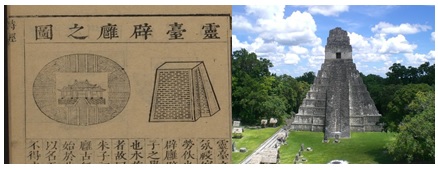
(3) The stepped pyramids distributed along the Pacific coast of South America are of the same style as the thousands of stone-mound tombs in the Jilin Province area of Manchuria and on the outskirts of Xi'an, and there is a process by which triangular pyramids appear. The arch of Maya stone architecture is the same style as the stepped roof (corbel arch) seen in Goguryeo tombs. The high staircases of Maya stone towers, which seem to connect heaven and earth, resemble the ancient East Asian religious architectural style that remains at the entrances of Chinese temples and in Japanese Shinto shrines.
The altar type is a flat elevation, and in East Asia, as the view below shows, the staircases of our country's Bulguksa Temple and the miniaturized staircases of the Dabotap Pagoda carry the same meaning. The El Tajín stone tower on the Yucatán Peninsula recalls, in scale and form, the stone pagoda of the Mireuksa Temple site of Baekje. Maya stone towers come in two types, spindle-shaped and altar-shaped; in East Asia the altar-shaped stone tower can be seen only in documents. Indian stone stupas are of the same form, showing that the type originally existed in East Asia as well.
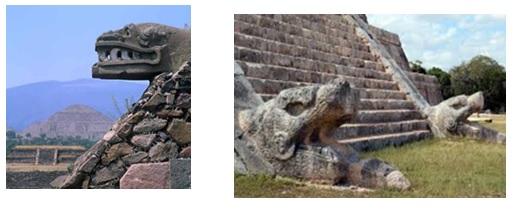
(4) The form of the dragon built into the Teotihuacan ruins of Mexico, where the Pyramids of the Sun and Moon were raised, is the same as the form of the dragon in East Asia, except that its body is made of bird feathers instead of fish scales. At Chichén Itzá on the Yucatán Peninsula one also sees a dragon coiling around a pillar. The dragon's face, the gwimyeon [demon mask], is the form seen on the roof tiles of Baekje and Silla architecture on the Korean Peninsula, and is common in the sculpture of Shang dynasty bronze artifacts. The gwimyeon with an elephant's trunk carved on Ming dynasty incense burners can easily be seen on the elevations of Maya buildings.
(5) The long jade-stone blade on the spear tip that native peoples across the whole North American continent used for hunting large game is called the Clovis spear point. A tool used so widely was produced unchanged for tens of thousands of years. It is a tool attached to spear tips for hunting large game throughout Northeast Asia, including around Lake Baikal in Siberia, and it seems to have been transmitted to North America as a weapon used by Neolithic primitive people. The half-moon-shaped stone knife with a handle resembles a fan and is called a fan knife. It is a knife for slicing meat, found throughout Asia and also throughout North and South America. The iron fan knife is still used in modern life, including among the Eskimo peoples of Siberia and Alaska.
(6) There are religious concepts of yin and yang and the concept of the Five Elements; two calendars are used, like the lunar and solar calendars; and just as East Asia has the twelve earthly branches and the 60-year cycle, there are cycles of 13 years and 52 years. The offering of human sacrifices was the system of burying the living with the dead (sunjang) that existed for a long time in the ancient history of East Asia. The site plan (garam layout) of the temples, with a north–south axis, the tower at the center, and gates on four sides, resembles the layout of East Asian palaces and temples. This kind of plan later developed into city planning. The grid city planning of East Asia can also be seen in the Maya city of Palenque. On going to war, building beacon towers on high places, lighting fires, and sending black smoke into the sky as a signal, and beating drums to send signals far away by sound, is also a phenomenon commonly seen in East Asia.
(7) Mexico has the Pyramid of the Sun and the Pyramid of the Moon, and the five animals symbolizing the Five Elements are represented by the serpent, eagle, jaguar, crocodile, and toad, a phenomenon corresponding to the Five Elements symbols commonly seen in Korea's Goguryeo culture—the Blue Dragon, Vermilion Bird, White Tiger, Black Tortoise, Yellow [center], and so on. There are many four-syllable names, such as Minnesota, Wisconsin, and Minnehaha; Korean history had many four-syllable names, such as Eulji Mundeok, Yeon Gaesomun, and Bak Hyeokgeose, which resembles the habit of four-character phrasing in Chinese, and the Japanese all use four-syllable personal names. The lower garment of the Maya is the same as the Japanese loincloth (fundoshi).
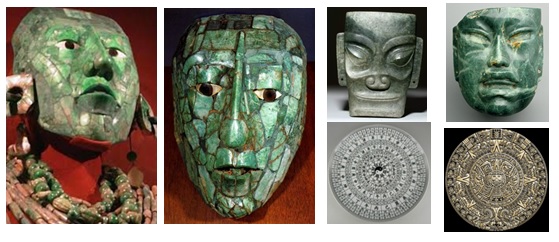
(8) The ancient Chinese made jade stones round like coins with a round hole in the middle, wore them on the body as ornaments, called them taotie, and said they warded off evil spirits. Taotie are commonly seen in the dress and ornaments of Maya nobles. That the faces of those conducting rites at festivals were covered with masks corresponds to the custom of the gwangdae [masked performers] in Korea. The bodies of Shang and Buyeo kings had their bodies and faces covered with pieces of jade. The bodies of Maya kings had their bodies and faces covered with pieces of jade. It is said that, according to Buyeo funeral custom, when a Buyeo king died, a jade suit of armor, the okgap, was placed in the tomb as a grave good. The East Asian calendar and the Maya calendar are similar.
(9) Among the sculptures of human figures in the National Museum of Mexico is a sculpture of the kind of figure performing tricks on a stage that the Chinese commonly make. The museum displays evidence that Ming dynasty porcelain was traded. Among North American native peoples one can see the custom of decorating the hair with Chinese coins. On the Korean Peninsula, jangseung [village guardian posts] were carved on tall poles and set up at the entrance of villages, and in many places in North America, including Alaska, one sees many totem poles carved with birds and people and raised high. In the speech of Canadian Indians, much that feels like our Korean language still appears. Farming terms such as "sal (ssal, rice)," "irang [furrow ridge]," "gorang [furrow]," "homi [hoe]," and "jaenggi [plow]" are nearly the same as our words.
(10) East Asia's navigational compass, the oldest in the world, was also used in the Peruvian culture of South America, and the East Asian custom of recording by tying knots in cords can also be seen there. In a scene where an elderly woman of the Inca Empire was interviewed, when asked, "What do you call a woman who has not married?" she answered, "chenye," so there may be many commonalities, like the Korean word "cheonyeo" [maiden].
(11) In the East Asian region and on the Korean Peninsula there was the custom of pyeondu, deforming a baby's head to flatten it. Perhaps such a custom resulted in today's descendants with flat faces and flat backs of the head. Museum exhibits show that the pyeondu custom also existed in Central America. As seen in the old customs of our country, there is the custom of decorating heavily with bird feathers and wearing brilliantly colored clothes. As recorded in Korea's Samguk Sagi, ball-kicking games were played at court, and in Central America, too, the ball game was the most important of the court events.
In the geneticists' history of human distribution, the East Asian people settled along the East Asian coast around 50,000 years ago and then divided along two routes—into the inland peoples who migrated into Manchuria, Mongolia, Tibet, and Eastern Europe, and into the native peoples of North and South America, who migrated along the coasts of Siberia and Alaska to North and South America—making it the great artery of human lineage, the oldest in the world.
If East Asian culture and the culture of the native peoples of the Americas can be this close, we can easily imagine that, since a coastal road had been open for tens of thousands of years between East Asian culture and Mediterranean culture as well, many aspects of culture and civilization were connected. The connection between Asia and the Central American continent faced climatic obstacles in winter, but the connection between East Asia and the Mediterranean had no winter obstacles and so was made much more easily.
Looking at climate change on Earth over the past 100,000 years, the hot climate like today's continued from 100,000 to 80,000 years ago, and then from 70,000 years ago the Earth's temperature grew colder and an ice age began on the European continent, the northwestern side of the Asian continent, and the North American continent. While the ice age continued from then until 12,000 years ago, the sea level was about 100 to 300 meters lower, so the present island nations of Southeast Asia—Japan, Taiwan, Indonesia, the Philippines, and others—were part of the Asian continent, connected by land. In particular, it is said there was a continent as large as India (Sundaland) between Indonesia and the Philippines. The ancient East Asian cultural remains hidden in the continent now lying beneath the sea hold great promise for the undersea exploration that lies ahead.
As the continent sank beneath the sea, culture fled east to Polynesia, and some of it, it seems, followed the equatorial currents to arrive in South America, where Olmec culture began, and later East Asians pioneered the sea route to South America. Olmec culture is an unprecedented, highly advanced culture that began in South America and appeared in Central America, and the faces of the Olmec people, with large lips, large eyes, and broad noses, have the look of Polynesians, closely resembling the native Hawaiians.
Of these peoples from Southeast Asia, those who settled in India are the Dravidians, and those who moved north along the coastline are the speakers of Sanskrit, a language similar to that of our Neolithic people who settled on the east coast of China and the Korean Peninsula. I see them as the people who later migrated to Manchuria, Mongolia, and Tibet and founded nomadic states. The humans who entered the European continent from Africa before 70,000 years ago did not survive when the ice age began; but the people who, after adapting to climate change in Southeast Asia, settled in Southwest Asia and then migrated along the coastline to settle in Europe grew accustomed to life through long winter seasons, so that their black hair became blond, and their blue eyes and white skin became vulnerable to the sun's heat and ultraviolet rays—and I imagine that from 10,000 years ago, as the thaw passed, they may have come into contact with Asian culture.